



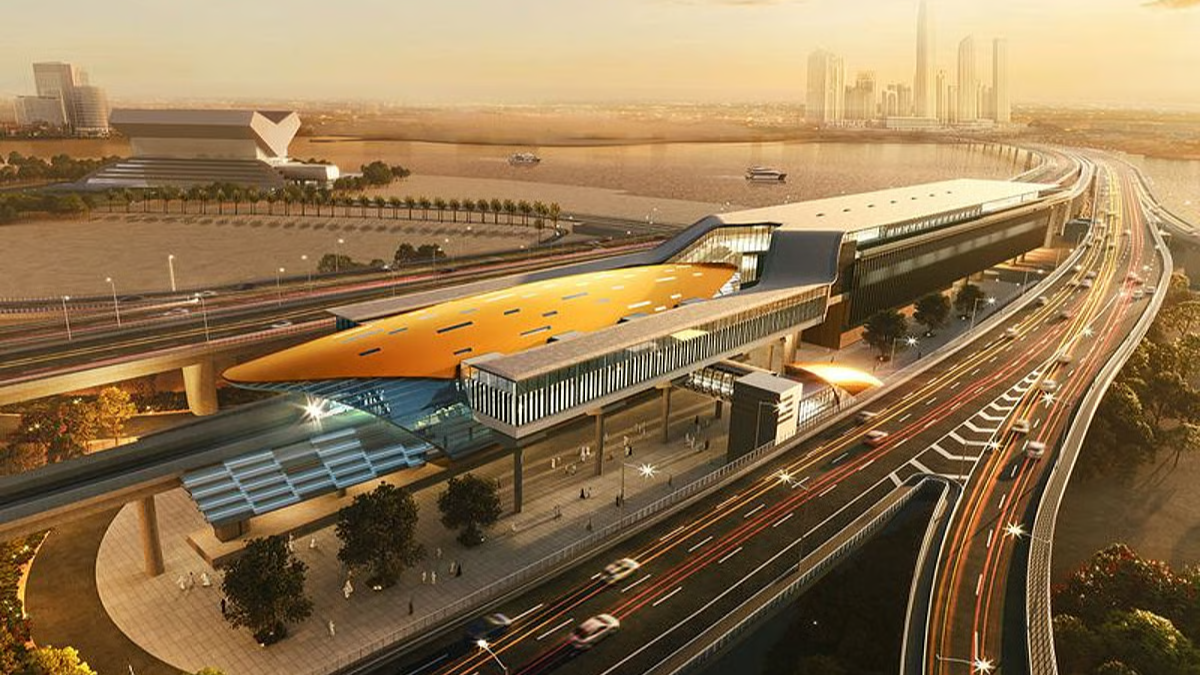

Construction details for Dubai’s upcoming Metro Blue Line point to a large-scale expansion that blends elevated and underground infrastructure across the city, according to the Roads and Transport Authority.

The new corridor is being built with a total daily capacity exceeding 350,000 passengers, running across roughly equal stretches above and below ground—about 14.5 kilometres elevated and 15.5 kilometres underground. The station plan includes five elevated stations, four underground stations, four elevated stations reserved for future development, and a single underground interchange station.
Positioned as a connector between the existing Red and Green Lines, the Blue Line marks a key phase in the evolution of Dubai’s transport network. The project formally moved from planning to execution in June, when Dubai Ruler Sheikh Mohammed bin Rashid Al Maktoum laid the foundation stone and unveiled the first station. By November 2025, officials reported that 10 per cent of construction had already been completed within five months of work.
The alignment has been designed around two distinct routes. One route, comprising 10 stations, branches out from the Green Line at Creek station, crossing through Dubai Festival City, Dubai Creek Harbour and Ras Al Khor before reaching International City 1, where an underground interchange station will be located. From there, the line extends through International City 2 and 3, continuing on to Dubai Silicon Oasis and terminating at Academic City.
A second route, featuring four stations, begins at Centrepoint station on the Red Line. It then passes through Mirdif and Al Warqa before also converging at the International City 1 Interchange Station.

Architectural elements form a central part of the project’s identity. Elevated stations draw inspiration from the curved form of a seashell, while station interiors are designed around seven conceptual themes, including Heritage, Earth, Air, Fire and Water.
The first station on the line, named Emaar Properties, has been designed by Skidmore, Owings & Merrill, the American firm known for its work on the Burj Khalifa, New York’s Olympic Tower and Chicago’s Sears Tower. Rising 74 metres and built across three levels, the structure is set to become the tallest metro station in the world. Its design combines a high-reaching façade with a traditional terminal arch, allowing natural light to reach the platforms through carefully positioned glass panels.
As construction accelerates, several areas of Dubai have already seen road diversions linked to the project. The proximity of future stations has also begun reshaping nearby communities, with rental prices increasing in neighbourhoods close to the planned route.
Once operational, the Blue Line is projected to reduce traffic congestion along its corridors by around 20 per cent. Authorities also expect heavy use from students, with about 50,000 university students from Academic City forecast to rely on the line by 2029.
