



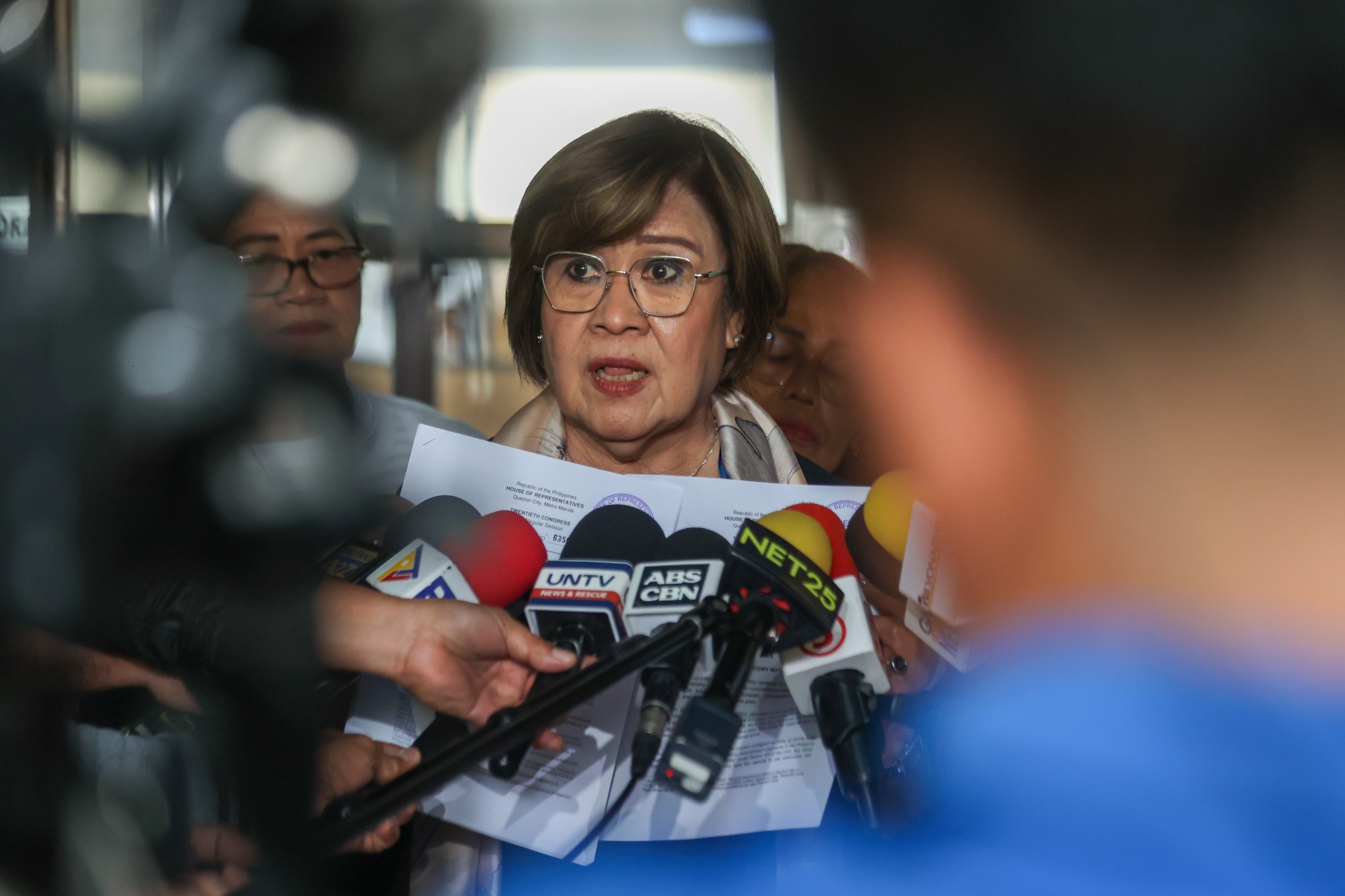

A proposal introduced in the House of Representatives aims to establish a separate criminal offense for public officials who accumulate wealth far beyond their lawful earnings, setting penalties that could extend up to four decades in prison.

The measure, filed by Mamamayang Liberal party-list Rep. Leila De Lima, outlines a legal framework that would treat both the acquisition and transfer of unexplained assets as distinct crimes. Her bill — House Bill No. 6626, known as the Anti-Illicit Enrichment and Anti-Illicit Transfer Act — seeks to amend the Revised Penal Code by inserting new provisions on malfeasance and misfeasance in office.
Instead of relying on existing plunder and graft laws, the proposal defines illicit enrichment as the possession of assets that are “grossly disproportionate” to a public official’s legitimate income and lawfully obtained property. A separate violation, termed illicit transfer, would penalize the act of conveying or moving any property deemed illicitly obtained.
The bill sets a tiered system of penalties tied to the value of the unexplained assets. Cases involving up to P10 million would carry imprisonment ranging from six months to 12 years. Unexplained wealth above P10 million but not exceeding P20 million would draw 12 years and one day to 14 years and 18 months. Amounts between P20 million and P50 million would be punishable by 14 years, 8 months and one day up to 20 years. Assets exceeding P50 million would fall under reclusion perpetua, with imprisonment stretching from 20 to 40 years.
De Lima said the move responds to longstanding challenges in prosecuting major corruption cases. “In light of the serious observations about, and criticisms against the Plunder Law and the court decisions interpreting it – coupled with the view that charges for malversation, bribery, graft and corruption may not be enough given the magnitude of wrongdoings in the biggest corruption scandal in Philippine history – there is a need to come up with a new, effective legal tool to put an end to corruption and hold all those involved accountable,” she said.

She cited the limitations of current legislation, noting how few individuals have been convicted of plunder. “Isipin po ninyo: Iilan lang ang na-convict ng plunder, may isa pang na-pardon. Sa napakalaking corruption scandal gaya ng flood control projects controversy ngayon, na maaari pang maulit sa hinaharap, hindi tama at hindi makatwirang pahirapan pa ring mapanagot ang mga sangkot, o hindi kasing-bigat ng kanilang kalokohan ang ikakaso laban sa kanila,” she said.
According to De Lima, her proposal is intended to create a high-level offense similar to plunder, but one that allows for more straightforward prosecution. “Kaya dito po natin naisip itong panukalang batas na ito, isang bagong krimen — paghahain ng mabigat na kaso na may mabigat ding parusa parang sa plunder, pero mas madaling patunayan,” she said.
Part of the bill’s design is to address what she describes as evidentiary hurdles that have historically hindered corruption cases. “Kung may nadiskubre halimbawa ang Ombudsman sa lifestyle check nila na lote, yate, bahay, condo, helicopter, shares of stock o business na wala sa SALN ng government official, at hindi ito maipaliwanag, maituturing na yun as illicit enrichment. Kung ang evidence of guilt is strong, at ang illicit enrichment ay sobra sa P50 million, non-bailable din ang kaso gaya sa plunder,” she said.
She also emphasized that the measure aligns with international standards, pointing to the Philippines’ commitments under the UN Convention Against Corruption (UNCAC). Article 20 of the convention encourages state parties to create legislation that criminalizes a significant increase in the assets of a public official that cannot be reasonably justified.
De Lima said the proposal removes the need to establish a predicate offense, a requirement in cases such as money laundering and plunder. “Illicit enrichment laws remove these barriers. In the case of public officials, prosecutors must only show that the person has assets that disproportionately exceed his or her legitimate sources of income. Also, prosecutors are no longer required to establish guilt for a ‘predicate’ or related offense,” she said.
