



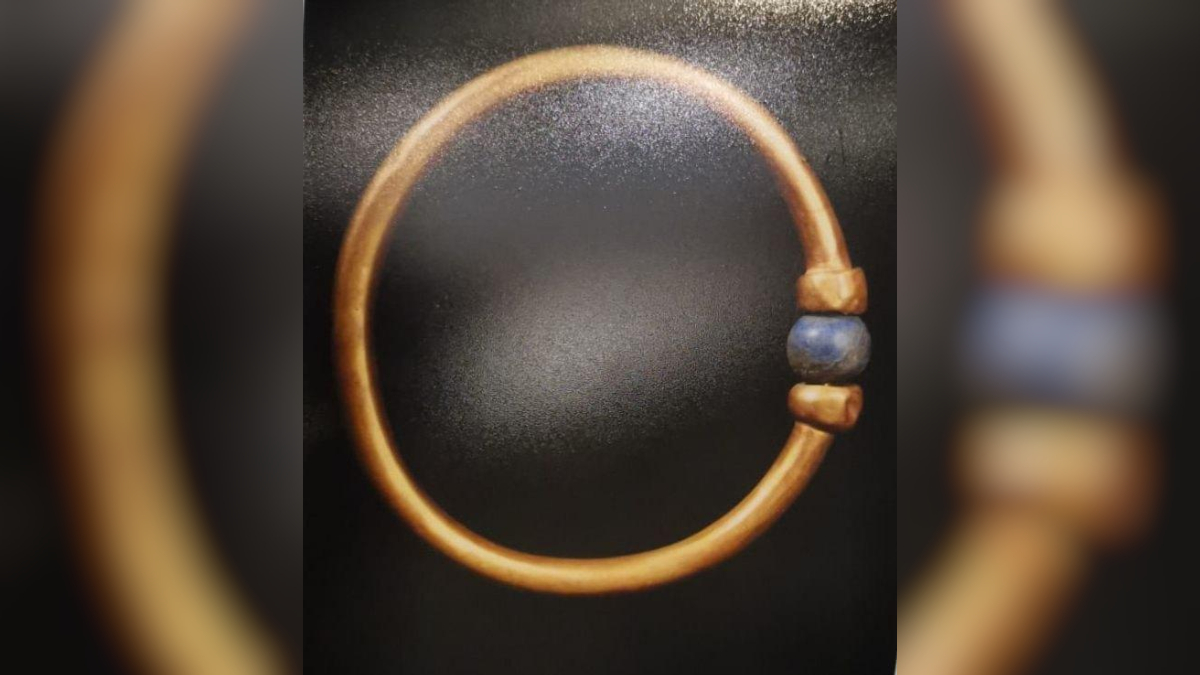

A priceless 3,000-year-old bracelet has gone missing from a restoration laboratory at Cairo’s Egyptian Museum, Egypt’s antiquities ministry confirmed. The incident, first reported by AFP, has triggered a nationwide alert across airports, seaports, and border crossings.

The missing artifact, a gold band set with spherical lapis lazuli beads, dates back to the reign of Pharaoh Amenemope of Egypt’s 21st Dynasty (1070–945 BC). Authorities have not disclosed when it was last seen, but the disappearance was discovered during an inventory check in preparation for the Treasures of the Pharaohs exhibition set to open in Rome at the end of October.
The ministry said an internal investigation is underway, and a full inventory of the laboratory’s collection is being conducted. Officials initially withheld public disclosure to allow the probe to proceed.

French Egyptologist Jean Guillaume Olette-Pelletier told AFP the bracelet was originally found in Tanis, in the tomb of King Psusennes I, where Amenemope was reburied. He stressed its importance despite its simplicity: “It’s not the most beautiful, but scientifically it’s one of the most interesting.” He explained that while the bracelet’s gold alloy was engineered to resist deformation, its lapis lazuli beads—sourced from present-day Afghanistan—symbolized divine attributes.
The Egyptian Museum, home to over 170,000 relics including the famed funerary mask of King Tutankhamun, faces this loss just weeks before the inauguration of the Grand Egyptian Museum on November 1. The new complex is being touted as a cultural landmark under President Abdel Fattah al-Sisi’s government, with Tutankhamun’s treasures set to be among its highlights.
Egypt has recently placed strong emphasis on heritage preservation and global cultural promotion, staging events such as the 2021 Golden Parade that transferred 22 royal mummies to the National Museum of Egyptian Civilization.
