




Hail may be one of the rarest weather phenomena in the Philippines, but a groundbreaking study has revealed that the country’s hottest days actually make these icy storms more likely.

“Most people are surprised when hail happens because it is relatively rare in the Philippines,” said Dr. Lyndon Mark P. Olaguera, senior author of the study. “Many take photos or videos and share them online. Some are scared since it’s unusual, while others just treat it as a strange kind of rain.” He added that some Filipinos even interpret hail as a sign of climate change.
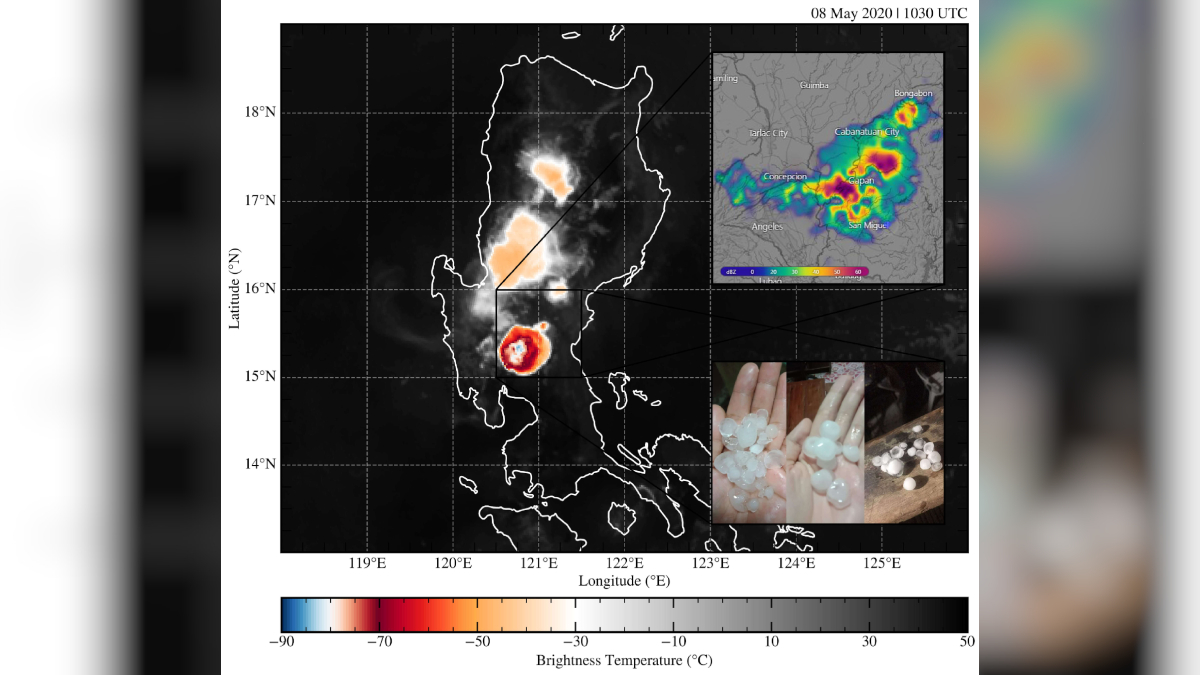
The largest hailstones ever documented in the country were recorded in Cabiao, Nueva Ecija, on May 8, 2020, with ice chunks measuring up to 5 centimeters—bigger than golf balls. Researchers found that extreme heat on that day fueled strong upward air movements, creating the perfect conditions for hail to form.
The study explained that hot ground temperatures generate a build-up of energy, known as Convective Available Potential Energy (CAPE), which drives moist air upward into thunderclouds. Inside, water droplets freeze and grow into hailstones. The presence of dry air in mid-levels of the atmosphere can further increase the chances that hail will survive its fall to the ground without melting.

Covering nearly two decades of data from 2006 to 2024, the study marks the first comprehensive analysis of hail in the Philippines. Findings showed hailstorms are most common in March, April, and May—during peak heat and thunderstorm activity—and often occur in the late afternoon. While Luzon recorded the highest number of events, larger hailstones were more frequently observed in the Visayas and Mindanao.
Researchers credited citizen reports—through local records, media, and even social media posts—for helping track hailstorms, given the country’s limited monitoring systems. They stressed that as climate change continues to intensify extreme weather, public participation in data gathering could play a vital role in building early warning systems.
The study, Spatiotemporal Analysis of Hail Events in the Philippines, was authored by Marco Polo A. Ibañez, John A. Manalo, and Generich H. Capuli of DOST-PAGASA, with Dr. Olaguera of Ateneo de Manila University and the Manila Observatory.
