



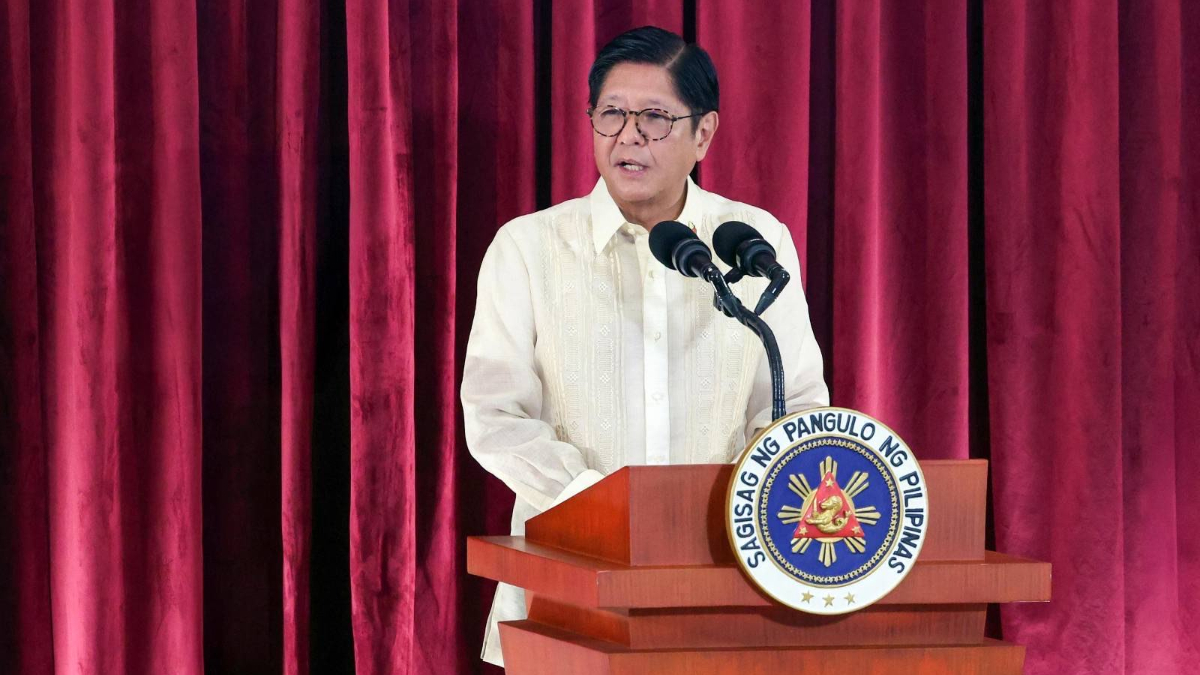

President Ferdinand Marcos Jr. has acknowledged that the Philippines would likely be pulled into a full-blown conflict if China makes a move to invade Taiwan, warning that the country’s geographical location makes neutrality nearly impossible in such a scenario.

In an interview with India’s Firstpost, Marcos didn’t mince words when asked about his confidence in Washington’s commitment to defend the Philippines under President Donald Trump’s leadership.
“I am [confident], because the assurance is that we have been receiving in those terms from the new [US] administration… have been very, very strong,” he said, referring to his recent three-day working trip to the U.S. from July 20 to 22, where he met with Trump and senior defense officials.
The President described the U.S. administration’s vow to stand by the Philippines as an “ironclad commitment,” especially in the face of growing Chinese aggression in the South China Sea. He emphasized the strength of the nearly 80-year-old Manila-Washington alliance rooted in historical, cultural, and security ties, including the 1951 Mutual Defense Treaty.
“And I sincerely believe that remains constant. And I’m not surprised because we really have had a very, very long history together with the US,” Marcos added.
However, the President also acknowledged the looming danger if tensions over Taiwan escalate into military confrontation. He said it would be unrealistic to expect the Philippines to stay out of the fray, especially given its proximity to the self-governed island.
“To be very practical about it, if there is a confrontation over Taiwan between China and the United States, there is no way that the Philippines can stay out of it simply because of our physical geographic location,” Marcos warned. “And so… if there is an all-out war, then we will be drawn into it.”

Marcos also underscored the potential humanitarian crisis such a conflict could trigger, especially with over 150,000 overseas Filipino workers currently in Taiwan.
“We would immediately mobilize everything that we could to bring our people out of the conflict,” he said.
While the Philippines adheres to the “One China Policy” and ASEAN’s principle of non-interference, it has been quietly preparing contingency plans to ensure the safety of Filipinos in Taiwan should tensions boil over.
Under the Enhanced Defense Cooperation Agreement (EDCA), U.S. forces now have access to nine Philippine military bases, including three in Cagayan Valley—located near Taiwan. These sites allow for the prepositioning of troops and supplies for both defense and humanitarian responses.
The Department of National Defense had previously emphasized that EDCA was not aimed at any specific nation but rather meant to enhance the country’s ability to respond to emergencies, disasters, and defense-related needs.
The Philippines continues to call on China to respect the 2016 arbitral ruling that rejected Beijing’s expansive claims in the South China Sea. China, however, refuses to acknowledge the decision.
