



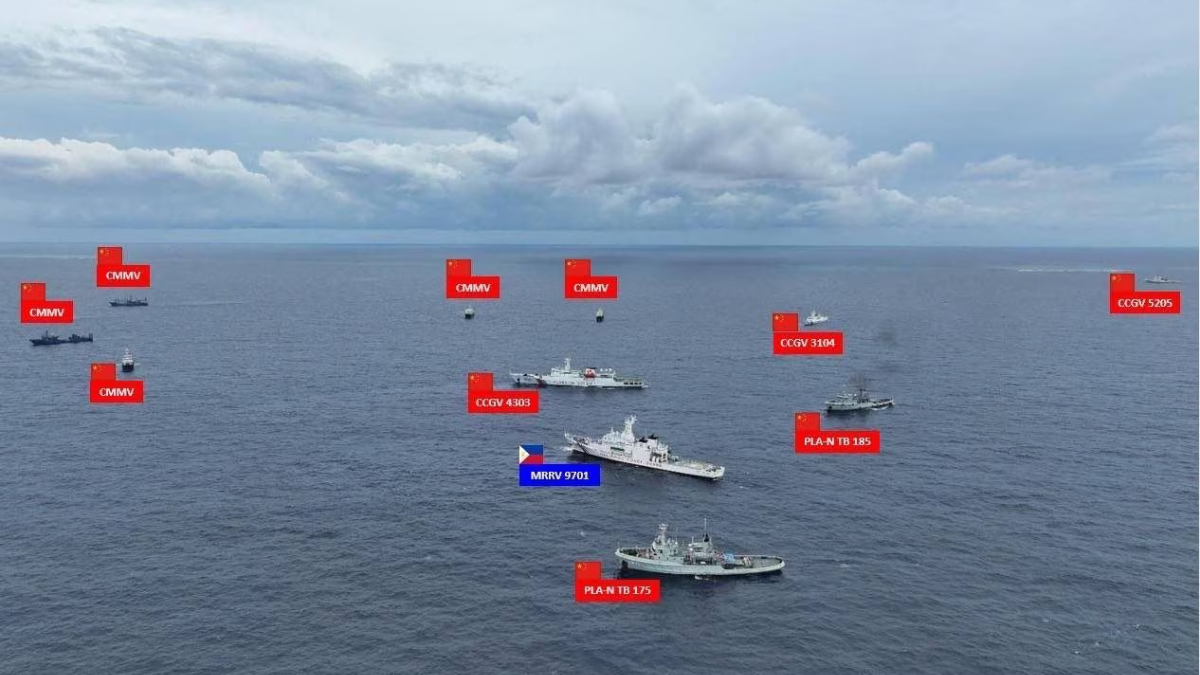

The Chinese Embassy in Manila has defended the growing presence of its research ships in Philippine waters, asserting Beijing’s claims over the Spratly Islands—an area internationally recognized as part of the Philippines’ exclusive economic zone (EEZ).

In a statement released Tuesday, August 5, the embassy maintained, “China has sovereignty over Nansha Islands and its adjacent waters and sovereign rights and jurisdiction over relevant waters,” referring to the Spratlys by their Chinese name. The embassy insisted it is “legitimate and lawful” for Chinese vessels to conduct “normal activities” within what it claimed are China’s jurisdictional waters.
The remark came as a response to concerns raised by the Philippine Coast Guard (PCG) over a noticeable surge in Chinese research vessel activity within the country’s EEZ since early 2025.
PCG Spokesperson Jay Tarriela described the increase as “alarming,” noting that approximately 20 to 22 Chinese research ships have been recorded entering Philippine waters this year—averaging three to four vessels per month, a sharp uptick from previous years.
On Sunday, the PCG confirmed it had deployed an aircraft to intercept the Xiang Yang Hong 05, which was seen about 15 nautical miles off Babuyan Island in Cagayan. The Chinese vessel did not respond to radio challenges. It had previously spent over three weeks conducting marine research in the Pacific Ocean, even reaching as close as 42 nautical miles from Guam before returning to Philippine waters on July 31. It left Sunday evening after being driven away by the Coast Guard.

The Coast Guard has also reported monitoring three other Chinese vessels conducting similar activities: Bei Diao 996, Xiang Yang Hong 10, and Zhuhai Yun.
Tarriela emphasized the advanced capabilities of these ships. The Bei Diao 996 is equipped for dual-use operations including testing underwater acoustic sensors and sonar systems. Xiang Yang Hong 10 is a multi-role vessel capable of deep-sea exploration and supporting unmanned underwater drones. Meanwhile, Zhuhai Yun is described as the world’s first intelligent unmanned drone carrier, capable of oceanographic research with significant military applications, such as mapping submarine routes and deploying smart mines.
While the PCG views these developments with growing concern, the Chinese Embassy downplayed the tension, stating that “confrontation leads us nowhere” and urged for resolution through “dialogue and negotiation.”
China continues to assert its sweeping maritime claims under the controversial “nine-dash line,” which covers nearly the entire South China Sea. However, an international arbitral tribunal ruled in 2016 that these claims have no legal basis—a ruling China has repeatedly ignored.
