



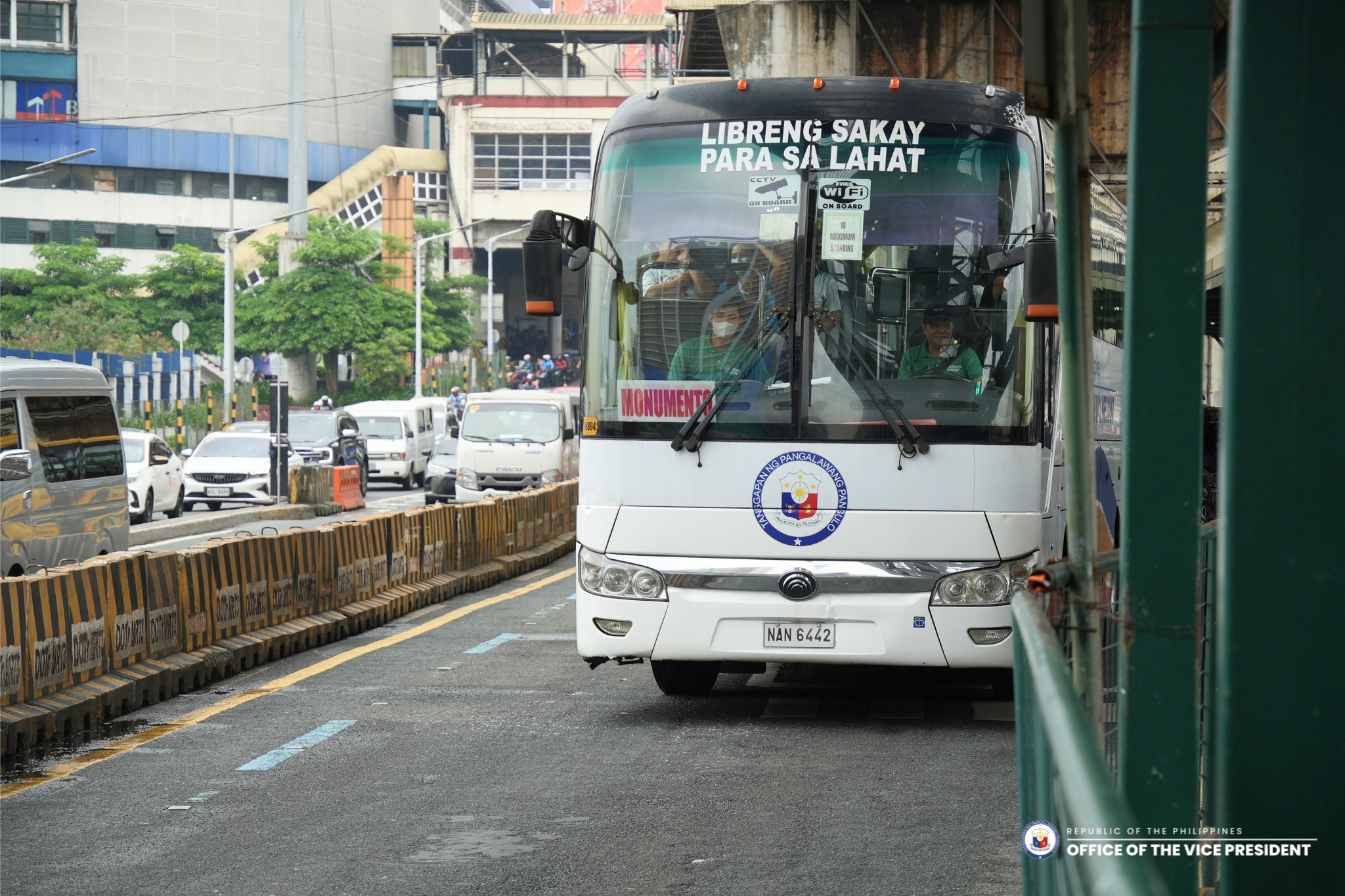

The Office of the Vice President (OVP) announced a major milestone for its “Libreng Sakay” program, reaching over 2 million commuters served as of June 30, 2025 — double the number since the initiative began.

In an interview, OVP spokesperson Ruth Castelo shared that nine buses are currently deployed across major locations in the Philippines, including Metro Manila, Naic-Cavite, Cebu, Bacolod, Davao, and Tacloban.
“Right now, as of June 30, 2025…we already served 2,025,275 people,” Castelo said, noting the OVP is looking to continue the program until the end of Vice President Sara Duterte’s term in 2028. “We have three more years, marami pa.”
Launched in August 2022, the program began with just five buses lent by private donors during the campaign season. The OVP later integrated the effort into the government’s “Libreng Sakay” initiative under the Department of Transportation’s service contracting program.
Of the current nine buses, Castelo said two have been fully acquired by the OVP, while the remaining seven are on contract and will be returned after Duterte’s term. Operational costs — including fuel, drivers, conductors, cleaning services, and free Wi-Fi — are fully shouldered by the OVP.

According to Castelo, the agency spends approximately PHP 170,000 to PHP 180,000 monthly per bus to keep the program running.
To further expand services, especially during peak hours, the OVP has submitted a proposal to the Department of Transportation to consider longer operating hours. Currently, the buses run from 5:00 a.m. to 9:00 a.m. and 5:00 p.m. to 9:00 p.m., Monday to Saturday.
“We’re preparing additional justifications to get approval,” Castelo added. “The DOTr is also conducting its own feasibility study to determine if a six-hour operation is possible.”
In its 2024 accomplishment report, the OVP noted that out of 1.78 million total beneficiaries across all its programs, the “Libreng Sakay” had the highest impact with over 1 million beneficiaries that year alone.
