




Introduction

The Philippine nursing profession operates within an increasingly complex cultural landscape shaped by internal diversity and global mobility. Filipino nurses provide care to patients from varied ethnic, linguistic, religious, and socioeconomic backgrounds within the country and are also among the most internationally deployed healthcare professionals worldwide. In this context, transcultural nursing has emerged as a foundational competency for safe, ethical, and patient-centered practice. Integrating transcultural nursing concepts into the Philippine nursing education system is, therefore, essential to ensure that graduates are equipped to deliver culturally congruent care in both local and international settings.
Transcultural nursing emphasizes understanding and integrating patients’ cultural values, beliefs, and lifeways into clinical decision-making. Madeleine Leininger’s Culture Care Theory underscores that culturally congruent care improves health outcomes, enhances patient satisfaction, and strengthens therapeutic relationships (Leininger & McFarland, 2006). As healthcare systems become more multicultural, nursing education must intentionally prepare students to navigate cultural differences with competence, humility, and ethical sensitivity.
Transcultural nursing and the Philippine healthcare context
The Philippines is characterized by significant cultural diversity, with more than 100 ethnolinguistic groups, diverse religious practices, and distinct regional traditions. Cultural beliefs strongly influence health-seeking behaviors, perceptions of illness, family involvement in care, and responses to medical interventions. Without adequate cultural awareness, nurses may misinterpret patient behaviors, inadvertently offend cultural norms, or fail to gain patients’ trust—ultimately compromising care quality.
Beyond domestic practice, Filipino nurses’ global migration highlights the relevance of transcultural nursing. Nurses practicing abroad must adapt to unfamiliar cultural expectations, communication styles, ethical standards, and healthcare systems. Research suggests that nurses who possess strong cultural competence demonstrate improved communication, reduced stereotyping, and enhanced patient safety in multicultural environments (Campinha-Bacote, 2011). Thus, transcultural nursing education is critical not only for addressing local diversity but also for preparing graduates for global nursing practice.
Theoretical foundations of transcultural nursing education
Leininger’s Culture Care Diversity and Universality Theory provides the conceptual backbone for transcultural nursing education. The theory asserts that care is the essence of nursing and that culturally congruent care can only be achieved through an understanding of cultural values, social structures, and worldviews (Leininger & McFarland, 2006). Key concepts include cultural preservation, accommodation, and restructuring, which guide nurses in making culturally appropriate clinical decisions.
In addition to Leininger’s framework, models such as Campinha-Bacote’s Process of Cultural Competence emphasize cultural awareness, knowledge, skill, encounters, and desire as ongoing developmental processes (Campinha-Bacote, 2011). These models support the idea that cultural competence is not a static achievement but a continuous learning journey—an approach well suited to outcomes-based nursing education.
Policy and regulatory alignment in the Philippines
The integration of transcultural nursing concepts aligns with national laws and educational policies governing nursing education. The Philippine Nursing Act of 2002 (Republic Act No. 9173) mandates that nursing education produce competent professionals capable of delivering safe, ethical, and holistic care across diverse populations (Republic of the Philippines, 2002). Cultural responsiveness is implicit in this mandate, as ethical and holistic care cannot be separated from cultural understanding.
The Commission on Higher Education (CHED) reinforces this direction through outcomes-based education (OBE) in the Bachelor of Science in Nursing (BSN) program. CHED Memorandum Order No. 15, Series of 2017, emphasizes patient-centered care, ethical practice, effective communication, and community engagement—competencies that naturally align with transcultural nursing principles (CHED, 2017). Furthermore, CHED’s flexible learning policies encourage innovative teaching strategies that can support experiential and reflective transcultural learning (CHED, 2020).
Curriculum integration approaches
Integrating transcultural nursing into the Philippine nursing curriculum can be achieved through a dual approach: the inclusion of a dedicated transcultural nursing component and the systematic threading of transcultural concepts across existing courses.
Dedicated transcultural nursing instruction
A dedicated course or module on transcultural nursing provides students with a solid theoretical and conceptual foundation. Core content may include:
- Concepts of culture, ethnicity, and diversity in health
- Cultural assessment frameworks
- Cultural safety, humility, and ethical considerations
- Health disparities and social determinants of health
- Care of indigenous peoples, migrants, and vulnerable populations
Introducing this content early in the program allows students to develop cultural awareness before entering intensive clinical placements.
Curriculum threading across nursing courses
Curriculum threading ensures that transcultural competence is reinforced throughout the program rather than confined to a single course. For example:
- Health Assessment courses can emphasize culturally sensitive history-taking and communication.
- Medical–Surgical Nursing can address cultural perceptions of pain, disability, and chronic illness.
- Maternal and Child Nursing can integrate cultural beliefs related to pregnancy, childbirth, and family roles.
- Psychiatric and Mental Health Nursing can explore culture-bound syndromes, stigma, and culturally informed coping mechanisms.
- Community Health Nursing can focus on culturally appropriate health promotion and participatory community engagement.
Empirical evidence supports this integrated approach. A study among nursing students in the Philippines demonstrated that cultural competence is significantly influenced by educational exposure and clinical experiences, highlighting the importance of curriculum design (Cruz et al., 2016).
Teaching and learning strategies for transcultural competence
Effective transcultural nursing education requires learner-centered, experiential teaching strategies that go beyond traditional lectures.
Simulation-based learning and OSCEs using culturally diverse scenarios allow students to practice communication, ethical decision-making, and clinical judgment in safe environments. Research indicates that simulation and case-based interventions can significantly enhance nursing students’ cultural competence and empathy (Tosun et al., 2021).
Case-based learning grounded in Philippine healthcare realities—such as indigenous healing practices, faith-based health beliefs, and family-centered decision-making—enhances relevance and contextual understanding. These cases encourage students to balance respect for cultural practices with evidence-based care.
Reflective learning activities, including journaling and guided debriefing, promote self-awareness and critical reflection. Such strategies help students recognize personal biases and develop cultural humility, a key component of culturally safe nursing practice (Campinha-Bacote, 2011).
Community immersion and service-learning experiences remain central to transcultural education. Structured community engagement enables students to collaborate with local leaders, design culturally appropriate health education materials, and evaluate the acceptability of interventions. These experiences reinforce social accountability and ethical responsibility.

Assessment of transcultural nursing competencies
Assessing transcultural competence requires multidimensional evaluation methods. Written examinations alone are insufficient to capture behavioral and attitudinal competencies. Effective assessment strategies include:
- OSCE rubrics focusing on communication, respect, and shared decision-making
- Clinical performance evaluations during RLEs
- Reflective portfolios documenting cultural encounters and learning outcomes
- Community project outputs and evaluations
Aligning assessment tools with CHED-defined learning outcomes ensures consistency and supports program quality assurance (CHED, 2017).
Faculty development and institutional support
Faculty preparation is critical to successful integration. Nursing educators must possess not only content knowledge but also pedagogical skills to facilitate transcultural learning and model culturally safe behaviors. Institutions should invest in faculty development programs that focus on transcultural nursing theories, inclusive teaching strategies, and awareness of bias.
Institutional support may also include partnerships with culturally diverse communities, shared case repositories, and interdisciplinary collaboration. Continuous curriculum evaluation and stakeholder feedback further strengthen sustainability and relevance.
Challenges and practical considerations
Common challenges include limited curricular space, variable faculty expertise, and inconsistent clinical exposure. Practical solutions include integrating transcultural objectives into existing courses, using low-cost simulation strategies, and standardizing assessment tools across year levels. Establishing a curriculum committee to map transcultural competencies to program outcomes can facilitate systematic implementation.
How Transcultural Nursing Integration Equips Filipino Nurses for Global Practice
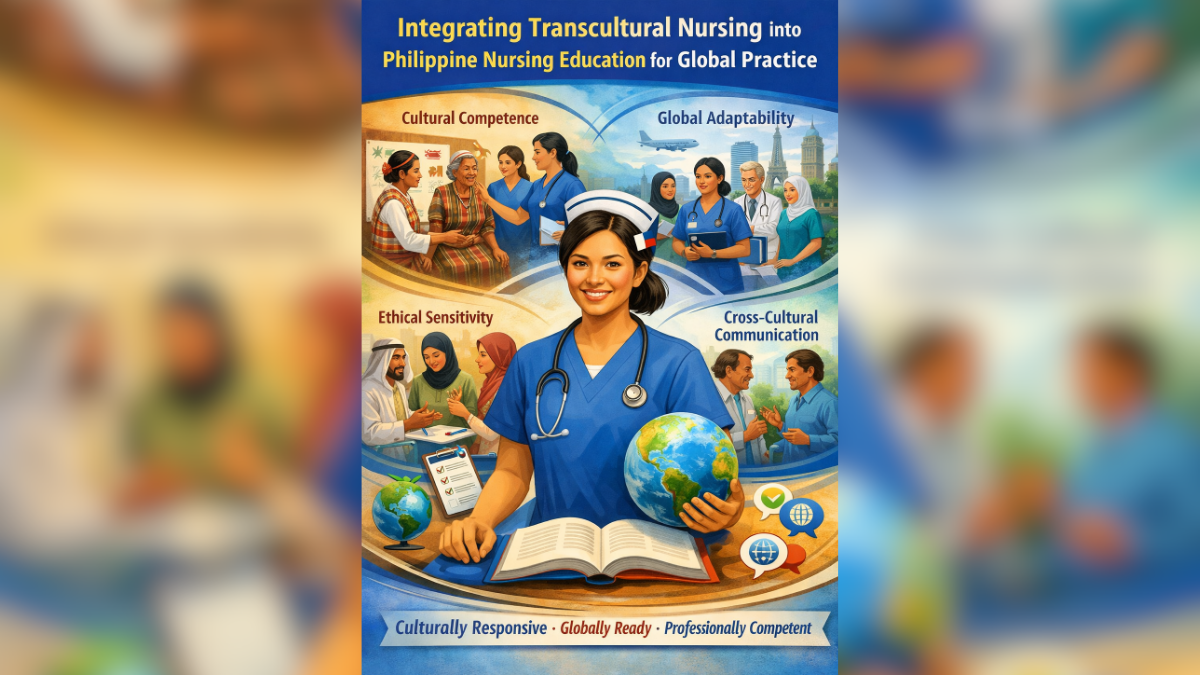
Integrating transcultural nursing concepts into the Philippine nursing curriculum is essential for preparing Filipino nurses to participate effectively in the global healthcare workforce. As healthcare systems become increasingly multicultural, nurses are expected to demonstrate not only clinical competence but also cultural responsiveness, ethical sensitivity, and adaptability. Transcultural nursing education directly supports these expectations by equipping graduates with the competencies necessary for cross-cultural practice.
Transcultural nursing education strengthens cross-cultural communication skills, enabling Filipino nurses to interact effectively with patients, families, and healthcare teams from diverse cultural and linguistic backgrounds. The integration of cultural assessment frameworks and culturally appropriate communication strategies reduces misunderstandings and promotes patient-centered care in international settings (Campinha-Bacote, 2011).
Moreover, transcultural nursing fosters cultural humility and ethical competence, which are critical in navigating culturally influenced ethical dilemmas commonly encountered in global practice, such as end-of-life decisions, family involvement in care, and informed consent. Grounded in Leininger’s Culture Care Theory, transcultural education emphasizes culturally congruent and ethically sound care that respects human dignity and cultural values (Leininger & McFarland, 2006).
Transcultural integration also enhances adaptability and professional resilience among Filipino nurses. Exposure to culturally diverse clinical scenarios during training prepares graduates to adjust more effectively to unfamiliar healthcare systems and workplace cultures. Evidence suggests that culturally competent nurses experience reduced acculturative stress and improved professional adjustment when working abroad (Tosun et al., 2021).
Finally, embedding transcultural competencies into the curriculum enhances the global employability and professional credibility of Filipino nurses. International healthcare institutions increasingly prioritize cultural competence as a quality and safety standard. Aligning Philippine nursing education with global cultural competence frameworks strengthens graduates’ readiness for international practice while supporting national professional standards (Republic of the Philippines, 2002).
Overall, transcultural nursing integration equips Filipino nurses with essential skills and values that support safe, ethical, and culturally responsive practice in global healthcare environments.
Conclusion
Integrating transcultural nursing concepts into the Philippine nursing education system is a strategic and ethical imperative. Through alignment with national policies, curriculum threading, experiential learning, robust assessment, and faculty development, nursing schools can prepare graduates who are culturally responsive and globally competitive. Ultimately, transcultural nursing education fosters cultural humility, safety, and equity-core values essential to modern nursing practice and to the continued excellence of Filipino nurses worldwide.
References
Campinha-Bacote, J. (2011). Delivering patient-centered care in the midst of a cultural conflict: The role of cultural competence. Online Journal of Issues in Nursing, 16(2). https://doi.org/10.3912/OJIN.Vol16No02Man05
Commission on Higher Education. (2017). CHED Memorandum Order No. 15, Series of 2017: Policies, standards and guidelines for the Bachelor of Science in Nursing (BSN) program.
Commission on Higher Education. (2020). CHED Memorandum Order No. 4, Series of 2020: Guidelines on the implementation of flexible learning.
Cruz, J. P., Estacio, J. C., Bagtang, C.. E., & Colet, P. C. (2016). Predictors of cultural competence among nursing students in the Philippines: A cross-sectional study. Nurse Education Today, 46, 121–126. https://doi.org/10.1016/j.nedt.2016.09.001
Leininger, M. M., & McFarland, M. R. (2006). Culture care diversity and universality: A worldwide nursing theory (2nd ed.). Jones & Bartlett.
Republic of the Philippines. (2002). Republic Act No. 9173: Philippine Nursing Act of 2002.
Tosun, B., Yava, A., Dirgar, E., & Bahar, Z. (2021). Effect of transcultural nursing education on nursing students’ cultural competence: A quasi-experimental study. Nurse Education in Practice, 52, 103000. https://doi.org/10.1016/j.nepr.2021.103000
