



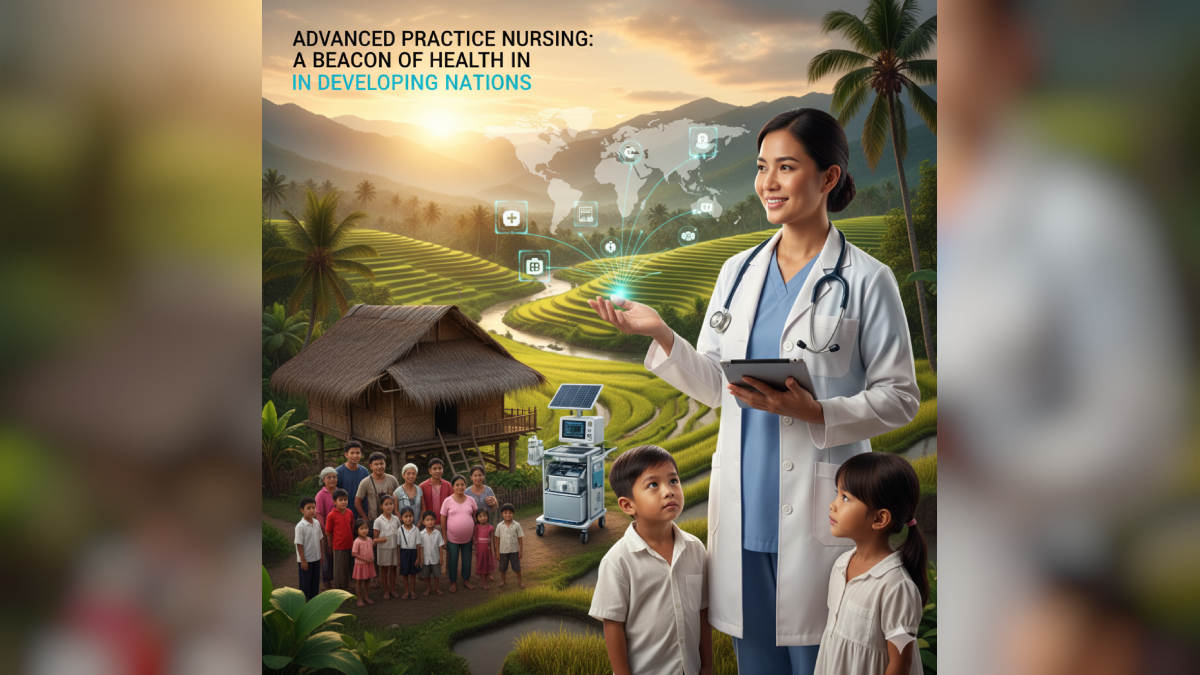

In many developing countries, including the Philippines, the health system faces multiple challenges: limited resources, unequal access to care in remote areas, overburdened physicians, and a high burden of chronic diseases. In this context, advanced practice nursing can be a transformative force. Advanced practice nurses (APNs) are registered nurses who receive additional education, training, and authority to perform clinical, leadership, and consultative roles. Their expanded scope can help fill gaps in healthcare delivery, improve quality, and promote equitable access. (Scanlon et al., 2023) – especially where physician resources are scarce.

The Concept of Advanced Practice Nursing
Advanced practice nursing refers to a stage of professional nursing beyond basic nursing education. APNs often include roles such as nurse practitioners (NPs) or clinical nurse specialists (CNSs). These nurses are trained to assess, diagnose, treat, and manage patients, sometimes prescribing medications, interpreting diagnostic tests, and providing complex care (Mackavey et al., 2025; Scanlon et al., 2023) Globally, numerous studies demonstrate that advanced practice nursing services can yield outcomes comparable to, or even superior to, those of physician-led care for specific conditions. (Kilpatrick et al., 2024) – especially in primary care and chronic disease management. In low- and middle-income countries (LMICs), APN roles are not yet widespread, but their potential is increasingly recognized (Scanlon et al., 2023) Due to their flexibility, broad knowledge, and ability to work in diverse settings, APNs can effectively adapt to resource-limited conditions and extend care to underserved populations. (Mackavey et al., 2025)
Why APNs Are Especially Useful in the Philippines
1. Alleviating physician shortages and unequal access
In the Philippines, many rural and remote areas suffer from a severe lack of physicians, making basic healthcare inaccessible to many. Some communities must travel long distances to see a doctor. In such settings, APNs can provide essential services, including diagnosing common illnesses, managing chronic diseases (e.g., hypertension, diabetes), and initiating referrals. Research in similar settings has shown that APN-led care often matches physician care in terms of safety and effectiveness (Kilpatrick et al., 2024). Moreover, Filipino nurses working in a collaborative advanced practice model in primary care have already reported that transitioning into that role posed challenges but also demonstrated real gains in access, competence, and trust-building with patients (Duller et al., 2023). The study emphasized that for APN deployment to succeed, collaboration with existing health providers and public trust must be nurtured (Duller et al., 2023).
2. Cost-effectiveness and resource optimization
One major constraint in developing nations is the limited availability of health budgets. APNs can help optimize resources: they often cost less to train and employ than physicians, yet can manage many common conditions and health needs. When APNs act in preventive care, early diagnosis, patient education, and chronic disease management, they can reduce the burden on hospitals and emergency services, saving costs at the system level. (Mackavey et al., 2025; Scanlon et al., 2023)
3. Improving continuity and holistic care
APNs are well-positioned to offer long-term, holistic approaches to health: combining prevention, health education, psychosocial care, and monitoring. In the Philippines, where many health issues are linked to social determinants such as poverty, nutrition, and environment, the holistic model of APN practice is particularly valuable. This continuity helps prevent complications, reduce hospital readmissions, and promote patient empowerment.
4. Strengthening health equity and universal health coverage
One of the key objectives of universal health coverage (UHC) is to ensure that all individuals receive the necessary health services without facing financial hardship. In developing countries, marginalized or remote communities often lack access. Deploying APNs strategically in underserved areas can reduce disparities in access to care. In global discourse, APNs are cited as essential to reaching health equity goals (Mackavey et al., 2025).
5. Enhancing the role and career paths of nurses in the Philippines
Filipino nurses are already recognized for their exceptional skills and contributions, both domestically and internationally. However, many feel constrained in their professional growth by a system that limits their roles to basic care functions. Advanced practice nursing offers a path to autonomy, leadership, and specialization. It can motivate nurses to stay in the local healthcare system rather than migrating abroad. As one commentary notes, strengthening APN roles may help stabilize the workforce and reduce brain drain (Corpuz, 2023).
Challenges and Considerations for Implementation
While the potential benefits are substantial, implementing advanced practice nursing in a developing country like the Philippines is not a straightforward process. Key challenges must be addressed systematically.
1. Education and training infrastructure
To develop APNs, robust graduate-level curricula, competent faculty, and clinical training sites are required. In many LMICs, graduate nursing programs are limited or underdeveloped. (Scanlon et al., 2023). In the Philippines, stakeholders have identified that designing and accrediting APN curricula, ensuring clinical practicum opportunities, and training faculty are significant hurdles. (Parial & Locsin, 2024)
2. Regulation, licensure, and certification

A legal and regulatory framework is essential to define the APN’s scope of practice, certification, accountability, and oversight. Without clear laws and proper governance, APNs may operate ambiguously, which can lead to conflicts with physicians or confusion regarding their responsibilities. In the Philippines, amendments to nursing laws have been proposed to allow APN roles, but progress is slow because of legal and institutional resistance (Parial & Locsin, 2024).
3. Professional acceptance and collaboration
Physicians, policymakers, and other health professionals must accept and trust APNs. Interprofessional collaboration and role clarity are vital. (Duller et al., 2023) found that in transitioning nurses, building trust and defining collaborative relationships were key. Without acceptance, APNs may be marginalized or their roles undermined.
4. Organizational and institutional readiness
Health facilities and systems must adapt to support APN roles. This includes clarifying reporting structures, supervision models, reimbursement schemes, and integration into health teams. In many places, organizational rigidity or lack of awareness can stall adoption (Parial & Locsin, 2024)
5. Sustaining role viability
Long-term sustainability is critical. APN roles require ongoing professional development, career ladders, institutional support, and evaluation of outcomes. Recent studies have highlighted that sustainability depends on funding, policy support, and effective monitoring. (Glarcher et al., 2025). Without these, new APN roles may fade over time.
Steps Forward and Recommendations
To realize the promise of advanced practice nursing in the Philippines and other developing countries, the following steps are suggested:
- Policy advocacy and legal reform: Policymakers, nursing leaders, and professional associations should work together to establish laws and standards that formally recognize APN roles, define the scope of practice, and ensure accountability.
- Develop strong education programs: Universities should design graduate-level APN curricula aligned with international standards, ensure clinical practicum placements, and train faculty mentors.
- Pilot models in underserved areas: Start with pilot APN projects in rural or remote communities, especially for primary care and chronic disease management, to gather evidence and build local support.
- Foster interprofessional collaboration: Create forums and guidelines that promote team-based care, clarify roles, and build trust between APNs, physicians, and other health workers.
- Monitor, evaluate, and adapt: Collect data on health outcomes, cost-effectiveness, patient satisfaction, and system efficiency. Use these findings to refine APN deployment and advocate wider adoption.
- Secure sustainable funding and support: Government health budgets, donor grants, or insurance reimbursement systems should recognize and finance APN services.
- Promote awareness and public trust: Educate the public about the role and competence of APNs to enhance acceptance.
Conclusion
Advanced practice nursing holds great potential to strengthen health systems in developing countries such as the Philippines. By filling gaps in care access, optimizing resources, improving continuity, and promoting equity, APNs can play a central role in achieving universal health coverage. However, this potential will only be realized if educational, regulatory, professional, and institutional challenges are addressed thoughtfully and collaboratively. With commitment from nursing leaders, health institutions, and government, advanced practice nursing can become a keystone of resilient, equitable, and adequate healthcare in the Philippines and other developing nations.
References
Corpuz, J. C. G. (2023). Advancing Filipino Healthcare: The Plight of Filipino Nurses in a Postpandemic World. SAGE Open Nursing, 9. https://doi.org/10.1177/23779608231220872
Glarcher, M., Rihari-Thomas, J., Duffield, C., Tuqiri, K., Hackett, K., & Ferguson, C. (2025). Advanced practice nurses’ experiences of patient safety: a focus group study. Contemporary Nurse, 61(3), 242–256. https://doi.org/10.1080/10376178.2024.2363911
Kilpatrick, K., Savard, I., Audet, L.-A., Costanzo, G., Khan, M., Atallah, R., Jabbour, M., Zhou, W., Wheeler, K., Ladd, E., Gray, D. C., Henderson, C., Spies, L. A., McGrath, H., & Rogers, M. (2024). A global perspective of advanced practice nursing research: A review of systematic reviews. PLOS ONE, 19(7), e0305008. https://doi.org/10.1371/journal.pone.0305008
Mackavey, C., Henderson, C., & Morris, G. (2025). Empowering Advanced Practice Nurses: A Review of Addressing Global Health Needs. Annals of Global Health, 91(1), 45. https://doi.org/10.5334/aogh.4723
Parial, P. M. R. L. L. B., & Locsin, P. R. F. R. C. (2024). Advancing Nursing Practice to Forward Universal Health Care in the Philippines. Acta Medica Philippina, 58(12). https://doi.org/10.47895/amp.v58i12.10774
Sarla F. Duller, Lourdes Marie S. Tejero, & Tating, D. L. R. (2023). Filipino Nurses’ Experiences in a Collaborative Advanced Practice Model: A Critical Incidents Study. Pacific Rim International Journal of Nursing Research, 27(4), 767–780. https://doi.org/10.60099/prijnr.2023.263006
Scanlon, A., Murphy, M., Smolowitz, J., & Lewis, V. (2023). Advanced Nursing Practice and Advanced Practice Nursing roles within low and lower‐middle‐income countries. Journal of Nursing Scholarship, 55(2), 484–493. https://doi.org/10.1111/jnu.12838
