



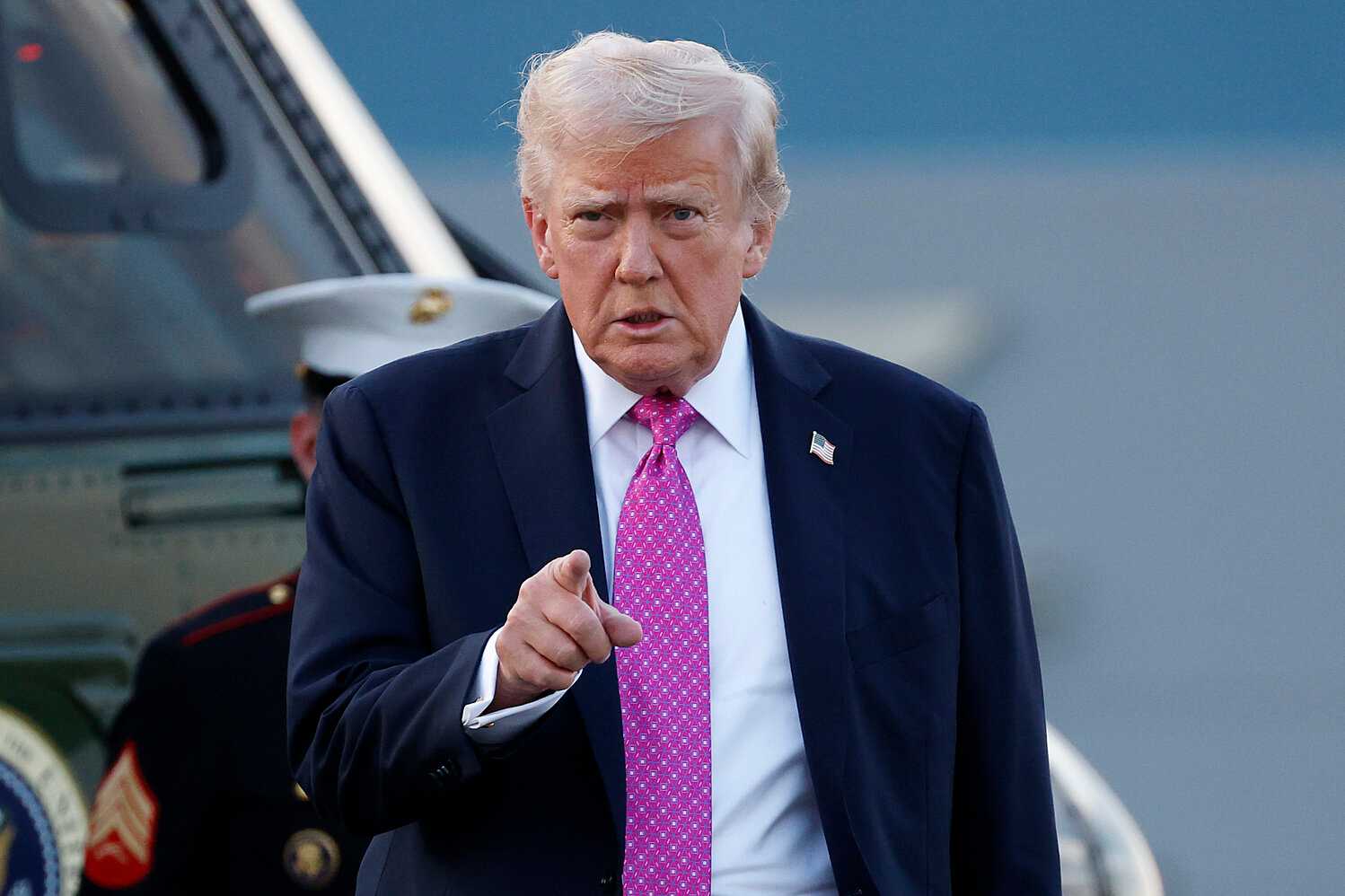

President Donald Trump said the United States was prepared for a prolonged military campaign against Iran, even as the conflict’s fallout spread to Saudi Arabia and Lebanon on Tuesday.

“From the beginning we projected four to five weeks, but we have the capability to go far longer than that,” Trump said at the White House, where he publicly laid out the operation’s goals for the first time: destroying Iran’s missile stockpile, dismantling its navy, ending its nuclear program, and severing its backing of armed groups across the region.
Trump called progress “substantially” ahead of schedule since Saturday’s opening strike, which killed Supreme Leader Ayatollah Ali Khamenei. But he stopped short of calling for the Islamic Republic’s overthrow — a shift from his weekend appeal for Iranians to topple their government.
In Riyadh, two drones struck the US embassy compound on Tuesday, causing what the mission described as “a limited fire and minor material damage.” Saudi authorities said they intercepted eight additional drones over two cities, including the capital, where a major oil refinery had already been shut following an earlier attack.
Trump told NewsNation that a response to the embassy strike would come “soon” but offered no specifics. The embassy ordered Americans in Riyadh, Jeddah, and Dhahran to shelter in place, while the State Department pulled nonessential staff and families from Bahrain, Jordan, and Iraq. Washington had earlier urged all US citizens to leave every country from Egypt eastward.
The fighting expanded into Lebanon for a second consecutive day as Israeli forces struck Hezbollah positions across Beirut’s southern suburbs and the country’s south. Lebanese officials reported at least 52 dead. Prime Minister Nawaf Salam responded by ordering an immediate ban on Hezbollah’s military operations and demanding the group hand over its weapons — an unprecedented step.
Israeli Prime Minister Benjamin Netanyahu told Fox News the joint campaign with Washington would continue but insisted it would not drag on indefinitely. “It may take some time, but it’s not going to take years,” he said. He also alleged Iran had been building new weapons sites since a 12-day round of coordinated strikes in June.
Iran’s retaliation went beyond the drone and missile salvos that forced Qatar’s state energy company to halt liquefied natural gas production. Revolutionary Guards General Sardar Jabbari threatened to seal the Strait of Hormuz, the passage through which roughly a fifth of the world’s seaborne oil flows.

“We will burn any ship that tries to pass through the Strait of Hormuz,” Jabbari said.
Qatar, which had maintained comparatively warm ties with Tehran before the war, said it shot down two Iranian bombers — the first time a Gulf Arab state has downed aircraft from its neighbor.
Secretary of State Marco Rubio offered a revised explanation of how the war began, saying Washington learned Israel was about to strike Iran and that Tehran would have retaliated against American forces in the region. Trump chose to act pre-emptively alongside Israel rather than absorb the blow, Rubio said.
“The imminent threat was that we knew that if Iran were attacked — and we believed they would be attacked — that they would immediately come after us,” Rubio told reporters before briefing lawmakers.
Democrats were unconvinced. Senator Mark Warner called it “unchartered territory” for the United States to enter a war triggered by Israel’s perception of a threat. Iran’s foreign minister, Seyed Abbas Araghchi, rejected the justification outright: “Mr Rubio admitted what we all knew: the U.S. has entered a war of choice on behalf of Israel,” he wrote on X.
Overnight in Tehran, heavy explosions shook windows as warplanes flew above the capital, and the Pentagon said it had achieved air superiority over the country. The US-based Human Rights Activists News Agency reported 101 casualties inside Iran by the third day of fighting, including 85 civilians and 11 military personnel. US Central Command said six American service members had been killed.
In a separate interview with the New York Post, Trump declined to rule out deploying ground troops to Iran “if they were necessary” — a notable remark from a president who campaigned on ending American involvement in foreign wars.
