



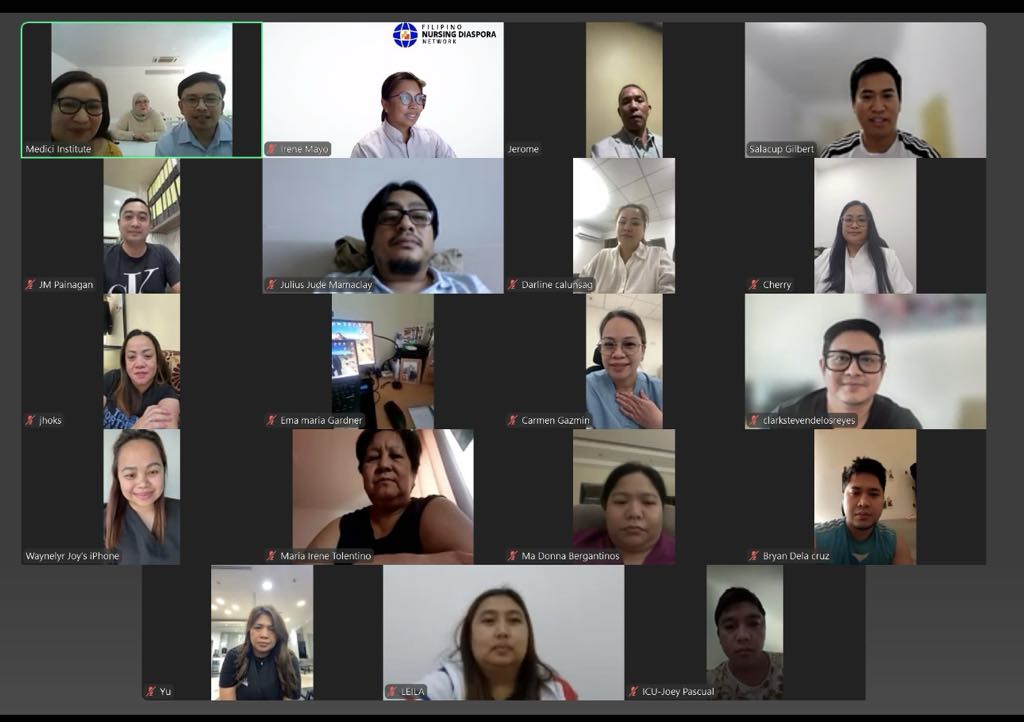

The Filipino nursing community in Bahrain is raising its collective voice. In an unprecedented show of unity and purpose, over 35 Filipino nurses, educators, and healthcare executives gathered for the first-ever Filipino Nursing Diaspora (FiND) National Roundtable Meeting last June 28, 2025. The pioneering gathering, led by FiND Country Representative Ma. Yvonne Villamor Bedrejo and Global Advisor for the Middle East Francis Byron Opinion, has ignited a movement to address long-standing barriers that have kept many Filipino nurses from practicing to their full potential.

For decades, Filipino nurses have been at the heart of Bahrain’s healthcare system. Their skills, compassion, and resilience have earned them recognition in hospitals, clinics, and
health facilities. Yet, as participants shared openly, structural challenges continue to hold them back. The meeting became a safe space to air frustrations and to imagine solutions
together.
Among the most pressing issues is Bahrain’s rigid licensing framework. Filipino nurses, newly licensed Filipino nurses who passed the PRC Special Professional Licensure
Examination for nurses are barred from applying for an NHRA license because they have to go back to the Philippines and get at least a year of hospital experience. This opens a
different pathway where some private hospitals hire them as Healthcare Assistants, where their scope is limited to assisting patients in activities of living or performing a limited
scope, such as taking patient vital signs. “It breaks my heart that they strived to pass the Philippine licensure examination, and yet they are not eligible to apply for a local license to
practice as nurses in Bahrain. even those with years of specialized experience, often find themselves relegated to healthcare assistant roles or entirely excluded from clinical
practice because of narrow rules that do not recognize Philippine experience or hybrid education credentials,” Francis Byron Opinion said, his voice resonating
with the group’s shared frustration.
Dr. Jerome Babate, FiND’s Executive Director, underlined how these challenges aren’t just personal setbacks for individual nurses but systemic losses for Bahrain’s health sector.
“Bahrain needs these nurses. They bring depth of skill and a work ethic that makes health services safer and more responsive. But when regulations are so inflexible, you end up
pushing qualified professionals to the margins. That’s not sustainable,” Dr. Babate remarked.
The meeting also revealed the steep cost of professional development in the country. For many Filipino nurses, the dream of further studies such as certification courses in wound
care, infection control, or critical care evaporates in the face of tuition fees that can cost up to two months of their salaries and to add that National Health Regulatory Authority
(NHRA) does not recognize online certification courses or hybrid learning models, forcing nurses to sacrifice income or work-life balance if they wish to upskill. “There is this idea
that quality education can only happen within the four walls of a classroom, but the rest of the world is already embracing blended learning. We need to keep up,” said Irene Mayo,
FiND’s Director for Engagement.
The roundtable quickly evolved from sharing frustrations to building a roadmap. Participants agreed to form a collective position statement that would advocate fairer
licensing pathways and accessible education opportunities. The document, to be endorsed by FiND, the Philippine Nurses Association–Bahrain, and the Bahrain Nursing
Society, aims to engage both Bahraini authorities and Philippine agencies, including the Department of Migrant Workers. “It’s not enough to talk among ourselves. We have to bring
this to the people with power to change the system,” Irene added.

Ma. Yvonne Villamor Bedrejo, who has been a driving force in organizing the event, emphasized the importance of breaking down silos. “We didn’t want this to be just another
association meeting. This is about collective action. Whether you are in a small clinic or a big hospital, we all have something at stake,” she explained. “This is the time to work
together, not separately.”
Participants also shared the emotional toll of seeing their ambitions stalled. Some recounted being forced to hide their true roles during regulatory inspections, pretending
not to perform tasks they were trained to do. Others spoke of watching less experienced colleagues fast-tracked into senior roles because of their nationality rather than competence. “There is no equal playing field,” Francis admitted, “but it doesn’t mean we have to accept it.”
Despite these challenges, the atmosphere was defined by determination rather than defeat. The group mapped out concrete steps: meeting with Dr. Jamilla Mukhaimer of the
Bahrain Nursing Society to present their concerns, building alliances with other Gulf nursing leaders, and identifying experts in Australia, the US, and Europe willing to create
affordable training modules. “We can bring the world to Bahrain,” Francis noted, “but it will take all of us contributing in different ways.”
Dr. Babate expressed optimism that this momentum would inspire more nurses to step forward. “We know there are hundreds of Filipino nurses in Bahrain who have stories like these. We hope they see that there is a space for them here, a community ready to stand with them.”
Before the meeting ended, participants shared one final reflection: that Filipino nurses are not merely workers to fill staffing gaps. They are professionals with ambitions, insights, and
a fierce dedication to patient care. As Ma. Yvonne said with conviction, “If we don’t stand up for ourselves, nobody else will.”
The roundtable is the first of many. Already, FiND is planning a series of dialogues and skills-building activities that will connect Bahrain’s Filipino nurses to the larger diaspora. In a region where regulations often divide, this gathering was a reminder that solidarity can be a powerful force for change.
