



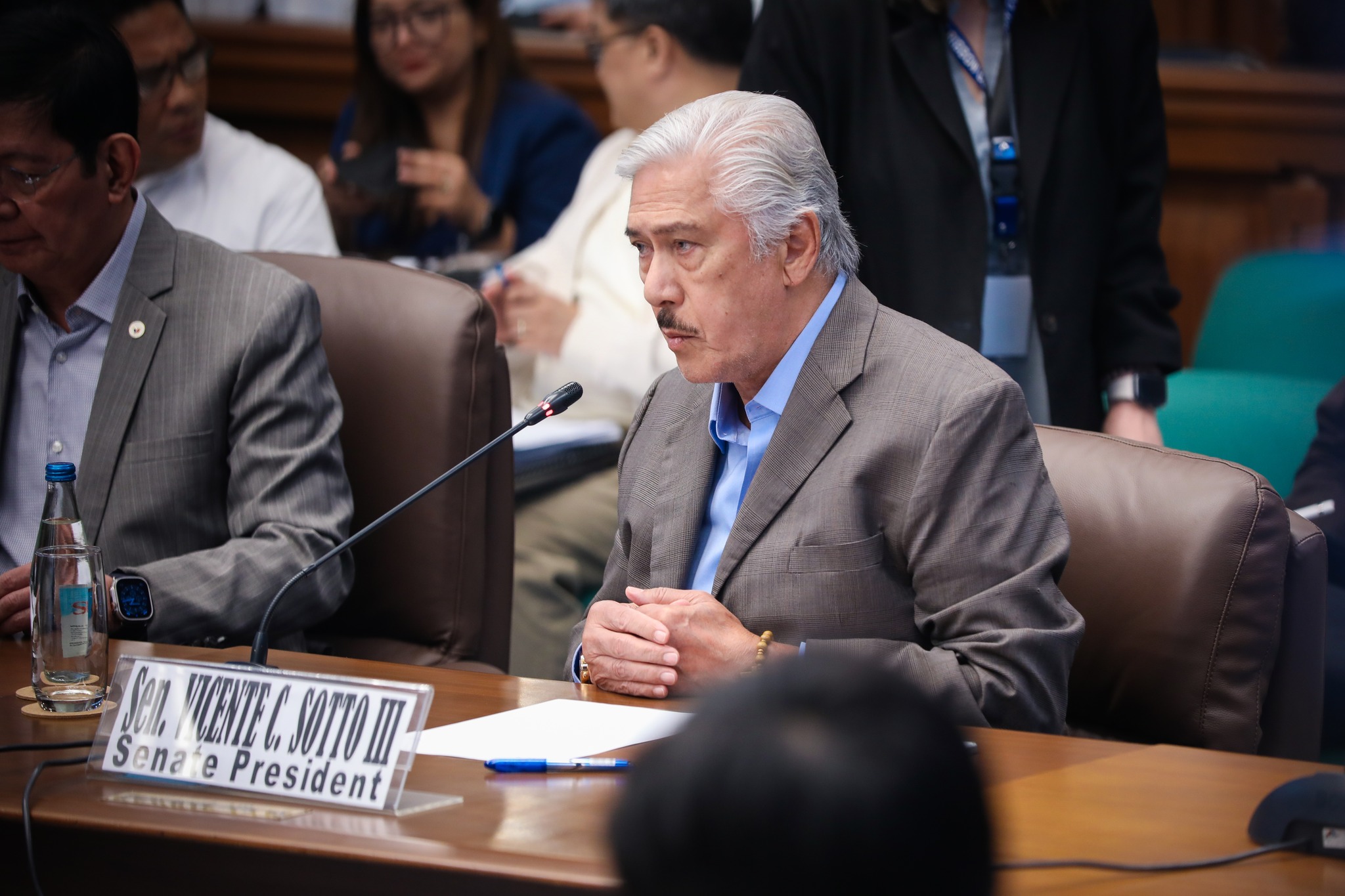

A proposal to restructure the government’s anti-drug machinery sparked sharp exchanges in the Senate, with Senate President Tito Sotto challenging the Philippine Drug Enforcement Agency’s track record and pressing for a major institutional shift.

During a hearing of the Committee on Public Order and Dangerous Drugs, lawmakers examined Senate Bill 190, which seeks to dissolve both the Philippine Drug Enforcement Agency (PDEA) and the Dangerous Drugs Board (DDB). Under the measure, their mandates would be merged into a new body to be called the Presidential Drug Enforcement Authority, which would operate directly under the Office of the President.
Sotto, who played a key role in the passage of the 2002 law that established the PDEA, argued that the country’s anti-narcotics drive has suffered from structural weaknesses. In his bill’s explanatory note, he said the campaign lacked a comprehensive framework, a gap he linked to mounting casualties and numerous dismissed cases in court.
PDEA Deputy Director General for Operations Renato Gumban expressed reservations about the proposal, saying the agency acknowledged the intent to strengthen its operations but opposed dissolving existing institutions. He pointed out that the law creating PDEA already centralized anti-drug enforcement by removing similar units from the Philippine National Police, National Bureau of Investigation, and Bureau of Customs, making PDEA the lead coordinating agency.
Sotto countered that the agency had misread the objective of his bill. He said the plan would not weaken the anti-drug campaign but instead elevate the enforcement body’s authority by placing it under presidential supervision, giving it broader oversight powers.

The Senate President also criticized what he described as an overemphasis on raids and arrests. He said efforts to curb drug use must go beyond enforcement, noting that prevention and rehabilitation have not received equal attention. Drawing from the controversial “tokhang” operations, he questioned the effectiveness of past strategies.
“Successful ba kayo? Hindi. Nadali pa kayo ng tokhang, ‘di ba? Ano nangyari ngayon? Ayun, may ICC (International Criminal Court), ‘di ba? So we want this upgraded. We want better for the country. We want a better way to address the problem of illegal drugs and drug abuse,” Sotto said.
Former president Rodrigo Duterte is currently facing charges of crimes against humanity for murder before the International Criminal Court over the drug war, which human rights groups estimate left between 6,000 and 30,000 people dead.
Sotto maintained that illegal drug supply and drug dependency should not be treated as a single issue. Even if authorities were to destroy all seized narcotics, he said, addiction would persist unless rehabilitation and preventive measures are strengthened alongside enforcement.
