



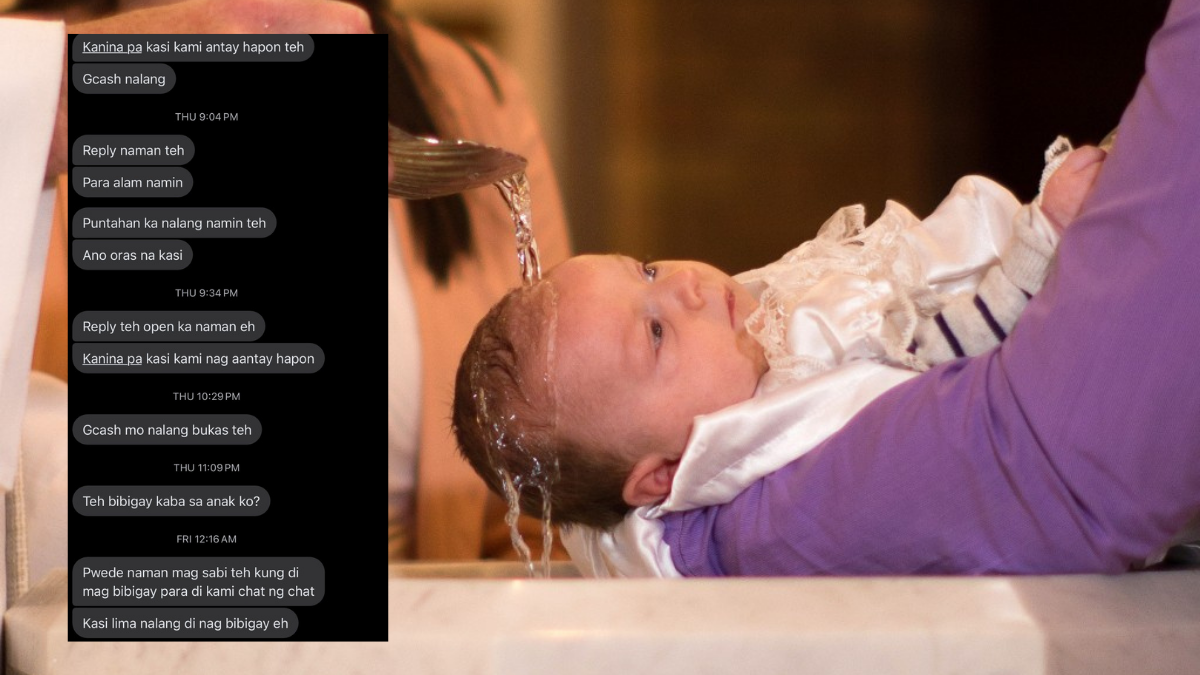

A Facebook post questioning the true meaning of being a godmother in the Philippines has ignited a nationwide conversation, drawing nearly 80,000 reactions, more than 4,300 comments, and close to 40,000 shares as of this week.

The post, shared by a Filipina netizen, resonated with many after she publicly expressed frustration over repeated messages pressuring her to give money to a child she was asked to be a godmother to—despite not being close to the parents.
“I don’t even know what’s the essence of being a Godmother anymore,” she wrote. “Kinuha mo ‘kong ninang kahit hindi naman tayo close… pero yung kulitin mo ‘ko na magbigay sa anak mo na parang meron akong UTANG sa’yo, it’s a NO for me.”
According to her account, she felt she had no choice but to accept the role because “bawal tumanggi,” a long-standing Filipino belief that refusing godparenthood brings bad luck. What followed, however, was a barrage of messages centered not on guidance or relationship—but on money.
Among the repeated messages she shared were blunt requests such as “Gcash nalang,” “Teh bibigay kaba sa anak ko?”, and “Pag di ka magbibigay sabihin mo para di ako chat ng chat parang tangeh teh.” One message even suggested postponing the contribution: “Sa new year mo nalang bigay te.”
The godmother explained she was on straight duty at NAIA and had already said she would give what she could—yet the messages continued.
“Hindi naman issue yung pera, I can give naman,” she wrote. “Pero yung manduhan mo ‘ko na i-gcash nalang? While knowing na I’m busy with my duty at NAIA… you’re disturbing me for God’s sake.”
Eventually, she sent ₱200 via GCash, sharing the transaction receipt as proof. But even that gesture did not end the pressure, prompting her to ask publicly: “Anong purpose ba’t kinuha mo ‘kong ninang? I don’t get it.”
Netizens react: “Ginawang business ang pagiging ninang”
The post quickly struck a nerve, with thousands of Filipinos sharing similar experiences. Many agreed that godparenthood has increasingly become transactional rather than spiritual.

One commenter wrote, “Ninang it means pangalawang magulang… Kung ganyan din lang na kinukulit ka, kinuha ka lang ninang nyan it because of money.” The same comment added that such people “hindi muna dapat kinukumare.”
Another viral response captured the humor—and frustration—behind the issue: “Ninang san na pamasko ko!!!” followed by angry emojis.
Others were more direct in their criticism. “Ginawang business ang pagiging ninang, please wag eh normalize yung ganito,” one netizen commented. “Kung di maka bigay yung tao ibig sabihin wala siyang money.”
Some questioned why parents would rely on godparents at all. “So apat nalang di nagbigay sa inaanak niyo,” one wrote sarcastically. “Sino yang apat na yan! Baka manotes pa.”
Another comment summed up how normalized digital demands have become: “Binati ng Merry Christmas, send GCash kaagad.”
A deeper cultural tension
Traditionally, godparents in the Philippines are chosen to help guide a child spiritually and morally, especially within Catholic families. Financial gifts—often given during Christmas or special milestones—were meant to be voluntary gestures, not obligations.
But the viral post exposed how modern realities, digital payment platforms, and economic pressures have blurred those boundaries. What was once a symbolic role is now, for many, perceived as a financial responsibility enforced through social pressure.
The author of the post made her stance clear: “Alam mo ba purpose ng pagninang? Hindi namin obligasyon magbigay.”
