


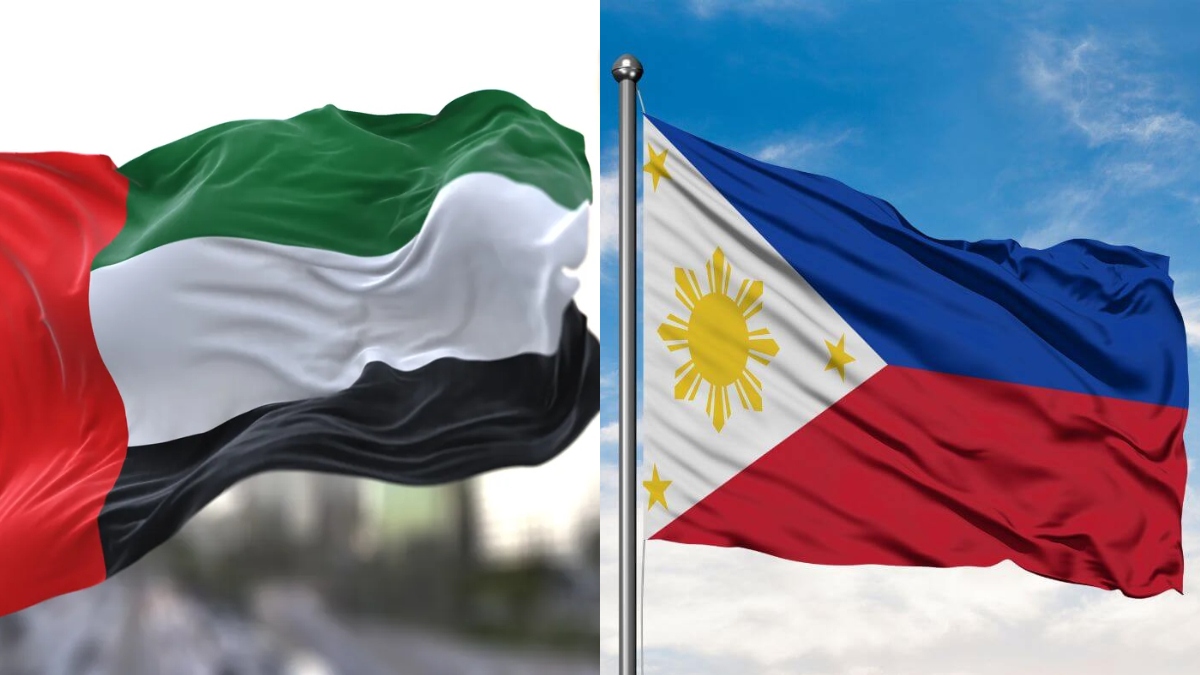

The Philippines and the United Arab Emirates (UAE) have marked the 51st anniversary of their diplomatic relations, celebrating more than five decades of friendship that has expanded from labor cooperation to multi-sectoral partnerships across trade, energy, culture, and security.

In a statement, the Philippine Embassy in Abu Dhabi congratulated both nations for the “continued expansion and evolving ties between our nations, built upon the strong people-to-people relations and presence of close to a million Filipinos living and thriving in the UAE.”
From labor ties to strategic partnerships
Since the establishment of diplomatic relations in 1974, ties between Manila and Abu Dhabi have matured significantly. What began as primarily labor cooperation has since evolved into areas such as renewable energy, artificial intelligence, security, and cultural exchange.
“The past three years alone saw the signing of various groundbreaking and pioneering agreements, ranging from cultural cooperation, security, to artificial intelligence, and the historic Official Visit of H.E. President Ferdinand Marcos, Jr. to the UAE to celebrate the golden anniversary of Philippines-UAE friendship and brotherhood,” the Embassy emphasized.
The UAE hosts around 700,000 Filipinos, making them one of the largest expatriate communities in the Gulf. Filipino workers contribute significantly to the UAE’s healthcare, hospitality, aviation, IT, and construction sectors, strengthening the people-to-people dimension of relations.
Expanding economic and energy ties

Economic relations have accelerated in recent years. Non-oil trade between the two countries surged from US$830 million in 2021 to US$1.85 billion in 2022, making the UAE the Philippines’ top export destination in the Gulf. The launch of the Investment Promotion and Protection Agreement (IPPA) in 2024 further solidified this momentum.
A milestone was achieved in January 2025, when UAE’s renewable energy giant Masdar signed a US$15 billion deal with the Philippines to deliver 1 GW of clean energy by 2030, with potential expansion to 10 GW by 2035. This aligns with the Philippines’ ambitious goal of raising its renewable energy share to 35% by 2030 and 50% by 2040.
The Embassy also highlighted expectations for the imminent signing of the Comprehensive Economic Partnership Agreement (CEPA), which is projected to bring “a bounty of mutual benefits and prosperity to our peoples.”
Cooperation on security, legal frameworks, and humanitarian efforts
Beyond economics, both nations have reinforced collaboration on security. On April 21, 2025, they signed an Agreement on Security Cooperation, which covers joint efforts against cybercrime, drug trafficking, human trafficking, and other transnational threats.
Legal cooperation has also been strengthened, with agreements on extradition, mutual legal assistance, and visa waivers for official passport holders signed during President Marcos Jr.’s November 2024 working visit to the UAE.
The UAE has extended humanitarian assistance to the Philippines on several occasions, including aid after Typhoon Yolanda, donations of COVID-19 vaccines, and 51 tons of relief goods for Mayon Volcano victims in 2023. In February 2025, the UAE pledged US$20 million to help rehabilitate the Pasig River through a circular economy approach.
