



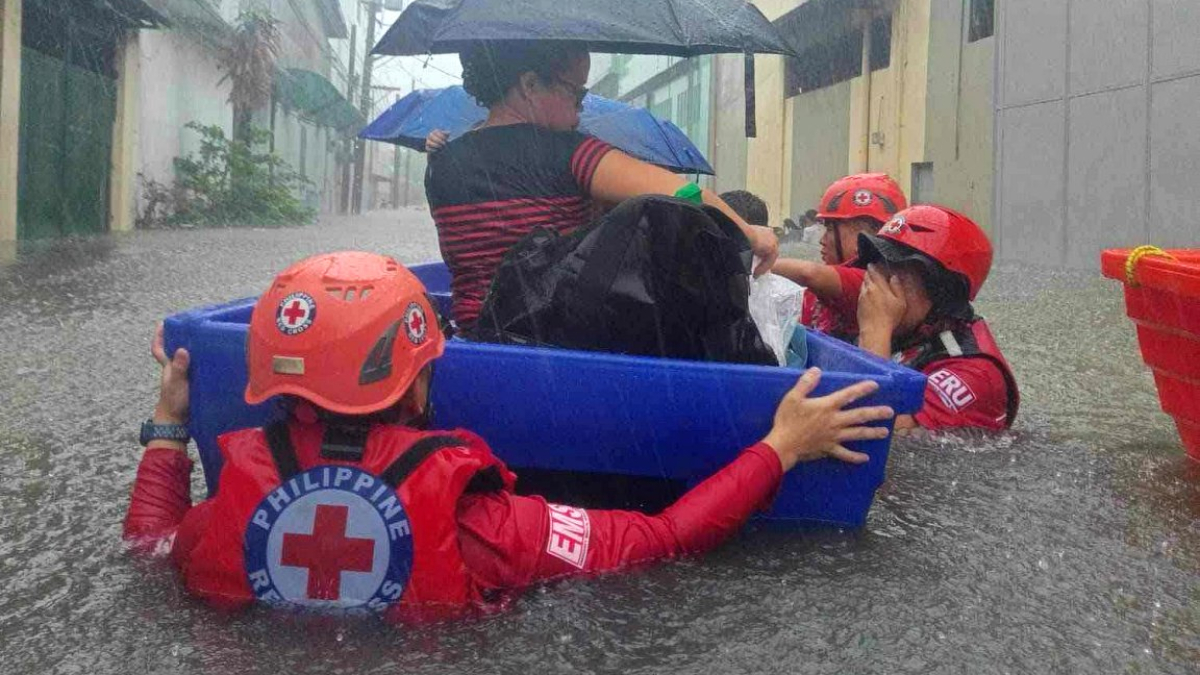

Amid mounting criticism over recurring floods and incomplete infrastructure, the Philippine government has slashed its proposed 2026 budget for flood control projects by nearly ₱72 billion, the Department of Budget and Management (DBM) confirmed on Monday.

The proposed allocation for next year now stands at ₱274.9 billion, a significant drop from this year’s ₱346.6 billion. Despite the cut, Budget Secretary Amenah Pangandaman clarified that the amount is still under review and could be adjusted once proper planning and justifications are submitted.
“More or less it’s around the same amount,” Pangandaman said, after turning over a full list of flood control initiatives to Public Works Secretary Manuel Bonoan. She noted that the final figures are still being finalized.
Her statement came during an inspection of the persistently flooded Apalit-Macabebe road in Pampanga, which remains underwater nearly two weeks after being battered by a series of typhoons and monsoon rains in July.
Apalit Mayor Oscar Tetangco lamented that the road project—previously raised to President Ferdinand Marcos Jr. in 2023—remains unfinished two years later.
Responding to this, Pangandaman said she has directed the reallocation of funds from completed projects to cover repairs for the flood-prone road.
“I just found out that we actually have funds allocated to other areas that are already completed or not really needed… Meanwhile, this road that’s always damaged has no funding,” she said.
The Department of Public Works and Highways (DPWH), she added, is also seeing a lower proposed budget under the National Expenditure Program (NEP), due to its already sizable ₱1.09 trillion allocation for 2025. Many ongoing projects must be completed before new funding is added, she explained.
President Marcos earlier approved the proposed ₱6.793 trillion national budget for 2026, which accounts for 22% of the country’s GDP and is 7.4% higher than this year’s ₱6.326 trillion.

In a podcast aired Monday, Marcos addressed budget concerns, supporting Congress’ role in budget amendments while emphasizing the Executive branch’s responsibility to avoid waste and misuse.
“It is also our duty to provide a plan and to ask for funds from Congress… to ensure that funds of the people are not lost, wasted or stolen,” the President said.
He also raised concern over the removal of funding for foreign-assisted projects, warning that doing so could damage the country’s reputation and risk low-quality project outcomes.
“Almost all of their funding have been removed… That tarnishes our reputation,” Marcos said, stressing the need to restore these allocations.
Meanwhile, Senator Sherwin Gatchalian, the new Senate finance committee chair, vowed sweeping reforms to improve transparency in the budget process. He described the coming phase as a “golden age of transparency,” citing efforts to require government agencies to upload every stage of their budget proposals on their websites.
Currently, only the NEP and the final General Appropriations Act are publicly available. Gatchalian said this limited visibility leaves citizens in the dark about what changes occurred along the way.
To further empower the public, his office is developing simplified tools to help ordinary Filipinos understand and track the national budget. He also plans to introduce a resolution establishing a digital feedback system for concerned citizens to report issues and flag suspicious allocations.
“Transparency leads to accountability. The public deserves to see the whole picture,” Gatchalian said.
He added that education will remain a top priority in 2026, aiming to push its budget to more than 4% of GDP. Interventions such as stronger reading and numeracy programs, additional teacher aides, and possibly public-private partnerships for school construction are among the planned measures.
