



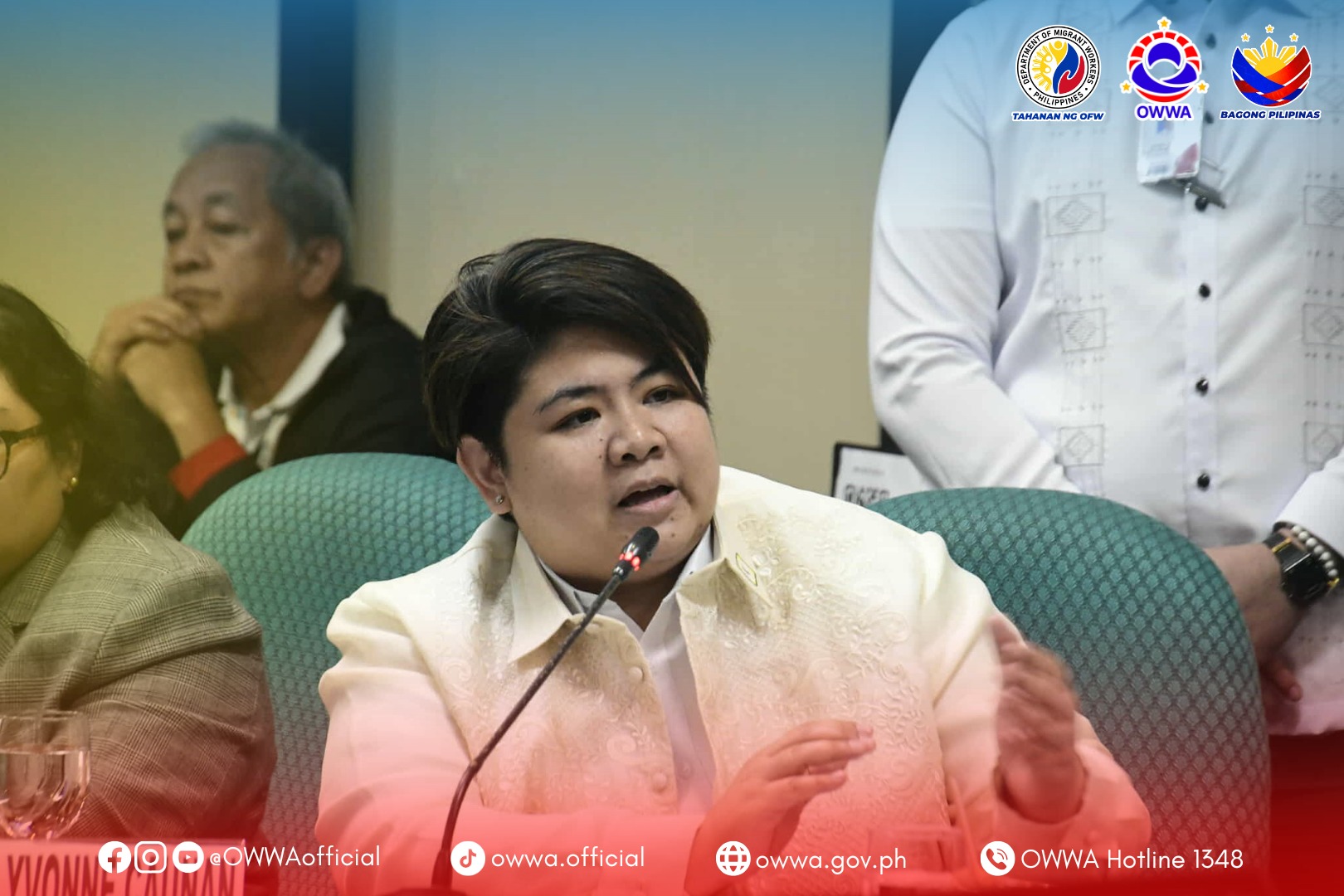

Overseas Workers Welfare Administration (OWWA) Administrator Patricia Yvonne “PY” Caunan reaffirmed the agency’s commitment to protecting the hard-earned money of overseas Filipino workers (OFWs), saying every dollar or dirham sent home carries deep emotional weight.

“Ang bawat dolyar o dirham na ipinapadala ng mga OFW sa kanilang pamilya ay may kasamang kwento ng pagtitiis at pagmamahal, kaya’t dapat itong binibigyan ng proteksyon at napupunta sa tama,” Caunan said during a Senate hearing on October 6, led by Senator Joel Villanueva.
Caunan, alongside Department of Migrant Workers (DMW) Secretary Hans Cacdac and other officials, attended the joint hearing of several Senate committees to express full support for Senate Bill Nos. 181 and 1074—measures that aim to safeguard OFW remittances.
In her presentation, Caunan submitted OWWA’s official position paper, emphasizing that remittances are not mere money transfers but symbols of service, love, and sacrifice. “Bawat dolyar o dirham na ipinapadala ay may kasamang sakripisyo at pangarap. Tungkulin nating siguraduhin na ito ay protektado, malinaw, at napupunta sa tama,” she said.

OWWA expressed strong backing for the bills’ key provisions, including a mandatory 50% discount on remittance service fees, stricter transparency and regulation on remittance charges and exchange rates, and continued financial literacy education for OFWs and their families.
Caunan highlighted that financial education is already part of OWWA’s Pre-Departure Orientation Seminar (PDOS) to prepare OFWs even before they leave the country. She also called on senators to support funding for enhanced PDOS programs tailored to specific countries and occupations, and for using digital platforms to reach more migrant workers worldwide.
The administrator further cited that financial literacy initiatives are part of OWWA’s mandate under the OWWA Act of 2016 (RA 10801) through programs such as the Family Development Support Program and the Reintegration Preparedness Program, both designed to help OFWs and their families manage their finances responsibly.
