




A Dubai-based professional’s account of being pulled off a grounded flight mid-crisis has taken on a life of its own online, drawing attention not to the chaos of Saturday’s airspace closure, but to what came after it.

Tushar Gagerna, who works in growth marketing and product within the fintech space, had been seated on a Delhi-bound aircraft at Dubai International Airport when — two hours after the scheduled 1 PM departure — the cabin crew asked everyone off the plane. Iranian strikes had hit UAE territory.
“In that moment on the plane, there was uncertainty. Hushed conversations. Phones lighting up with news alerts. That strange collective silence when nobody quite knows what to say,” he wrote in a post that has since circulated widely across LinkedIn.
What he described next flipped the expected narrative of a crisis.
Airport staff had already arranged a dedicated holding area by the time passengers finished disembarking. Gagerna noted the contrast between the gravity of events outside and what he encountered on the ground: “Organised. Calm. Clear communication.” Complimentary food and water followed. Then came the detail he called the most striking of all — immigration officials were issuing emergency visas on the spot to foreign nationals with no pre-existing plans to remain in the country.
“In the middle of a geopolitical crisis, with airspace shutting down and flights grounded — the UAE was actively making sure that visitors who had no plan to stay, who had no hotel booked, who were just passing through — were legally covered, safe, and documented,” he wrote.

His post landed at a moment when the scale of the disruption was still becoming clear. Retaliatory Iranian missile and drone attacks had struck UAE airports on February 28 and March 1, following US and Israeli strikes on Iran. Zayed International Airport in Abu Dhabi recorded one fatality and seven injuries from a drone strike; Dubai International reported four people hurt. The General Civil Aviation Authority moved to close the country’s airspace, triggering a cascade of cancellations across every major carrier operating through the Gulf — Emirates, Etihad, flydubai, Air Arabia, Air India, IndiGo, and Air India Express among them. Aviation data firm Cirium counted more than 1,800 cancelled flights across the broader Middle East on Sunday alone.
The on-the-ground response Gagerna described was, it turns out, part of a coordinated government operation. The GCAA confirmed the state was covering all accommodation and meal costs for passengers unable to depart. Some 20,200 travellers had been processed through rebooking systems and placed in temporary lodging by national carriers and airport authorities. Abu Dhabi’s Department of Culture and Tourism separately directed hotels to absorb the cost of extended stays for guests with no way out. “We kindly requested to extend their stay until they are able to depart. The cost of the extended stay will be covered,” the department said in a statement.
Private businesses moved in the same direction without being asked. A Dubai holiday-home operator — whose own family friend was stranded at Zayed International — opened available apartments to displaced travellers and posted about it publicly. The Instagram post attracted more than 30,000 likes and, according to the host, prompted around 250 fellow short-term rental operators to follow suit. Property developer Danube Properties put out its own offer: “If you are currently stranded in Dubai, we are offering accommodation free of charge. Priorities will be given to families with children and elderly members.”
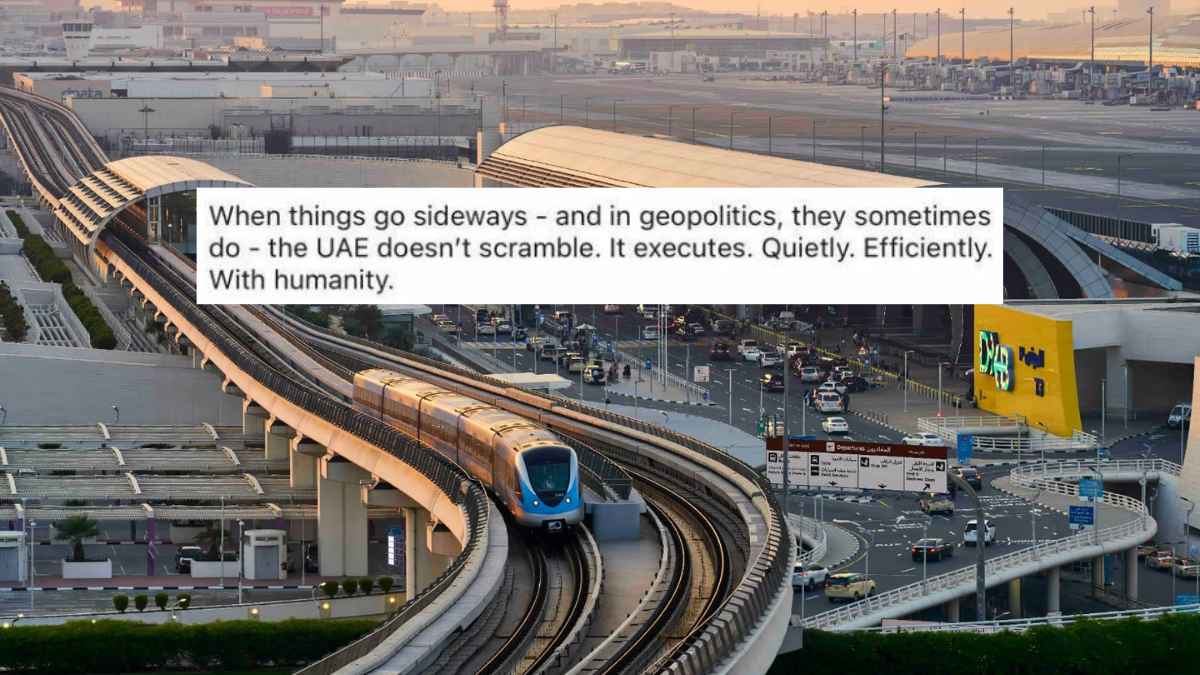
Gagerna closed with a line that has been quoted repeatedly in comments and shares: “When things go sideways — and in geopolitics, they sometimes do — the UAE doesn’t scramble. It executes. Quietly. Efficiently. With humanity.”
As of Monday, March 2, UAE airports remain closed. Emirates has suspended operations through at least Monday afternoon. Etihad is allowing passengers holding tickets issued before February 28 to rebook on any date through March 15 without additional charges. UAE authorities have instructed everyone currently in the country — residents and visitors alike — to “seek immediate shelter in the nearest secure building, steer away from doors, windows and open spaces” until conditions change.
