



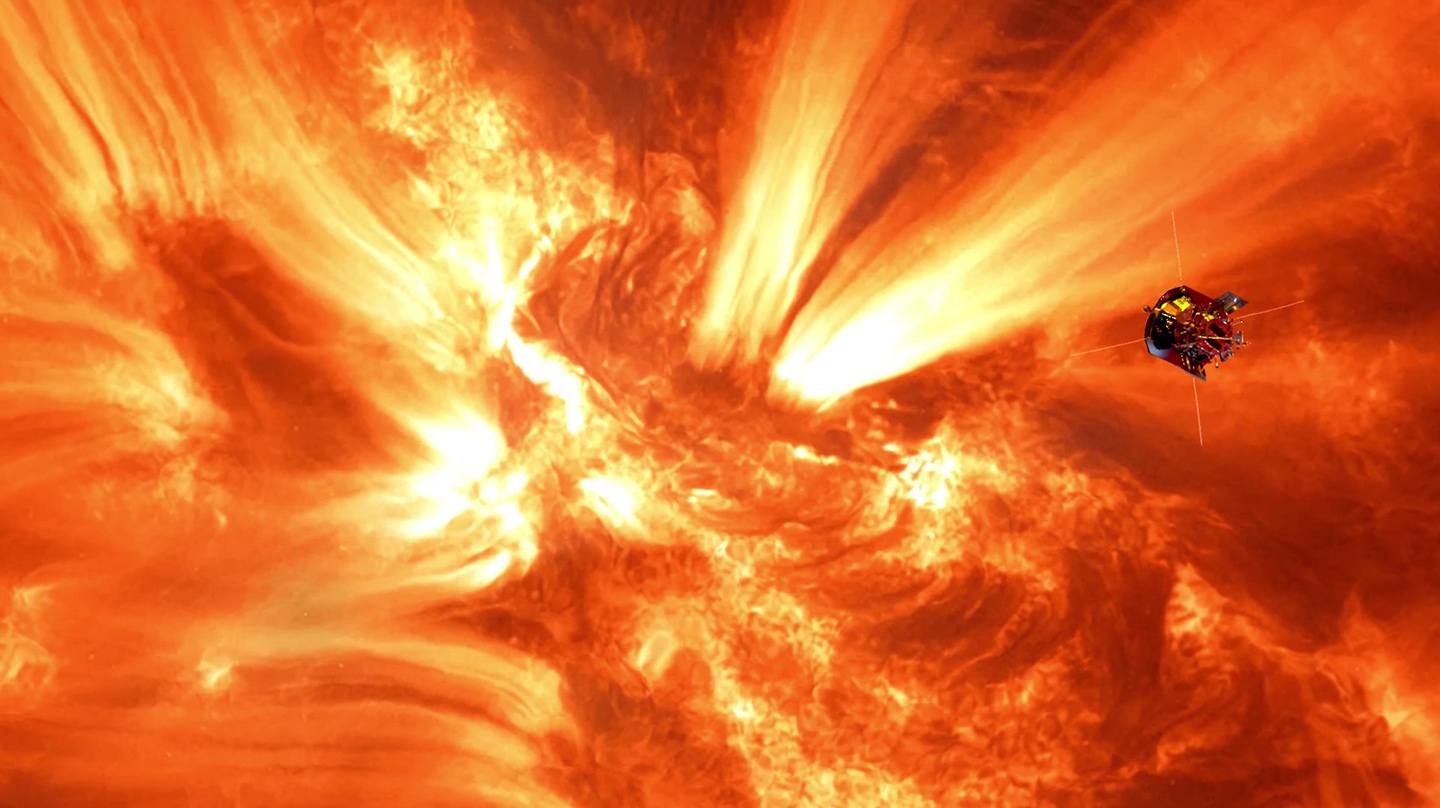

In a groundbreaking leap for solar science, NASA has unveiled the most detailed footage ever taken of a violent solar eruption, thanks to its Parker Solar Probe—the closest any spacecraft has ever flown to the Sun.

The footage, captured on December 24, 2024, during a historic flyby just 3.8 million miles from the Sun’s surface, shows the interior of a coronal mass ejection (CME) in real-time. Using its wide-field imager (WISPR), the Parker Probe recorded swirling flows and turbulent eddies—providing the first visual confirmation of Kelvin-Helmholtz instabilities, a solar phenomenon long theorized but never directly observed at this range.
“We’re watching CMEs pile up on each other,” said Angelos Vourlidas of Johns Hopkins Applied Physics Laboratory. “This helps us learn how they merge and how that affects space weather.”
The Parker Probe, launched in 2018, has repeatedly broken its own record for closest approach to the Sun. This latest data is now being hailed as a turning point in understanding how solar storms form and develop—crucial knowledge for predicting space weather that impacts satellites, communications systems, and astronaut safety.

“We are witnessing where space weather threats to Earth begin, with our eyes, not just with models,” said Nicky Fox, NASA’s associate administrator. “This new data will also help us improve our technology for the safety of astronauts and our technology, both in space and on Earth.”
Despite extreme conditions, NASA confirmed that the probe remained fully functional throughout the flyby, further proving the robustness of its engineering.
The next close encounter is scheduled for September 15, 2025, with scientists eager to collect more insights into how solar outflows originate and shape the environment of our solar system.
