



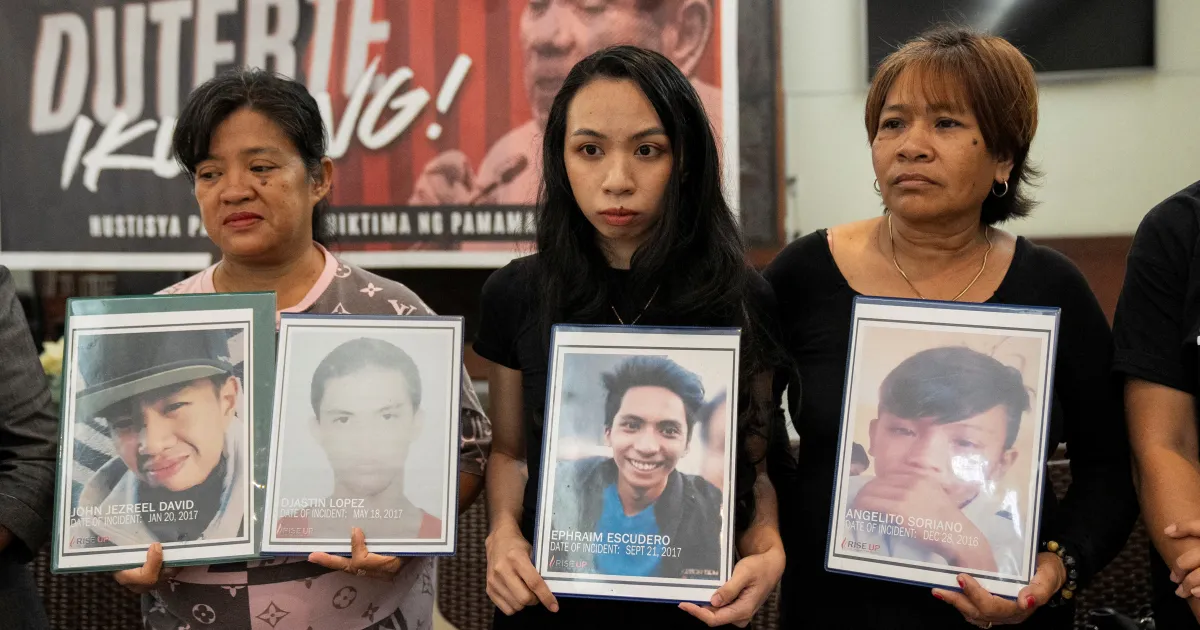

Families who lost loved ones in the Philippines’ bloody anti-narcotics campaign say the International Criminal Court’s refusal to free former president Rodrigo Duterte on health grounds is an essential condition for their pursuit of justice. They stressed that keeping him in custody helps ensure “the case to proceed efficiently and smoothly” and protects those preparing to testify, noting it is also vital “to make victims and witnesses feel safe coming forward.”

The ICC Appeals Chamber issued its ruling on November 28, turning down the defence’s bid to secure Duterte’s temporary release. The panel upheld a September 26 decision of Pre-Trial Chamber I, and the 80-year-old former leader — now elected mayor of Davao City — remained under detention in The Hague. Duterte chose not to be present for the hearing.
In a Khaleej Times report, ICC Assistant to Counsel Atty. Kristina Conti underscored that “Duterte’s (continued) detention is crucial for victims and witnesses to feel safe coming forward. By large, it is an assurance that he cannot simply intimidate persons, interfere with the evidence, or disrupt proceedings.” According to her, the Appeals Chamber’s rejection of the plea “was factual and legal,” pointing out that the judges found “basis for his continued detention and that he is a flight risk,” while the defence failed to justify release “on humanitarian grounds.”
Duterte’s lead counsel, British-Israeli lawyer Nicholas Kaufman, previously argued that the former president’s health had worsened, presenting this as the central reason for humanitarian release. Conti countered that remaining in ICC detention was “(actually) providential for him, given the capacity and earnestness of the ICC and the host country The Netherlands to provide proper medical care if such is necessary.”
The Appeals Chamber — composed of presiding Judge Luz del Carmen Ibáñez Carranza, Judge Tomoko Akane, Judge Solomy Balungi Bossa, Judge Gocha Lordkipanidze, and Judge Erdenebalsuren Damdin — dismissed all three grounds presented by Duterte’s defence.

While the latest ruling focused on detention, the case itself stems from accusations that Duterte was involved in crimes against humanity for the widespread killings attributed to his anti-drug operations between 2016 and 2022 and earlier during his time as Davao City mayor. Amnesty International and other rights groups have long pointed to thousands of alleged extrajudicial killings. The Philippine National Police tallied more than 6,000 deaths, while human rights organisations estimate the toll could reach 30,000.
The former president was turned over to the ICC on March 12, a day after Philippine authorities arrested him at Manila International Airport following his arrival from Hong Kong. Duterte appeared frail and spoke very little during his first court appearance by video link on March 14. Days earlier, however, he appeared upbeat in a video recorded aboard a private jet that stopped in Dubai before heading to the Netherlands. “Do not worry, I’m okay,” he said, before reiterating that he took full responsibility for the anti-drug campaign. “This (trial) has something to do with the law and order before. I told the military and police to work and I will take full responsibility—this (arrest) is it. For whatever happened in the past, I took full responsibility—it was my job—and I am responsible.”
The court will announce the date for the confirmation of charges hearing once remaining issues are addressed. Conti noted that with the interim release matter settled, both prosecution and defence can now concentrate on two pending questions: jurisdiction, which remains before the Appeals Chamber, and Duterte’s fitness to stand trial, currently with the Pre-Trial Chamber.
Human rights organisations Karapatan and Hustisya also backed the latest ICC action. “Victims and their families have already waited far too long for Duterte’s trial to begin,” they said, urging the ICC to proceed without delay. They stressed that the Appeals Chamber’s move clears the way for the next stage in the proceedings, adding: “No more delays!”
Karapatan secretary-general Cristina Palabay said the ruling “brings a measure of certainty to the victims’ quest for justice at the ICC,” explaining that “It does not mean the struggle is over, but it keeps the path open, and the victims have that degree of assurance that Duterte remains in prison.”
