



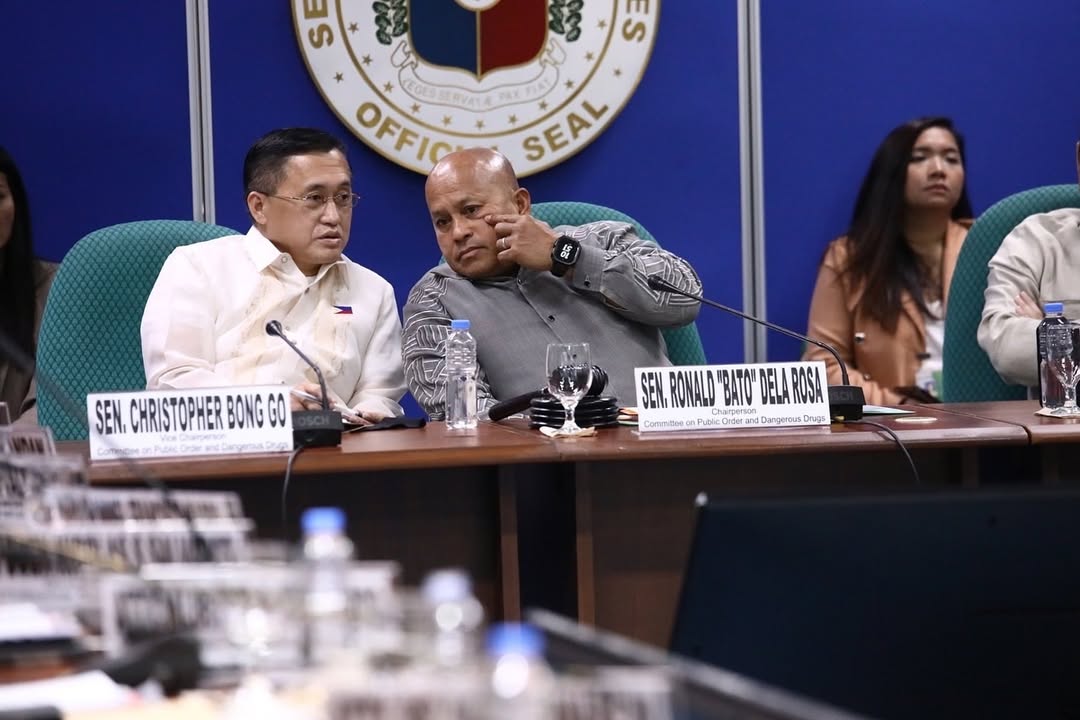

Warrants of arrest against Senators Ronald dela Rosa and Christopher “Bong” Go may eventually be issued by the International Criminal Court (ICC) in connection with the crimes against humanity case against former president Rodrigo Duterte, according to an ICC-accredited lawyer cited by The Manila Times.

Gilbert Andres, the common legal representative of victims in Duterte’s anti-drug campaign, said applications for arrest warrants remain confidential under ICC rules and are known only to the Office of the Prosecutor and judges of the Pre-Trial Chamber. He noted that the public would only learn of any warrant once it is transmitted to relevant state authorities.
Dela Rosa and Go were among those named as alleged indirect co-perpetrators in a recently released less redacted ICC document, along with former Philippine National Police chiefs Oscar Albayalde, Camilo Cascolan and Vicente Danao; former Justice secretary Vitaliano Aguirre II; former National Bureau of Investigation director Dante Gierran; and former Philippine Drug Enforcement Agency director Isidro Lapeña.
Andres explained that ICC arrest warrants are not covered by Philippine extradition rules because the ICC is an international organization, not a state. Instead, he said surrender proceedings could be carried out under Republic Act 9851, or the Philippine International Humanitarian Law Act, which allows government cooperation with international tribunals handling international crimes.
He also argued that the Senate should not be treated as a refuge for officials facing accountability, adding that while arrests inside Senate premises might be avoided as a matter of courtesy, senators could still be arrested outside if valid ICC warrants exist. “No individual should be shielded from accountability for international crimes by virtue of position or office,” Andres said.

The lawyer said the ICC document, originally filed in July 2025 in heavily redacted form, was later released in a less redacted version after prosecutors determined that revealing the names would not endanger potential victims or witnesses. He added that the disclosure provides context to the prosecution’s theory of a “common plan” behind an alleged widespread and systematic attack on civilians.
Andres also rejected allegations that the release of names was politically driven, stressing that ICC judges do not consider political factors in their proceedings. He clarified that “co-conspirators” is a concept under Philippine domestic law, while “indirect co-perpetrators” is defined under Article 25 of the Rome Statute and refers to individuals who allegedly orchestrate or enable crimes without directly committing them.
The developments come ahead of the Feb. 23 confirmation of charges hearing against Duterte. Separately, the ICC Office of the Prosecutor told Pre-Trial Chamber I it would take no position on Duterte’s defense request to disqualify the external legal representatives for victims, according to a public redacted filing dated Feb. 16 signed by Deputy Prosecutor Mame Mandiaye Niang.
In the same filing, prosecutors disclosed they will not rely on two specific pieces of evidence during the confirmation hearing and do not intend to use the same material at trial, citing the need to protect witness security and ongoing investigations.
