





For many overseas Filipino workers, the hardest part of leaving is not the work itself, but the quiet reckoning that comes after realizing staying home would have meant standing still. Paul John Babas Reyes knows that feeling well, having spent the last seven years navigating a path shaped by necessity, faith, and a steady refusal to settle for less than what he knew he could become.

At 34, Reyes works in Abu Dhabi as a basic paramedic, responding to prehospital emergency cases where time, judgment, and compassion often collide. His journey there, however, did not begin with sirens or emergency calls. It started much earlier—in Isabela, in warehouses and cornfields, in the kind of work young people take on not for ambition but for survival.
From Cauayan to the field
Reyes grew up in Cauayan City, Isabela, where working during school breaks was not unusual. “Kung counted ito, at young age kapag summer break, nagwork ako sa tabacalera,” he shared with TGFM, describing long days scraping tobacco residue and dismantling equipment inside bodegas. When there was no warehouse work, he joined relatives in the fields to plant or harvest corn. “Pandagdag din yun pambili ng mga gamit sa school.”
Those early jobs did not come with any grand narrative, but they built something foundational: an understanding that progress required effort, and often, discomfort. That mindset stayed with him when he became a nurse in the Philippines and later when he faced the stark realities of the profession back home.
“As much as I want to stay with my Family back home, it’s just difficult to be a Nurse in the Philippines,” he said. Government hospitals often meant contractual work or unpaid volunteering. Private hospitals offered low wages. Other nursing roles were not even recognized as proper bedside experience. “The cons are always larger than the pros. I moved overseas for practical reasons.”
Finding purpose in emergency care
Reyes arrived in the UAE in 2018, taking what many Filipino nurses consider the quickest entry point into the profession abroad—homecare. His first posting was in Al Ain, followed by a return to hospital work in Dubai. Later, he became an ambulance nurse in Sharjah before moving into his current role in Abu Dhabi.
Today, his work places him at the center of people’s most vulnerable moments. It is precisely this exposure that gives him a deep sense of fulfillment. “What i like most about this job is being there to people in their not so good days,” he shared. “If they are in scared, in need, in pain or unsure about something. The fact na nandun ako para sa kanila, and I am able to help them. Ansarap lang sa pakiramdam.”
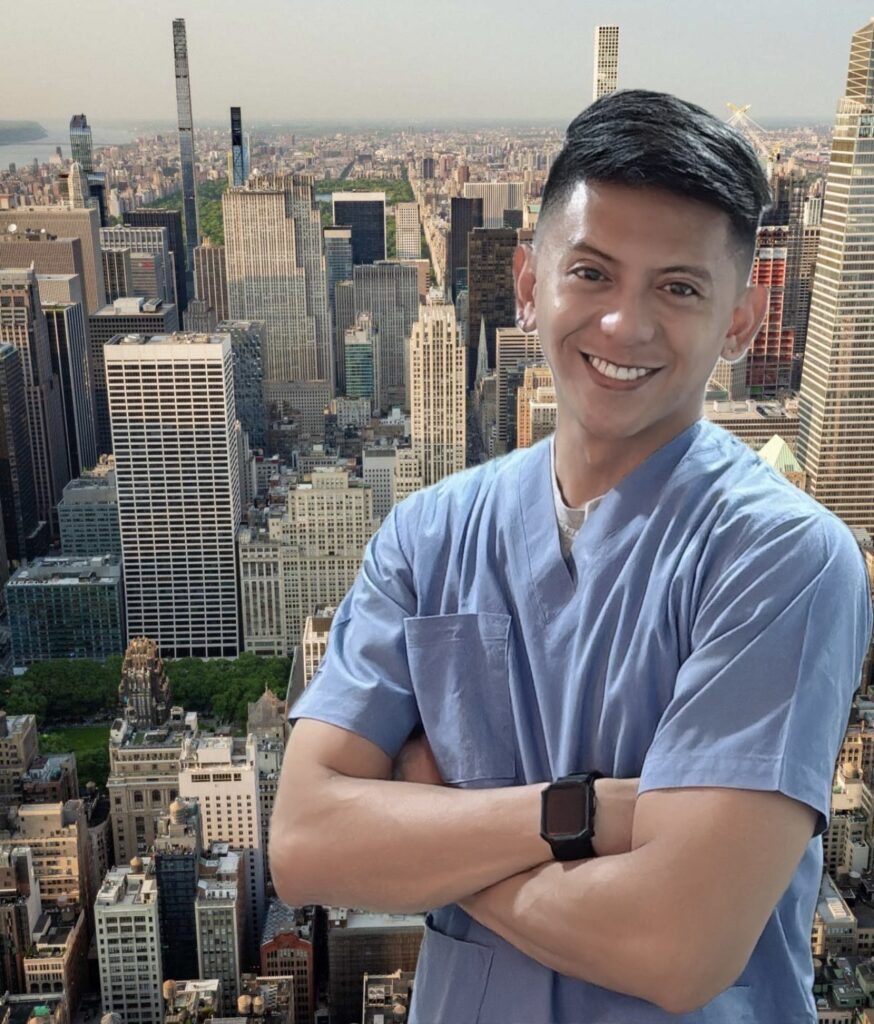
For Reyes, the job is not just technical—it is emotional and human. “It gives meaning to what I love to do,” he said, a statement that reflects a calling rather than a career ladder.
When things fall apart abroad

Working overseas, he emphasized, is never a guaranteed upward climb. His first homecare job ended abruptly after just three months. “I was terminated out of the blue… of unknown reason,” he said. Later, a promising opportunity in Abu Dhabi nearly unraveled his career when a company asked him to resign from his current post, only to withdraw the offer after he submitted his cancellation papers. “Pano to? Nakapagresign na ako pero di itutuloy yung hiring?”
These professional setbacks were painful, but they were eclipsed by a deeper loss—grieving for a loved one from thousands of kilometers away. “Yung mawalan ka ng mahal sa buhay tapos ang layo mo?” Reyes said. He described moments of receiving devastating news mid-shift, unable to break down in front of colleagues, forced to keep working while mourning silently. “I didn’t have proper grieving. Until now.”
Faith became his anchor. “Of course prayers lang talaga kinapitan ko sa lahat,” he said. Over time, prayer shifted from a reaction to a routine. Daily rosaries, church visits, and even watching Mass online became part of his system. “Hindi na naalis sa sistema ko,” he said. “Mas naging matibay yung faith ko kay God.”
The cost—and value—of opportunity
Looking back, Reyes often asks himself a difficult question: “If I stayed in the Philippines, ganito din kaya ang situation ko?” For him, the answer underscores why so many Filipinos choose the uncertainty of life abroad. “I guess that speaks already about the vast opportunities we can have if we just open our minds that there’s more out there.”
Those opportunities did not come easily. Reyes now holds six medical licenses—registered nurse credentials in the Philippines, the US, and multiple UAE jurisdictions, as well as paramedic certifications. He has completed a Bachelor of Science in Nursing and earned a master’s degree in management major in public health administration, graduating with a general weighted average of 1.354.
He is quick to demystify that achievement. “Sabi nila ‘matalino’ (di umano hahaha),” he said, before explaining the real motivation behind his study habits. “Sinisagad ko mag aral kapag may licensure exam ako kasi I can’t afford to have take 2. Literal na ‘i cant afford’ kasi wala akong perang pang take 2!”
The discipline, he admitted, was partly financial—and proudly Ilocano in design. “Pera na naman kasi ulit,” he said with a laugh. Still, he acknowledged the role of grace. “Awa ng Diyos, pumapasa. Thank you Lord!”
Carrying faith forward
Reyes is cautious when speaking about the future. “May mga plano ako pero I can’t discuss baka maudlot,” he said, preferring to share them only when they are certain. For now, he is content where he is. “As of now masaya ako dito sa abroad. Thanks God for carrying me through.”
To fellow OFWs, his message is both generous and grounded. “Saludo ako sa mga kasamahan kong OFW,” he said. “Iba’t iba tayo ng kwento pero iisa lang layunin natin.” He urged Filipinos abroad to let go of toxic mindsets, to compete fairly, and to celebrate each other’s progress. “Palakpakan natin yung mga kapwa nating OFW na umaangat kasi di natin alam balang araw tayo naman ang papalakpakan.”
