



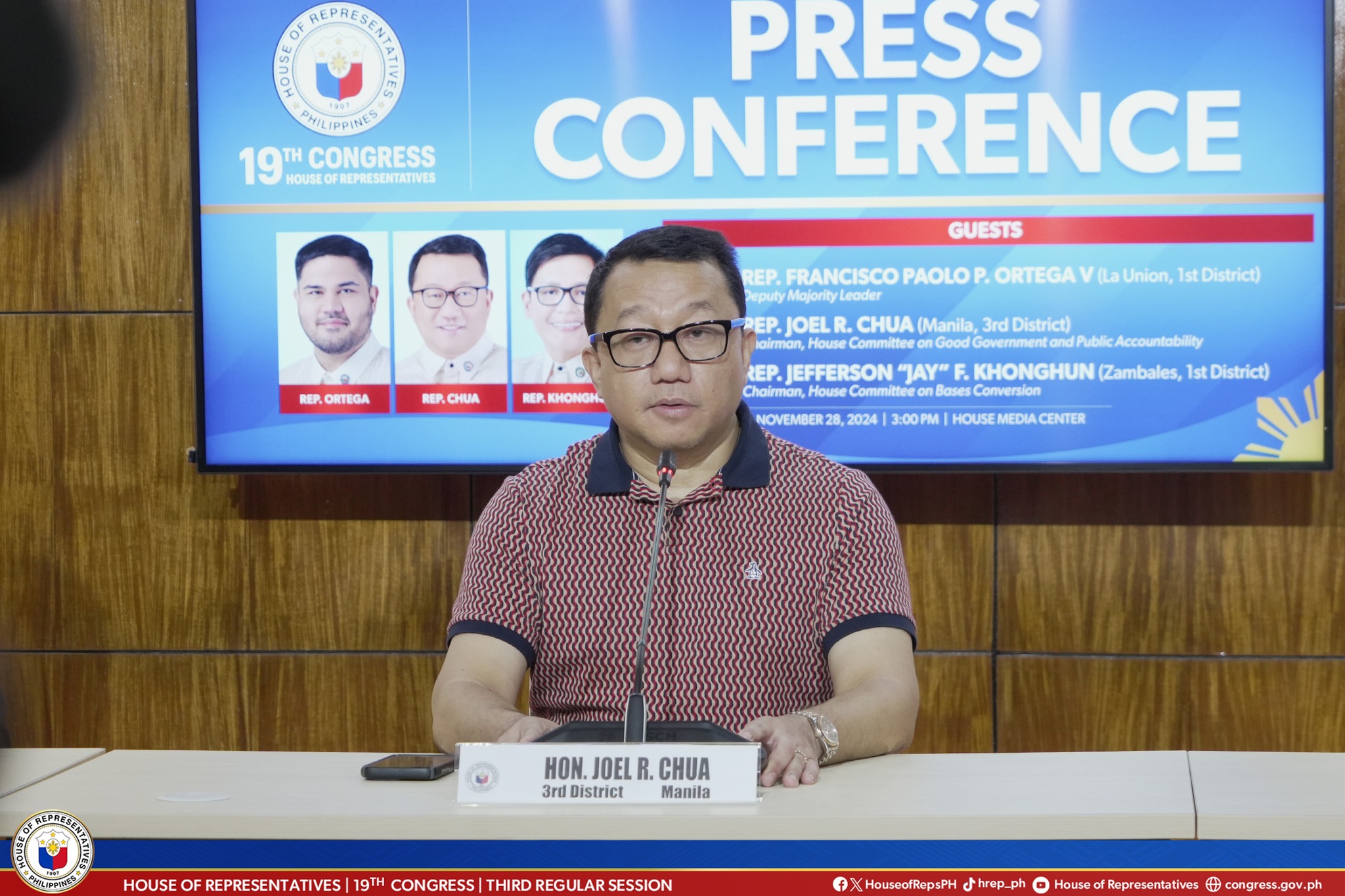

The chair of the House committee on good government and public accountability said on Monday that the impeachment complaint filed against President Ferdinand Marcos Jr. does not, at this stage, present sufficient grounds to move forward.

Rep. Joel Chua made the statement after an impeachment complaint was lodged by lawyer Andre de Jesus and endorsed by Pusong Pinoy Party-list Rep. Jett Nisay earlier in the day. He confirmed that the filing had been formally noted by the House of Representatives and would undergo the preliminary assessment required by law.
“We have been informed that an impeachment complaint against President Marcos Jr. was filed today. As with any impeachment complaint, the House of Representatives will accord it the initial consideration required under the Constitution and our rules,” Chua said.
He cautioned, however, that the complaint faces significant hurdles based on what has been disclosed publicly so far. “At the same time, it must be stated frankly that, based on what is publicly known at this point, the complaint faces a steep and difficult path in the House,” he added.
The impeachment filing accuses the President of graft and corruption, culpable violation of the Constitution, and betrayal of public trust. These allegations stem largely from the March 2025 arrest and subsequent detention of former president Rodrigo Duterte in The Hague, where he is facing trial over alleged crimes against humanity linked to the anti-drug campaign during his administration. The complaint also cites Marcos’ approval of unprogrammed appropriations, allegations of drug use, and claims that he shielded allies from scrutiny related to flood control projects.
Chua stressed that impeachment cannot proceed without meeting strict constitutional requirements. “Impeachment requires clear, specific, and well-substantiated allegations of impeachable offenses—not conjecture, political disagreement, or generalized accusations. So far, no issue has emerged that clearly rises to the level of an impeachable offense as defined by the Constitution,” he said.

While describing impeachment as a remedy of last resort, the lawmaker said the House remains duty-bound to evaluate the complaint for sufficiency in both form and substance, consistent with due process. “There will be no shortcuts, and there will be no prejudgment. This assessment, however, does not excuse the House from its duty,” he said.
He added that lawmakers would examine the filing strictly on its face. “The House will examine the complaint on its face, determine whether it meets constitutional and jurisprudential standards, and act accordingly—guided by reason, evidence, and law, not by noise or pressure,” Chua said.
In assessing the complaint, Chua said the House would apply the Supreme Court’s recently issued rules governing impeachment proceedings. These rules were laid down in July 2025, when the High Court voided the impeachment case against Vice President Sara Duterte for violating the one-year bar and due process.
Under the new framework, impeachment articles must be accompanied by evidence when circulated to House members, and such evidence must be adequate to support the charges. All lawmakers must be given access to both the articles and supporting materials, and respondents must be afforded an opportunity to be heard before any transmittal to the Senate, regardless of the number of endorsements. The rules also require that charges pertain to grave impeachable acts committed during the official’s current term, and that respondents be given copies of the complaint and evidence with reasonable time to respond.
Chua noted that these standards would be observed even as the House’s appeal of the Supreme Court ruling remains pending. “The public can be assured that the House will act deliberately, transparently, and within the bounds of the Constitution,” he said.
