



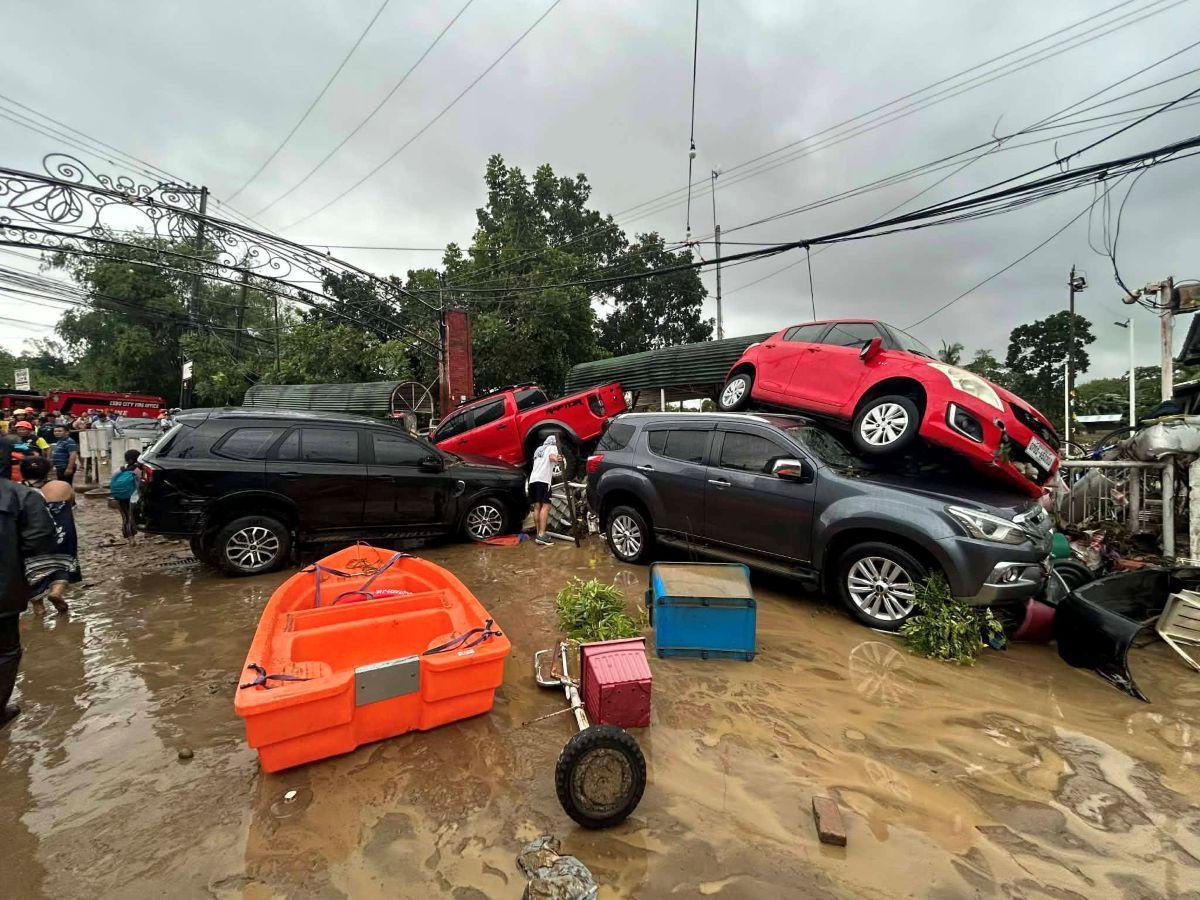

With at least 111 lives lost and communities submerged across Cebu, Governor Pamela Baricuatro has called for accountability over billions spent on flood control projects that, she said, failed to protect the province.

“We’re flooded to the max,” Baricuatro lamented, pointing out that ₱26 billion had been allocated for flood mitigation. She urged a thorough probe into what she described as Cebu’s worst flooding in memory.
Malacañang confirmed that 343 flood control projects were implemented in Cebu from 2016 to 2022, with 168 more added from 2022 to 2025. Communications Undersecretary Claire Castro said President Ferdinand Marcos Jr. had already ordered an investigation into possible irregularities.
“There were budgets allocated but it doesn’t seem to be working,” Castro said. “If she is angry, that’s what President Marcos Jr. feels too.” She added that Baricuatro’s cooperation would be crucial in identifying those responsible for alleged anomalies.
Castro emphasized that the probe would cover projects from both the current and previous administrations. “Let’s work together to find those who should be held accountable,” she said, noting that 55 projects remain ongoing in Cebu.

She also confirmed that the President plans to visit the province soon to oversee recovery efforts and extend aid to affected families. “Even if she is not an ally of the President, no matter what color that is, the President is ready to help anyone as long as help is needed,” Castro added.
Government agencies have since mobilized relief operations. The Department of Health distributed medicines, water, hygiene kits, and containers to communities in Cebu, Aklan, and Eastern Visayas, while monitoring lahar risks from Kanlaon Volcano. The Department of Social Welfare and Development, meanwhile, provided more than 121,000 family food packs and financial aid to bereaved families and stranded passengers.
Experts have urged the government to move away from heavy infrastructure as the main flood solution. UP Resilience Institute director Mahar Lagmay said dikes and revetments should be “the last option,” emphasizing science-driven, nature-based approaches such as reforestation, watershed management, and catchment facilities.
Harvard and UP disaster resilience researchers likewise called on lawmakers to adopt evidence-based reforms, recommending independent oversight and integrated flood management to restore integrity and transparency in the country’s flood control programs.
