



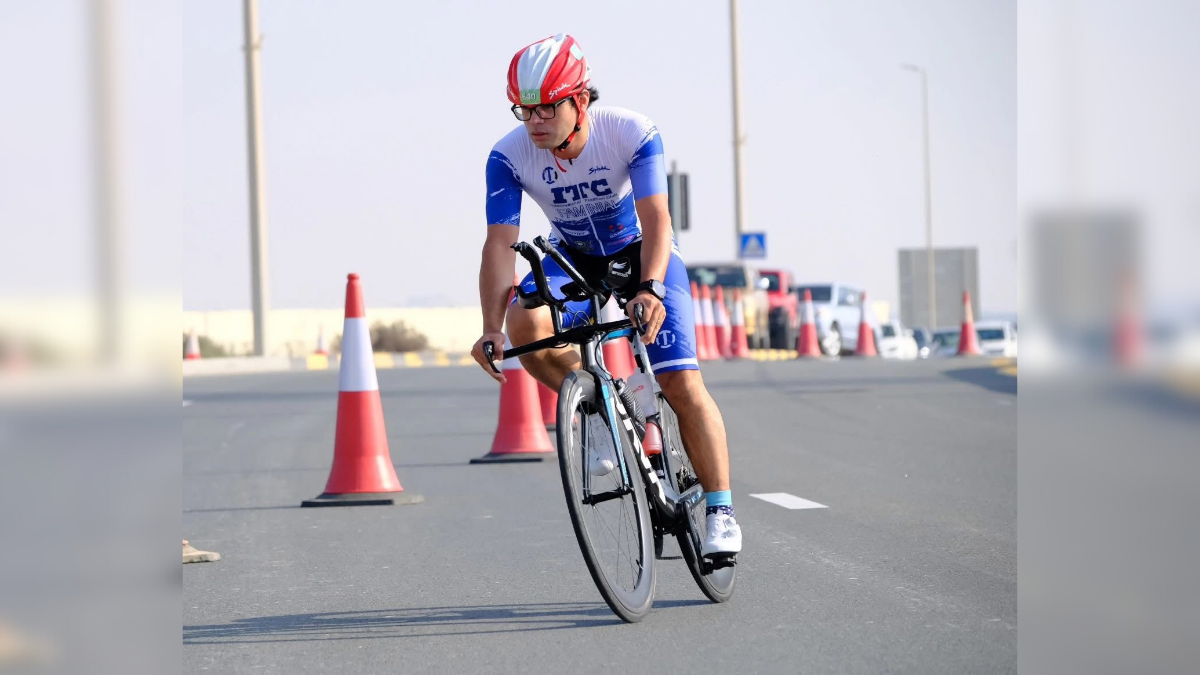

For many Filipinos abroad, the routine begins with work, responsibility, and the quiet pressure to keep proving that the sacrifice of leaving home is worth it.

Michael Alfredo Ignacio Faminial has learned to live inside that pressure—and to turn it into forward motion.
Based in the Kingdom of Bahrain, Faminial wears several identities at once: endurance athlete, school administrator, founder, and community leader. Yet none of those titles quite explain how he arrived at a point where personal discipline evolved into something far larger than race results or podium finishes. What began as an individual pursuit of endurance slowly became a blueprint for leadership, representation, and service—one that now reaches far beyond sport.
When sport became more than competition
Faminial’s professional life sits at the intersection of education and athletics. As a school administrator in the athletics department at the American School of Bahrain, he understands structure, long-term development, and the value of systems that help people grow. Those same principles quietly shaped his approach to sport.
“I believe that sport is more than competition—it is a powerful platform for leadership, service, and bringing people together across cultures,” he says.
That belief took form with the founding of the International Triathlon Club (ITC), a multicultural endurance sports organization based in Bahrain. What set ITC apart from the beginning was not just its training rigor, but its intent. Faminial wasn’t interested in building a club that revolved around individual stars. He wanted an environment where discipline and humility could coexist, and where athletes—many of them expatriates—could find structure, belonging, and purpose.
The results followed. Under his leadership, ITC placed third overall among triathlon clubs at IRONMAN Bahrain 2024. A year later, the club achieved what few would have imagined possible so early in its life: first place overall at IRONMAN Bahrain 2025. The win placed a Filipino-founded and Filipino-led organization ahead of long-established international clubs on one of endurance sport’s most demanding stages.
For Faminial, the milestone mattered—but not in the way outsiders might assume. “Leading the club to international recognition has been meaningful,” he says, “but what matters most to me is the community we have built and the values we uphold—discipline, resilience, humility, and bayanihan.”
Leadership beyond the finish line
Those values are not theoretical. Within ITC, athletes are mentored, supported, and encouraged to take ownership not only of their performance, but of one another. The club operates as an ecosystem rather than a hierarchy—one where success is shared and leadership is cultivated.
That approach has had a tangible effect, particularly for Filipinos abroad who often search for grounding amid transient work contracts and shifting routines. Through structured training and community engagement, ITC became a space where people learned to commit—to goals, to teammates, and to themselves.

Faminial’s leadership style reflects a broader shift in how Filipino excellence abroad is being defined. Instead of visibility through individual triumph alone, his work emphasizes institutional presence. Filipinos, in this model, are not just participants on the global stage; they are builders of platforms, setters of standards, and stewards of community.
“As a Filipino living abroad, I am proud to represent our people through action,” he says. “Showing that Filipinos can lead globally with integrity, compassion, and purpose.”
Endurance with a cause
In June 2025, that philosophy was tested in a way that had nothing to do with medals or rankings. Faminial undertook a 170-kilometer ultra-endurance run around Bahrain—completed over approximately 41 continuous hours—not to chase a personal record, but to raise awareness for the welfare of stray cats and dogs.
The physical toll was extreme. The intent was clear. By choosing to suffer publicly and visibly, he turned endurance into advocacy. The initiative drew attention to local animal welfare efforts, mobilized volunteers, and sparked conversations well outside athletic circles. The run was later featured by The Global Filipino Magazine, highlighting not just the feat itself, but the values behind it.
“Beyond sport, I am committed to using my passion and endurance to serve others,” Faminial says. “Whether through mentoring athletes or undertaking challenges like my 170-kilometer humanitarian run for animal welfare, I strive to prove that success has greater value when it creates positive impact.”
For many who followed the run—athletes, community members, and volunteers alike—it reframed what leadership could look like. The message was simple but demanding: endurance means little if it does not move something forward.
The influence that stays
Those closest to Faminial often describe his influence as steady rather than loud. Within ITC, members credit his example for pushing them to attempt endurance sports they once thought were beyond reach. Others speak of how his approach encouraged them to volunteer, mentor newcomers, or rethink how they measure success.
What resonates most is consistency. The same discipline that shapes training plans informs his advocacy. The same humility that guides his leadership tempers his victories. In a field where visibility can easily eclipse purpose, Faminial has kept the two aligned.
“My work matters because it is not only about personal achievement,” he says, “but about inspiring others to believe that they, too, can make a difference wherever they are in the world.”
That idea—quietly radical in its simplicity—sits at the heart of his journey. It explains why a school administrator became a global sports leader. Why a triathlon club became a community. Why a 170-kilometer run became an act of service.
