



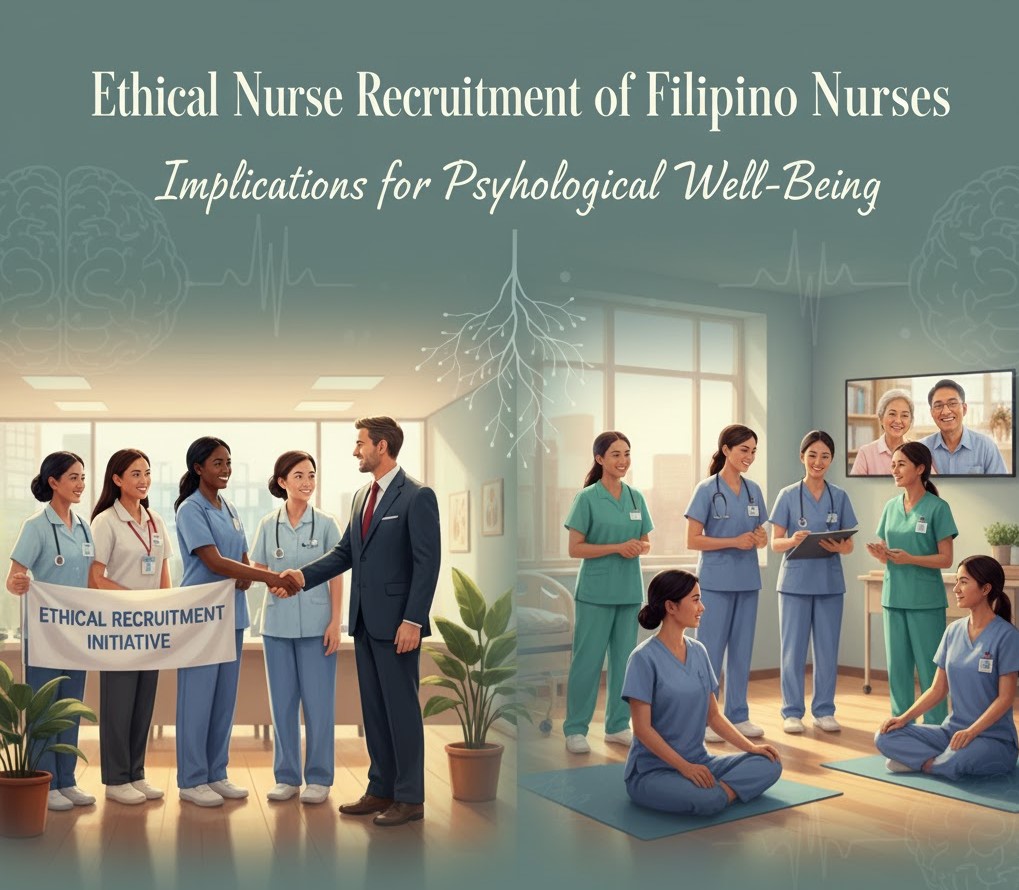

Filipino nurses make up one of the largest internationally mobile nursing workforces, contributing essential skills to health systems worldwide. Global nurse shortages, wage differentials, and active recruitment by destination countries shape their migration. Ethical recruitment is vital to ensure the protection, dignity, and well-being of nurses across the migration continuum-from pre-departure to integration abroad. This article synthesizes current policy frameworks and emerging evidence on how recruitment practices intersect with the psychological well-being of Filipino nurses and proposes actionable recommendations for governments, employers, and recruiters (ICN, 2019; WHO, 2010/2025).

Global and National Frameworks for Ethical Recruitment
A cornerstone of ethical recruitment is the WHO Global Code of Practice on the International Recruitment of Health Personnel, which outlines principles for transparency, mutuality of benefits, and the protection of migrant health workers’ rights. Recent WHO deliberations emphasize the need to strengthen the regulation of private recruiters and manage recruitment ethically during emergencies, issues directly relevant to the experiences of Filipino nurses during and after the COVID-19 pandemic (WHO, 2010/2025).
Complementing the WHO Code, the International Labour Organization’s (ILO) General Principles and Operational Guidelines for Fair Recruitment insists on zero abuse, contractual clarity, and government oversight of recruiters to prevent exploitation, such as charging illicit fees or contract substitution (ILO, 2019).
Destination-country guidance adds further guardrails. The UK Code of Practice and its “red/amber list” restrict active recruitment from countries with critical workforce shortages and require ethical recruiter accreditation; these measures are significant because the UK remains a substantial destination for Filipino nurses (UK DHSC, 2025; NHS Employers, n.d.).
On the Philippines’ side, government regulations (formerly administered by the POEA, now the Department of Migrant Workers) set limits on placement fees and prohibit a range of charges to protect overseas Filipino workers (OFWs), including nurses. Clear enforcement of fee prohibitions and documentation requirements is intended to reduce indebtedness and vulnerability (DMW/POEA, 2016/2025).
Why Ethical Recruitment Matters for Psychological Well-Being
Ethical recruitment is not only a labor standards issue, but also a mental health and well-being issue. Research shows that migrant workers, including nurses, face elevated risks of anxiety, depressive symptoms, and stress, driven by indebtedness, discrimination, language barriers, role strain, and separation from family (Mucci et al., 2019; Marchi et al., 2024).
Pre-migration and Recruitment Phase
Evidence from Filipino nurses indicates that even before departure, those intending to migrate may report worse self-rated mental health and higher social stress than non-migrants, potentially exacerbated by financial pressures and uncertainty during the recruitment process (de Castro et al., 2015). Unethical practices-such as excessive fees, opaque contracts, or misinformation about roles and salaries-can amplify stress, precipitate debt bondage, and undermine trust, setting an adverse psychological baseline (ILO, 2019).
Transition and Early Integration
Upon arrival, internationally qualified Filipino nurses (IQNs) commonly navigate acculturative stressors, including new clinical protocols, documentation norms, and communication styles, as well as perceived devaluation of prior experience and language or accent-related challenges. These stressors are associated with reduced well-being and job satisfaction if unaddressed (Maneze et al., 2014; Mucci et al., 2019). Qualitative work among Filipino nurses during the COVID-19 pandemic in the UK and other settings highlights themes of “sink or swim” adaptation, moral distress, and the emotional burden of high-risk care without robust social support (Borbolla et al., 2025; Pogoy et al., 2021).
Work Environment, Moral Distress, and Retention
Poor practice environments- understaffing, role mismatch, limited orientation, or discrimination- are linked to stress, burnout, and turnover intention among migrant healthcare workers. Contemporary studies highlight the relationship between moral distress, burnout, and departure intent. The well-being of Filipino IQNs improves when social support, fair workloads, and psychologically safe teams are present (Thankachen et al., 2025; Lee et al., 2024; Berdida, 2025).
System-Level Ethics and Psychological Outcomes
At the system level, misaligned policies can drive unethical recruitment patterns, mainly when high-income countries rely on “red-list” sources, creating moral tension and professional conflict for migrant nurses who wish to serve but are aware of shortages in their source countries. Policy debates in Europe and the UK illustrate this tension and its downstream impacts on integration and well-being (EFN, 2025; The Guardian, 2025).
What Ethical Recruitment Looks Like in Practice
Zero-fee recruitment and contract transparency. Enforcing no-fee policies and standardizing written offers (role, salary, location, roster expectations, and credentialing pathways) reduces financial stressors and uncertainty that fuel anxiety and depression (ILO, 2019; DMW/POEA, 2016/2025).
Responsible country-to-country agreements. Bilateral arrangements aligned with the WHO Code can include workforce investment in the Philippines (e.g., training and faculty development) so migration yields mutual benefits, easing moral strain for migrants and improving public perception (WHO, 2010/2025; UK DHSC, 2025).
Destination-employer obligations. Paid, extended orientation; supervised transition programs; language and communication support; recognition of prior competencies; and equitable promotion pathways are linked to better psychological outcomes and retention among migrant nurses (Berdida, 2025; Maneze et al., 2014).
Anti-discrimination and safe reporting mechanisms. Clear policies to address racism, bullying, and harassment, paired with confidential reporting and restorative responses, protect well-being, mitigate moral injury, and strengthen team cohesion (Lee et al., 2024; EFN, 2025).
Psychosocial supports. Access to culturally responsive counseling, peer support groups, and faith-based or community networks can buffer acculturative stress and promote resilience—protective factors repeatedly identified in the migrant health literature (Mucci et al., 2019; Marchi et al., 2024).

Implications and Recommendations
- For Philippine regulators (DMW): Intensify monitoring and sanctions against illegal fees and contract substitution; publish a transparent registry of compliant agencies; and strengthen pre-departure mental health preparation and financial literacy programs to reduce stress from loans and remittances (DMW/POEA, 2016/2025; ILO, 2019).
- For destination governments: Fully enforce ethical codes (e.g., UK Code of Practice), limit active recruitment from red-list states, and pair recruitment with investments in domestic training to reduce systemic dependence that fuels ethical tensions (UK DHSC, 2025; NHS Employers, n.d.; WHO, 2010/2025).
- For employers and recruiters: Adopt zero-fee recruitment; provide transparent contracts before migration; deliver structured transition programs; ensure anti-discrimination enforcement; and offer on-site mental health supports and peer mentorship. These actions are associated with lower stress, burnout, and turnover intent among migrant nurses (Berdida, 2025; Thankachen et al., 2025; Lee et al., 2024).
- For professional bodies and unions: Expand culturally tailored support networks for Filipino nurses, promote leadership development, and advocate for fair recognition of competencies to bolster self-efficacy and psychological well-being (ICN, 2019; EFN, 2025).
Conclusion
Ethical nurse recruitment is inextricably linked to the psychological well-being of Filipino nurses. Robust enforcement of fair recruitment standards, destination-country accountability, and employer investments in supportive work environments collectively reduce stressors throughout the migration journey. Implementing these measures not only safeguards the mental health of Filipino nurses but also enhances retention and the quality of care in destination health systems—fulfilling the spirit of the WHO Code, which states that migration should benefit individuals, source countries, and host systems alike (WHO, 2010/2025).
References
Berdida, D. J. E. (2025). Stress, psychological well-being, social support, practice environment, resilience, job satisfaction, and acculturation among Filipino internationally qualified nurses. Nursing Outlook. https://doi.org/10.1016/j.outlook.2025.
Borbolla, D., et al. (2025). “It’s sink or swim for us”: The lived experiences of Filipino nurses in the UK during the COVID-19 pandemic. Journal of Advanced Nursing. https://doi.org/10.1111/jan.xxxxx
Department of Health and Social Care. (2025, March 27). Code of practice for the international recruitment of health and social care personnel in England. UK Government.
de Castro, A. B., Gee, G. C., Takeuchi, D. T., & Ciftci, A. (2015). Examining pre-migration health among Filipino nurses. Journal of Immigrant and Minority Health, 17(6), 1883–1890. https://doi.org/10.1007/s10903-014-0121-0
European Federation of Nurses (EFN). (2025, January). Report on Ethical Recruitment.
International Council of Nurses. (2019, November). International career mobility and ethical nurse recruitment (Position statement).
International Labour Organization. (2019). General principles and operational guidelines for fair recruitment and definition of recruitment fees and related costs.
Lee, J. J., et al. (2024). Moral distress, burnout, turnover intention, and coping among nurses during the late stage of the COVID-19 pandemic. Healthcare. https://doi.org/10.3390/healthcareXXXX
Maneze, D., DiGiacomo, M., Salamonson, Y., & Davidson, P. M. (2014). Acculturative stress in Filipino migrants with functional English: Implications for health promotion. International Journal of Migration, Health and Social Care, 10(2), 86–97. https://doi.org/10.1080/17542863.2013.812131
Marchi, M., et al. (2024). Bridging the gap: A systematic review and meta-analysis of interventions to improve migrants’ mental health care access. Migration Studies Review, 5(4), 60. https://doi.org/10.3390/migra
Mucci, N., et al. (2019). Migrant workers and psychological health: A systematic review. Sustainability, 12(1), 120. https://doi.org/10.3390/su12010120 MDPI
NHS Employers. (n.d.). Code of Practice red and amber list of countries. Retrieved November 3, 2025. NHS Employers
Philippine Overseas Employment Administration / Department of Migrant Workers. (2016). Q&A on the Revised POEA Rules 2016; and Rules and regulations governing overseas employment (fee prohibitions).
Thankachen, S., et al. (2025). A cross-sectional analysis of occupational stress and psychological distress among migrant healthcare workers. The Lancet Regional Health – Europe. https://doi.org/10.1016/j.lanepe.2025.
The Guardian. (2025, March 21). Post-Brexit reliance on NHS staff from ‘red list’ countries is unethical, says Streeting.
World Health Organization. (2010). WHA63.16: WHO Global Code of Practice on the International Recruitment of Health Personnel.
World Health Organization. (2025). Executive Board 156: Strengthening the WHO Global Code of Practice—Report by the Director-General.
