



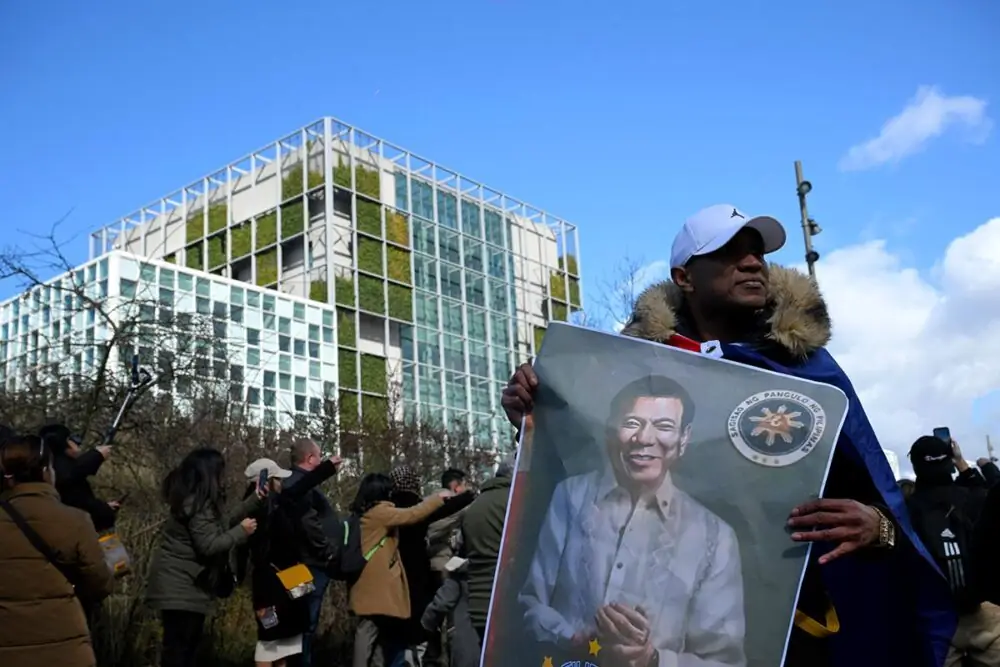

Former president Rodrigo Duterte has asked the International Criminal Court to excuse him from personally attending the upcoming review of his detention set for Friday, Feb. 27.

In a written waiver submitted to the tribunal by his legal team on Monday, Feb. 23, Duterte said he had been fully briefed on the implications of foregoing his appearance. “My counsel has explained to me the legal consequences emanating from such a waiver and I trust him and my ICC legal team to represent me faithfully,” the document read. He also stated, “I do not wish to follow this hearing from outside the courtroom through the use of communications technology.”
The session is scheduled for 2 p.m. in The Hague, or 9 p.m. in Manila, and will take place after the conclusion of closing arguments in the confirmation of charges proceedings. Judges of Pre-Trial Chamber I had previously granted his request not to attend the confirmation hearings. Under the court’s procedures, magistrates must reassess a detainee’s status at least once a year. Earlier, the chamber rejected Duterte’s bid for interim release.
As the court proceedings continue, Duterte’s former chief legal counsel, Salvador Panelo, criticized the prosecution’s presentation during the opening of the confirmation hearings. He described the material offered as “speculations, allegation and hearsay” and insisted there was no proof directly linking the former president to wrongdoing.

Speaking over radio dzBB, Panelo said he was content with the arguments put forward by defense lawyer Nicolas Kaufman. He maintained that statements attributed to Duterte in public speeches were overstated rhetoric rather than literal directives. According to Panelo, “Like what the defense explained to you, most of this is hyperbole, and this is the style of president Duterte even when he was a law student, a lawyer when he was young, a fiscal, until he became a mayor. That’s his style of bluster, and he used that to scare the criminals.”
He further argued that this approach was instrumental in curbing illegal drugs. “That’s his style, and this is very effective. That’s why he destroyed the drug syndicates to the minimum. If he didn’t do that, nothing. Unlike now, we have a President who is soft, who doesn’t talk. If he talks, nothing. He has no courage. That’s why the drug syndicates return,” Panelo claimed.
Panelo also reiterated his stance that the ICC lacks authority over Duterte, pointing to the Philippines’ withdrawal from the Rome Statute. He contended that the tribunal has yet to issue a conclusive ruling on jurisdiction, and disputed its position that the country retains residual obligations for acts allegedly committed before withdrawal.
He argued that the ICC may only step in when a state is unable or unwilling to prosecute grave crimes. “All member-states will only have a chance to allow the ICC to enter if they are unable to punish those who commit crimes against humanity, genocide, war crimes and war of aggression. They cannot prove that because the Philippines, in our country, has the capacity to put two presidents and two senators in jail,” he said. “Now, there is a senator who is in jail. We ousted a president because of the crimes they committed against the country. We have detained thousands of people,” he added.
