



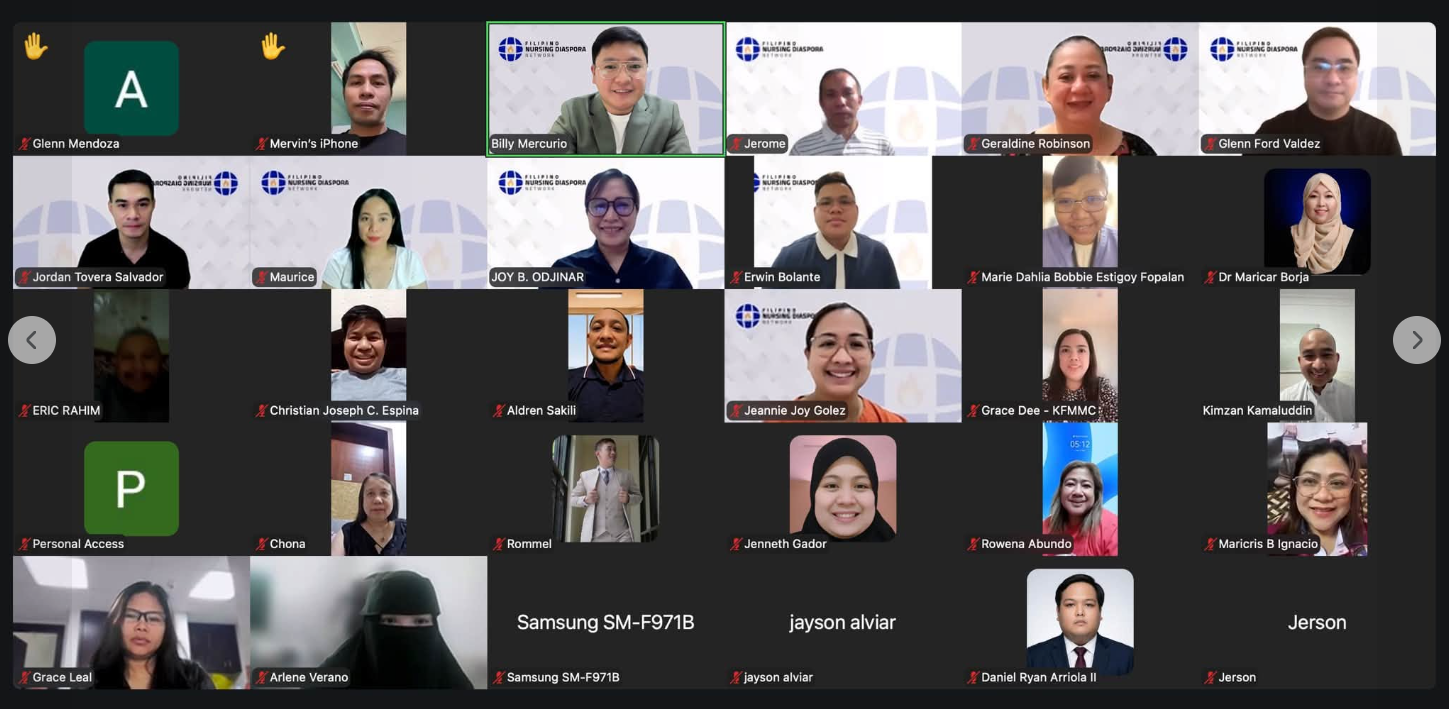

From Riyadh and Jeddah to Al Khobar, Al Ahsa, and the Kingdom’s southern regions, Filipino nurses came together with a common purpose on 25 September 2026: to move beyond professional connection toward collective action.

Held virtually via Zoom, the 2nd Filipino Nursing Diaspora (FiND) Network Kingdom of Saudi Arabia National Roundtable Meetingbrought together an impressive cross-section of Filipino nurses working in clinical practice, education, research, nursing administration, quality and patient safety, professional development and healthcare leadership.
The gathering demonstrated both the depth of Filipino nursing expertise in Saudi Arabia and a growing appetite for a stronger professional platform through which that expertise can be connected, shared and mobilized.
For Mr. Billy Mercurio, FiND KSA Country Representative, the meeting was fundamentally about unity.
“Our strength lies in our unity,” Mercurio told participants. “We are no longer individuals working in different hospitals or cities. We are a collective force.”
Under the guiding idea of “One Global Community, One Nursing Voice, Boundless Impact,” Mercurio challenged colleagues to connect, align, and support one another. Whether a nurse had been in the Kingdom for six months or two decades, he emphasized that every journey and every voice mattered.
That message was reinforced by Ms. Irene Mayo, FiND Director for Engagement, whose connection with Saudi Arabia is deeply personal. Born and raised in Al Khobar/Dhahran, Mayo recalled witnessing Filipino workers—including nurses—building lives in the Kingdom while supporting families in the Philippines.
She described the participants as a “powerhouse” but posed an important challenge: How can such an extraordinary concentration of experience be transformed into meaningful and sustainable action?
“There is enormous strength in our community,” Mayo said, “but we know that connection alone is not enough. We need collective action.”
She encouraged FiND KSA to build opportunities around education and professional development, mentorship and leadership, research collaboration and support for future generations of Filipino nurses working internationally.
Providing the broader global context, Dr. Jerome Babate, Executive Director of the FiND Network, presented an overview of the organization and its current thrusts. He traced FiND’s beginnings to a 2018 gathering of Filipino nurse leaders in Sydney—including Dr. Jordan Salvador, who represented Saudi Arabia—and described how those early conversations eventually developed into an international network.
“Behind every Filipino nurse working abroad is a story of courage,” Babate said. “FiND exists to connect those stories and turn individual experience into a stronger collective voice.”
He highlighted the Network’s work in peer support, professional learning, research, international symposia, webinars, policy engagement and leadership development. He also stressed a larger aspiration: Filipino nurses should increasingly be heard not only as members of the workforce but as leaders and contributors wherever they practice.
The Saudi roundtable gave that ambition practical expression. Mercurio outlined proposals for a responsive FiND KSA structure across the Kingdom’s northern, central, southern, western and eastern regions, creating local points of connection for Filipino nurses regardless of geographic location. He also discussed professional advocacy, peer support, community health activities and plans to increase Filipino nurses’ visibility as clinicians, researchers, educators and thought leaders.
Yet some of the meeting’s most compelling moments came directly from participants themselves.
Erwin Garcia Bolante, a nursing excellence leader in the western region, saw FiND as a vehicle for knowledge exchange between Saudi Arabia and the Philippines. “There’s a lot of opportunities,” he observed, particularly through research and seminars that could contribute to nursing practice in both countries. He also renewed his personal commitment to becoming actively involved in FiND KSA.
For Dr. Jordan Salvador, the gathering represented continuity. After 12 years in Saudi Arabia and preparing for his next professional chapter in the United States, he reflected on being part of FiND’s journey and expressed his intention to remain connected: “I’m looking forward…to be active once I’m in the US.” His presence was particularly symbolic given his participation in the 2018 Sydney meeting that helped lay the foundations for FiND Network.

Dr. Maricar Borja, a clinical nurse educator, emphasized professionalcommunity: “My expectation in joining this nursing diaspora is for us to have a stronger nursing community—that we can share our knowledge, create opportunity…[and] have professional advancement in our nursing profession.”
From the southern region, Marie Dahlia Fopalan brought the perspective of a younger nurse interested in research. She hoped not only to learn through FiND but also to “encourage and inspire more nurses from the southern region to join the network,” demonstrating why geographic inclusion matters to a national professional community.
Meanwhile, Eric Rahim Detuyatu, whose Saudi nursing journey spans nearly 25 years from bedside practice through management and training, articulated a mentoring responsibility. He hoped FiND would become “a platform for all of us nurses to contribute to each other’s growth” while advancing professional advocacy and helping “mould and mentor new and upcoming nurses.”
The discussion was further enriched by Dr. Benjo Breboneria, who reflected on the rapidly changing Saudi healthcare environment and the professional opportunities available to nurses who are prepared to be proactive. He pointed to the growing emphasis on shared governance, professional governance and professional development across Saudi healthcare institutions. “I think there are opportunities,” he said, challenging Filipino nurses to look beyond their initial bedside roles and intentionally pursue career development, leadership and continuing education.
Similarly, Dr. Maurice Cudal highlighted FiND’s potential to bring together professionals with shared aspirations while creating pathways for collaboration. “What I expect here, of course, [is to] find people who share the same mission with me,” she said, adding that the Network could create opportunities “to connect and impact” through partnerships in training, events and professional development. Her comments underscored the roundtable’s broader message that professional networks become meaningful when relationships lead to concrete collaborative activity.
Together, these voices revealed that Filipino nurses in Saudi Arabia are not a homogeneous workforce. They include bedside clinicians, educators, nurse executives, quality specialists, researchers, project managers and experienced leaders. Their concerns likewise range from professional development and research capacity to leadership opportunities, workforce transition, mentorship and the challenge of translating learning into practice.
Dr. Glenn Ford Valdez, FiND Global Advisor for the Middle East, brought these themes together in his closing message.
Calling the roundtable a “landmark event,” Valdez emphasised resilience but argued that experienced leaders now carry another responsibility: preparing those who will follow them.
“As leaders, we should serve as mentors and advisors to those that will come after us,” he said.
He also identified fragmentation as a challenge and positioned FiND as a potential bridge among existing organisations and professional communities. “It is now high time for us to work together,” he stressed, noting the considerable expertise already present in Saudi Arabia across administration, research, education and training.
The goal, he suggested, is not to compete with existing nursing organisations but to connect expertise and put it to productive use—especially for nurses who will enter the Kingdom in the years ahead.
That may ultimately be the significance of the 2nd FiND KSA National Roundtable.
It was not simply another Zoom meeting. It provided a space where Filipino nurses across regions, institutions, specialties and generations could hear one another, identify shared concerns and begin imagining what they could accomplish collectively.
For decades, Filipino nurses have contributed to Saudi Arabia’s evolving healthcare system. The conversation on 25 September suggested that their next chapter can be about more than contribution through individual practice.
It can also be about visibility, mentorship, research, leadership and collective professional influence.
And as Mercurio reminded the gathering, the opportunity is to “break the silos and build a network that uplifts every Filipino nurse.”
