



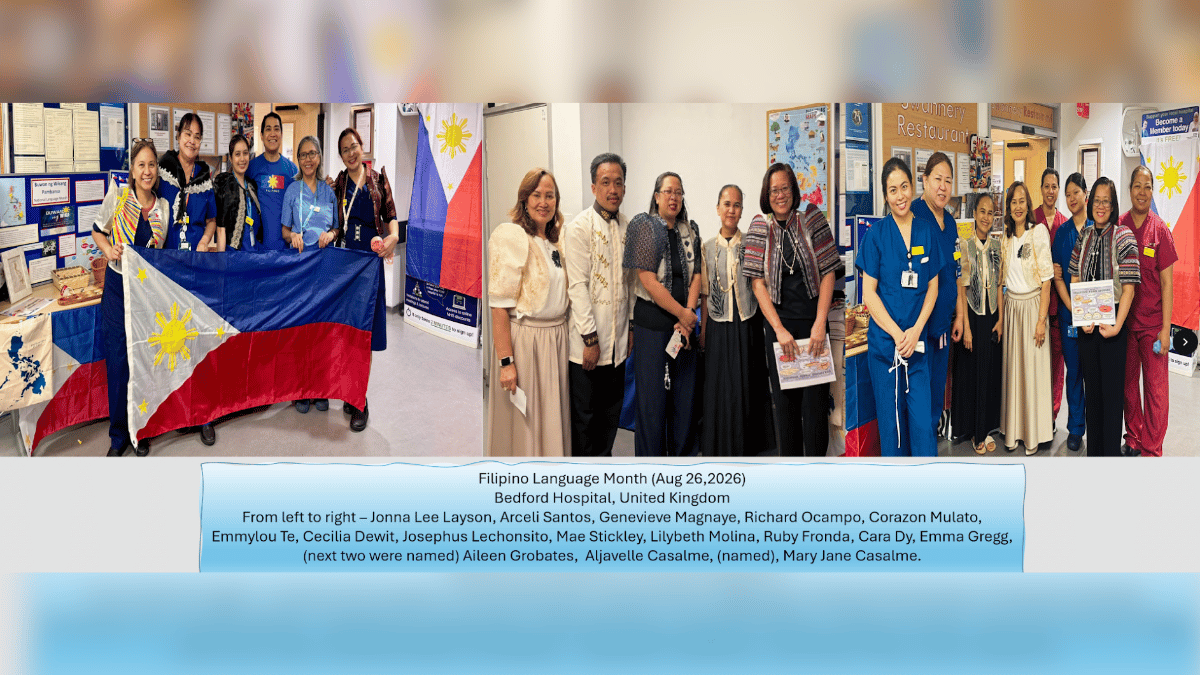

For a few memorable moments at Bedford Hospital, an ordinary hospital corridor felt thousands of kilometres closer to the Philippines.

Filipino healthcare colleagues stood together, hands over their hearts, singing the Philippine national anthem. Staff and visitors passing through stopped to listen. For Filipino nurses who have spent years—and in some cases decades—building careers and lives in the United Kingdom, it was an emotional expression of identity and belonging.
The enthusiastic participation of Filipino nurses in Filipino Language Month at Bedford Hospital became much more than a cultural celebration. Through language, traditional dress, food, games and storytelling, they shared a part of themselves with colleagues while demonstrating that cultural identity can enrich rather than divide a multicultural healthcare workplace.
For Ruby Fronda, Deputy Lead Nurse in Endoscopy at Bedford Hospital, the motivation was straightforward: “Because I am proud to be Filipino.”
Ruby and her husband arrived in England in 2001 as part of a group of Filipino workers recruited from Singapore. Twenty-five years later, Bedford has become home. Yet her connection with the Philippines remains strong.
During the celebration, Ruby and colleagues proudly wore traditional Filipino bolero attire with shell necklaces. They introduced colleagues to coconut bowls and spoons, native bags, the pamaypay or traditional hand fan, and sungka, a traditional Filipino game. Simple Filipino expressions—including “Kumusta?” and “Salamat po”—opened another window into Filipino life.
Food naturally became part of the conversation, from the Philippine national dish to other familiar favourites.
But Ruby believes the significance goes deeper than cultural objects.
“For me, it’s more than sharing our clothes, language, and food,” she said. “It’s about sharing a part of who we are and knowing that people accept us, while appreciating and enjoying our culture, heritage, language and the beautiful things that make us Filipino.”
That sense of belonging resonated with Emma Gregg, who moved from Davao City to the UK in 2002 and made Bedford her home. With more than 25 years of surgical nursing experience, she is now a Theatre Sister at Moorfields Eye Hospital and remains passionate about mentoring overseas nurses beginning their own UK journeys.
For Emma, one moment stood above the rest.
“Hearing my Filipino healthcare colleagues sing the Philippine national anthem in the corridor was such a proud and emotional moment,” she recalled. “For a moment, the corridor felt like home.”
Her experience has also taught her something fundamental about multicultural healthcare: different backgrounds need not prevent people from pursuing a common purpose. “Regardless of our race, culture, or background, we can work together towards a common goal,” she said. “In healthcare, that goal is simple yet meaningful: to provide the best possible care to our patients.”
For Emmylou Te, an Endoscopy Team Leader who has served at Bedford Hospital for almost 25 years after previously working in intensive care, Filipino culture is visible not only during celebrations but in everyday teamwork.
She describes Filipino colleagues as friendly, hardworking and resilient—qualities that help teams support one another through difficult shifts. She is particularly proud to share Filipino values of respect, care and hospitality.

“These are deeply important in Filipino culture and also reflect the way we care for our patients,” she explained. For Emmylou, making patients feel welcome, comfortable and valued is therefore both professional practice and an expression of cultural values.
And, of course, cultural exchange sometimes arrives through food: pancit, adobo and her homemade ube cake have all helped introduce colleagues to Filipino culture.
Lilybeth Molina, a registered nurse whose career has taken her from the Philippines to the Middle East and then the UK, sees an even stronger connection between Filipino identity and nursing. Now a Staff Nurse in Trauma and Orthopaedics Outpatient at Bedford Hospital, she identifies malasakit, pakikisama, hospitality, respect and bayanihan as foundations of how she approaches patients and colleagues.
As a union activist, Lilybeth has also learned the value of organising cultural activities. Filipino Language Month, for her, offered an opportunity to bring kabayans together and strengthen community bonds.
Her message to Filipino nurses worldwide is to “stay grounded in the core values that we are brought up with,” even when celebrating heritage overseas requires determination, time and persistence.
That balance between remembering home and embracing another society is perhaps best captured by Feral Vincent Quitlong, a Filipino registered nurse with more than eight years of UK experience who currently works in critical care.
“Be proudly Filipino, but never stop being willing to learn,” Feral Vincent said.
“We don’t have to choose between holding on to our heritage and embracing the culture of the communities we now live and work in.”
It is a powerful observation. Migration does not necessarily require leaving one identity behind to acquire another. As Feral Vincent puts it, “Our identity isn’t diminished when we embrace another culture. It becomes richer.”
Filipino Language Month at Bedford Hospital therefore celebrated far more than words.
The bolero, pamaypay, sungka, Filipino food and familiar phrases provided visible expressions of heritage. But underneath them were deeper values that Filipino nurses have carried across continents: compassion, hospitality, resilience, respect, community and malasakit.
These nurses have spent years caring for people far from the country where their own journeys began. They have adapted to another healthcare system, worked alongside people from many cultures and built meaningful lives in Britain without relinquishing the identity that shaped them.
As Feral Vincent reflected: “Wherever we are in the world, let us remember where we came from, respect where we are, and contribute something meaningful to where we are going.”
For one celebration at Bedford Hospital, that philosophy came vividly to life. And when Filipino voices filled a hospital corridor with the national anthem, home did not seem quite so far away.
