



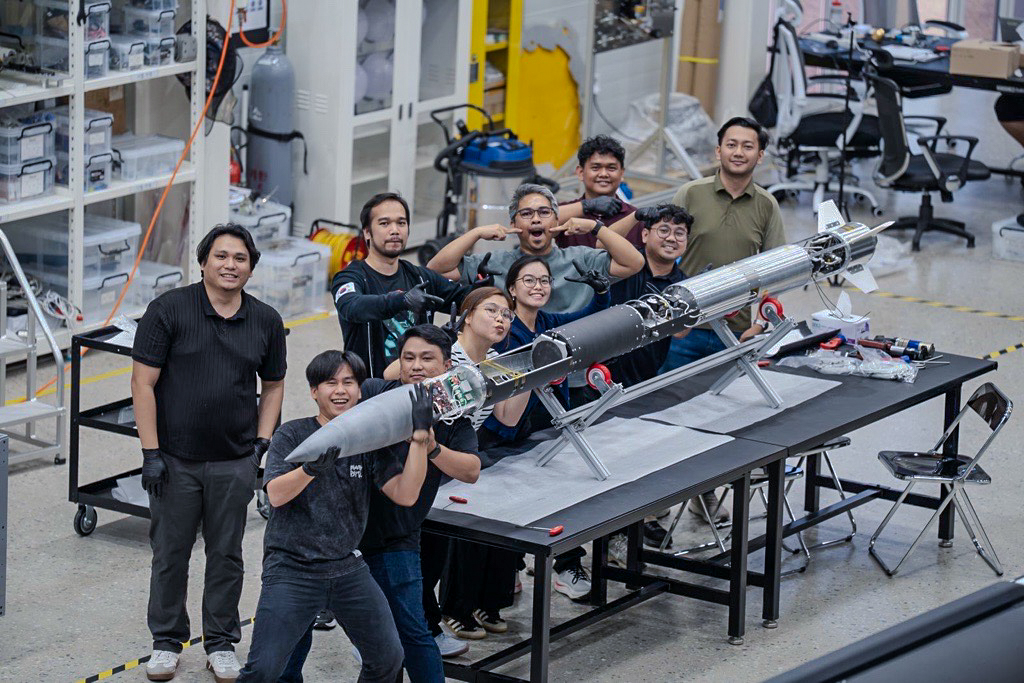

A liquid-fueled sounding rocket now being put together by Filipino engineers in South Korea will be shipped home for further testing before it lifts off from the Cagayan North International Airport in Lal-lo next year, the Philippine Space Agency (PhilSA) said, as reported by GMA News.

The agency said the airport already has the infrastructure needed to support the launch, where the rocket is expected to carry a small, locally made payload to an altitude of at least five kilometers.
“The liquid-fueled sounding rocket the PhilSA team built during the training will be shipped to the Philippines and undergo further testing in preparation for the launch next year, during which it will carry a locally developed payload around two kilograms to an altitude of at least five kilometers,” PhilSA said.
For PhilSA head Gay Jane Perez, the 2027 flight is as much a test of the country’s readiness as it is of the hardware.
“A successful liquid-fueled sounding rocket test launch in 2027 will demonstrate that we have the technical, operational, safety, and regulatory foundations for future launches from the Philippines, and potentially attract foreign investments from private aerospace companies,” Perez said.
The rocket is based on the Blue Whale 0.1 (BW0.1), a liquid-propellant sounding rocket platform designed by South Korean space mobility firm Perigee Aerospace Inc., which has been working with PhilSA since 2022. Ten PhilSA personnel started training with the company in August, and the program is scheduled to wrap up in October 2026.

“The ongoing training provides PhilSA personnel with hands-on experience in rocket assembly and systems integration, testing, operational procedures, and preparations for the planned test launch,” the agency said in a press release.
PhilSA said the program is meant to build local know-how in rocket systems, launch operations and safety procedures, along with the support work that goes into a launch. The team’s coverage extends beyond assembly and testing in Korea to the preparations and actual operations during the Cagayan test flight.
On the ground in Cagayan, site work is being carried out to keep surrounding areas safe. PhilSA said it has been holding consultations with the Cagayan Economic Zone Authority (CEZA), the local government and residents of nearby communities. Connectivity and logistics for the launch are being handled by the Department of Information and Communications Technology and Ascend International Gateway, a Philippine company that operates and manages airports.
The test flight was first flagged by President Ferdinand Marcos Jr. in his fifth State of the Nation Address, where he called Cagayan a “geographically and economically primed” location that could become the country’s gateway to space.
Perez said building up the country’s own launch capability would reduce its reliance on others when putting satellites into orbit.
“Progressively developing our domestic launch capabilities will allow greater flexibility and independence in sending satellites into space, which serves the country’s key sectors such as security, telecommunications, and agriculture,” Perez said.
