




A ship captain with close to three decades at sea has welcomed the government’s newly signed blueprint for Filipino seafarers, saying it gives equal weight to their welfare and to the country’s standing in international shipping.

“I really appreciate our government for helping us, Filipino seafarers and our families. Nakikita naman namin ‘yung balance sa seafarers’ protection and in helping us sustain global competitiveness,” said Captain Henry Lumahang, who has worked as a seafarer for nearly 28 years.
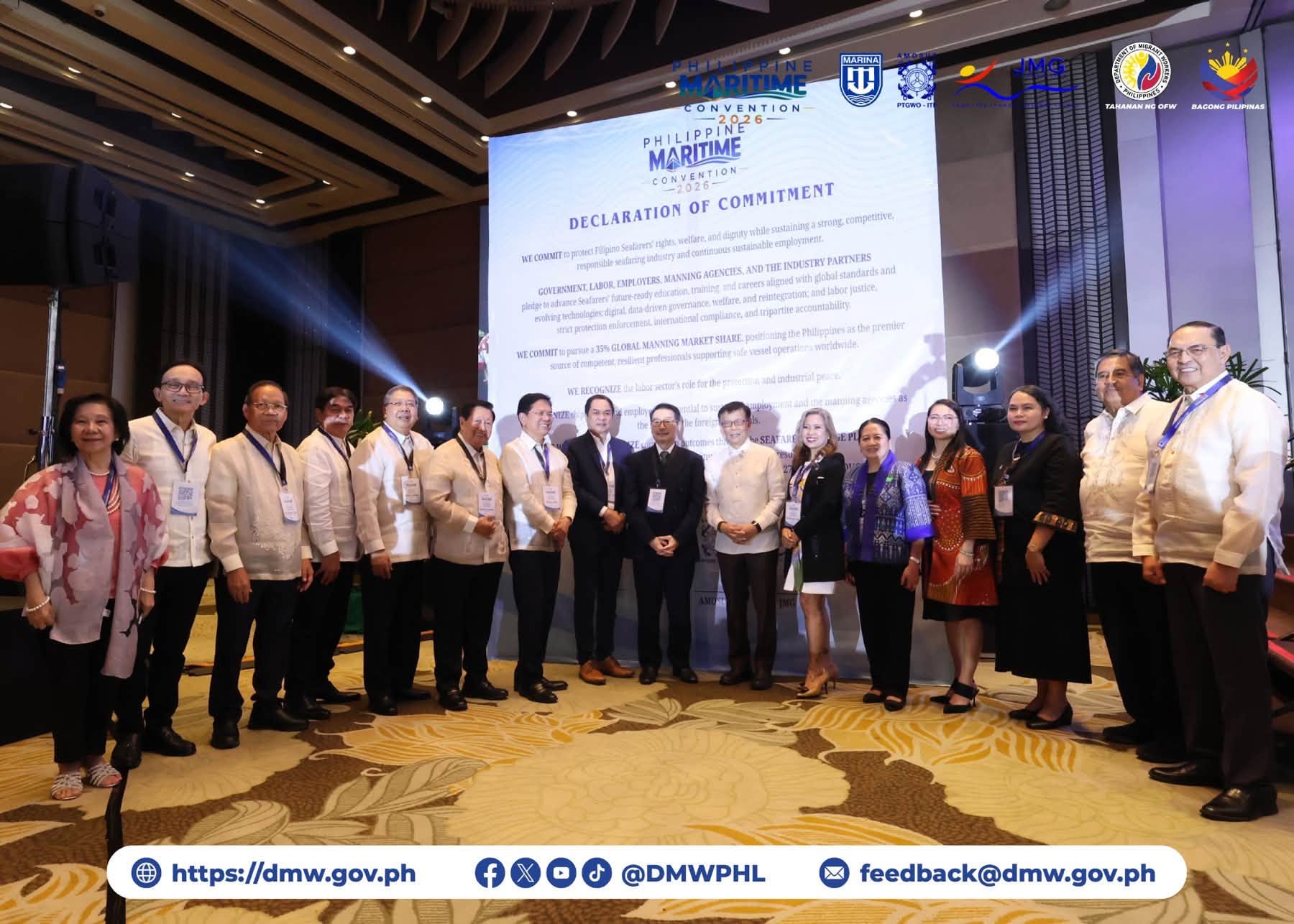
Lumahang was referring to the Seafarers’ Voyage Plan 2030, which government agencies, labor and industry groups formally backed on September 23 by signing a Joint Declaration of Commitment at the Philippine Maritime Convention 2026. Signatories included the Department of Migrant Workers (DMW), the Maritime Industry Authority (MARINA), the Associated Marine Officers’ and Seamen’s Union of the Philippines (AMOSUP), and the Joint Manning Group (JMG), along with other players in the sector.
On the legal front, the plan calls for tougher enforcement of the Magna Carta of Filipino Seafarers and closer regulatory compliance. It also seeks better systems for handling crises and bringing seafarers home, access to labor justice, and tighter coordination both among government agencies and among government, workers, and employers.
Welfare commitments center on a full-cycle national reintegration program built around Kalinga, Kaalaman, at Kabuhayan. The plan also promises improved welfare services, greater use of data in delivering them, and stronger monitoring.

Training and career development make up another major component. Commitments include an overhaul of maritime education and training, more opportunities for onboard training, preparation for skills the industry will need in the coming years, digital delivery of maritime services, and clearer paths for career advancement.
These measures fall under four pillars: protecting seafarers, securing future-ready competence, delivering with accountability, and sustaining the seafaring industry.
“Today, we present a structured, focused roadmap to translate the high-level policy directions and consensus from the Philippine Maritime Convention 2026 into tangible, time-bound deliverables for Filipino seafarers,” DMW Undersecretary Felicitas Q. Bay said.
Under the plan, the government is aiming for Filipinos to fill 35 percent of the global seafarer manning market by 2030.
