



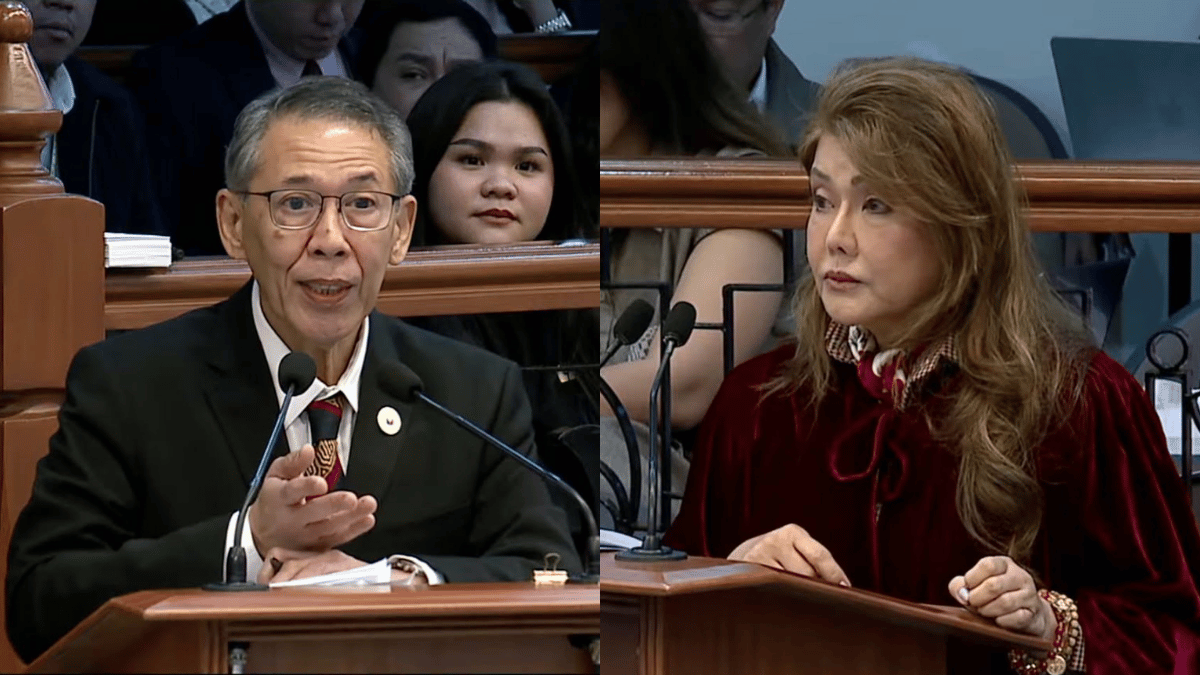

The value of calling a retired anti-graft magistrate to the witness stand became an early flashpoint Monday, September 14, when the Senate impeachment court opened its examination of the unexplained-wealth allegations against Vice President Sara Duterte and one senator-judge pressed the prosecution to justify the choice.

Retired Sandiganbayan Presiding Justice Amparo Cabotaje-Tang was fielded by the House panel as its first witness for Article II, the section of the complaint dealing with wealth that prosecutors say cannot be squared with the Vice President’s lawful earnings. Rather than speak to specific records or transactions, she was brought in to lay out the governing principles behind public accountability rules.
Senator-judge Imee Marcos took issue with that arrangement. “Nagtataka ako kung bakit narito ang ating testigo pagkat hindi naman siya magkukumpirma ng mga dokumento at wala namang maidudulot na tulong tungkol sa mga facts. Will she testify to matters and questions of fact or identify documents specifically?” she asked.
House prosecutor and Akbayan Rep. Chel Diokno pushed back on the premise that the testimony served no purpose. “She will not be speaking about any of the facts or documents that will be presented, she’s merely being presented to provide a legal framework to the court and to the Filipino people from whom the funds in question emanate,” he said. Diokno tied the point to the broader stakes of the proceedings, arguing that broadcasting the trial means little if the public cannot follow the legal standards being applied.
Marcos was not alone in her skepticism. Senator-judges Erwin Tulfo raised similar doubts, per Manila Bulletin and Rappler reporting, over whether the court needed a primer from a witness who would cite none of the case evidence. On the defense side, lawyer Mark Vinluan moved to keep Cabotaje-Tang off the stand entirely, calling her a “surprise witness” whose late entry was procedurally improper and an intrusion on Duterte’s rights. The Manila Times reported that Vinluan also drew a distinction between the Sandiganbayan and the Supreme Court, noting that rulings from the former can still be reviewed or overturned by the latter.

Not every senator-judge shared the reservations. Senate President Pro Tempore Vicente Sotto III backed hearing her out, telling the chamber that the impeachment court is sui generis and that the session could serve an educational function, according to Rappler. He suggested the bench could settle any lingering disagreement through a caucus or a vote. Senator-judge Risa Hontiveros likewise saw merit in drawing on a former Sandiganbayan justice’s expertise, noting the defense would get its turn to test her on cross-examination.
Presiding Officer Francis Escudero ultimately let the testimony proceed, subject to cross-examination. He held that there was no need to formally certify Cabotaje-Tang as an expert, since nothing she offered would bind the court. “Although she may be qualified as an expert, subject to cross, whatever Justice Cabotaje-Tang will say is not binding on the court, and her opinion is not conclusive upon the courts,” Escudero said, adding that she could speak to general legal doctrine but not to the particular facts surrounding Duterte. He also pointed out that the prosecution’s pre-trial brief had reserved slots for unnamed witnesses.
Once cleared, Cabotaje-Tang walked the court through the standards at the heart of the case. Asked whether a sitting president or vice president may simply engage in business while in office, she answered, “Hindi po,” pointing to the prohibition in Article VII, Section 13 of the Constitution. Citing Republic Act 6713, she said cash on hand and cash in bank have to be itemized in an official’s Statement of Assets, Liabilities, and Net Worth, and rejected the practice of folding different asset categories together. A spouse’s assets, she added, generally belong in the SALN as well unless a prenuptial agreement fully separates the couple’s property.
The dispute over her testimony consumed roughly the first hour of the day’s proceedings, which mark the start of what prosecutors expect to be a document-heavy phase built around more than 1,800 financial records. Rappler reported that Cabotaje-Tang offered one qualifier favorable to the defense position: in her view, funds pulled out of a bank account almost immediately would not necessarily need to appear in an official’s SALN.
