




The number of votes needed to remove Vice President Sara Duterte from office will soon be examined by outside legal minds, after the Senate impeachment court moved to bring in constitutional authorities to break a looming stalemate tied to four missing senators.

Reginald Tongol, who speaks for the impeachment court, said retired magistrates and constitutional scholars are being lined up for the task. He explained that no current Supreme Court justice can weigh in, since the dispute over the voting figure is likely headed to the High Court itself. A minimum of three specialists will receive invitations, Tongol said, though he cautioned that no arrangement has been locked in.
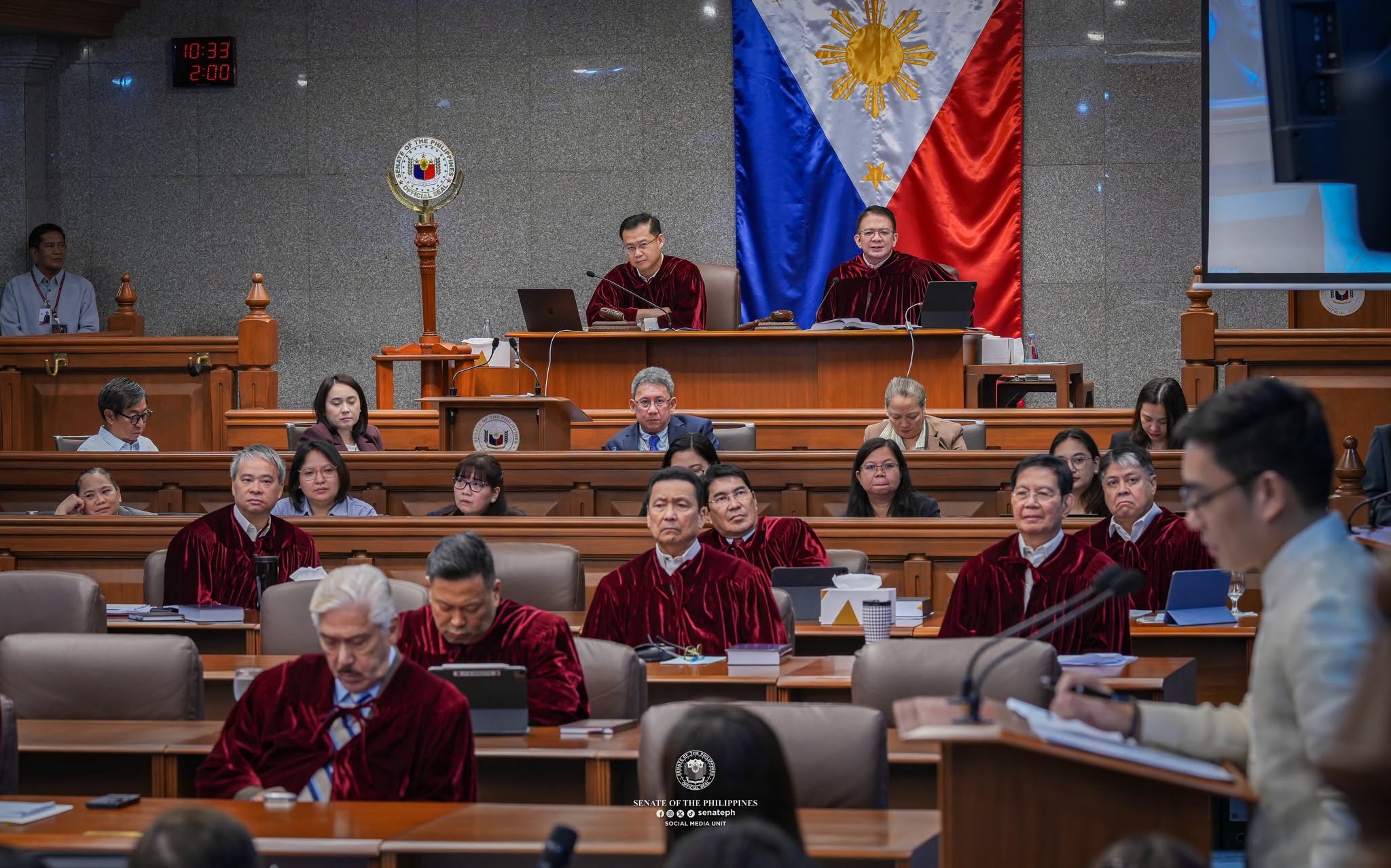
The plan traces back to a challenge lodged by Sen. Erwin Tulfo, who contested a ruling handed down by presiding officer Francis Escudero on the trial’s opening day in July. Escudero had pegged the bar for conviction at 16 votes, computed against the Senate’s complete roster of 24. Announcing the shift on Tuesday, September 8, Escudero told the court the matter warranted outside counsel.
“Given the sensitive and serious nature of this issue and topic, as discussed earlier with counsels for the parties and the senator-judges, we will be enlisting the opinion and assistance of amici curiae, or friends of the court so to speak, in order to give their opinion with respect to this issue,” Escudero said.
In laying out his objection, Tulfo asked whether the charter’s reference to “all members” must be read as a rigid 24, even when four lawmakers sit outside the Senate’s power to compel their attendance. He drew on the 1949 case Avelino versus Cuenco, the ruling the chamber turns to when fixing a quorum, which counts only those members actually able to show up.
“If we insist that the voting base is fixed at 24, regardless of the evidence presented, regardless of the vote of the senators who are able to listen to the testimonies, the absence of those senators, whether we like it or not, will result in an acquittal by default,” Tulfo argued.
Two of the four missing senators, Jinggoy Estrada and Rodante Marcoleta, are in detention on plunder charges. Ronald dela Rosa has gone into hiding, and Loren Legarda remains overseas on a lengthy medical leave.
Beyond the vote count, Tongol pointed to a second knot the experts must untangle: how to treat the absent lawmakers under the law, and in particular whether senators detained and suspended under the anti-plunder statute should still figure into the chamber’s total.

Tulfo’s invocation of the Avelino precedent drew Sen. Pia Cayetano to the floor, where she revisited the June 3 gathering she described as a “rump session.” At that meeting, a 12-member bloc aligned with current Senate President Sherwin Gatchalian removed her brother, Alan Peter Cayetano, as Senate president following his refusal to attend sessions. Speaking in place of her brother, now the Minority Leader and absent from Tuesday’s hearing, Pia disputed the notion that the chamber has treated Avelino as settled doctrine.
“It was said that this body has consistently relied on the Avelino v Cuenco. That’s not accurate. These 12 members used the Avelino v Cuenco for their own purposes to declare there was a quorum. The now-minority does not agree to that. Let’s not make it appear it’s the rule of the Senate,” Pia said.
The senator-judges themselves split on how to read the constitutional language. Sen. Joel Villanueva maintained that the text plainly requires 16 of the full 24 to convict.
“This is very clear to me: ‘No person shall be convicted without the concurrence of two-thirds of all the members of the Senate.’ I thought that is non-debatable. But now that there is an appeal, which I totally understand,” Villanueva said.
Sen. Robin Padilla, an outspoken backer of Duterte, likewise held that the 1987 Constitution leaves no doubt about the 16-of-24 formula. Sen. Bam Aquino cast the dispute in narrower terms, saying it turns not on Duterte’s guilt or innocence but strictly on the threshold. Sen. Francis Pangilinan, meanwhile, framed the debate as one of separation of powers among the judiciary, the legislature, and the impeachment court, urging his colleagues to honor the Sandiganbayan’s authority over Estrada and Marcoleta.
The defense signaled it would tread carefully. Lead counsel Sheila Sison told the court that any role Duterte’s team plays in the arguments over Tulfo’s motion would be taken purely as a precaution.
“We would just like to put on record that whatever participation that the respondent and the defense would have on any oral argument or on any debate or proceeding relating to the matter taken up by honorable Sen. Erwin Tulfo in his motion, which the presiding officer had taken to be an appeal of his ruling on July 6th, would be only out of abundant caution, and without prejudice to any remedy that the respondent through her defense team would avail,” Sison said.
Tongol also allowed that the invited experts could well recommend the Senate defer the whole question to the Supreme Court, calling that a real possibility while noting the panel’s views would carry significant weight with the senator-judges. The court has set September 16 aside for a full day with the resource persons, with the regular proceedings paused; oral arguments from both panels follow on September 23, and Escudero said the vote on whether to uphold or reverse his ruling will come right after.
