



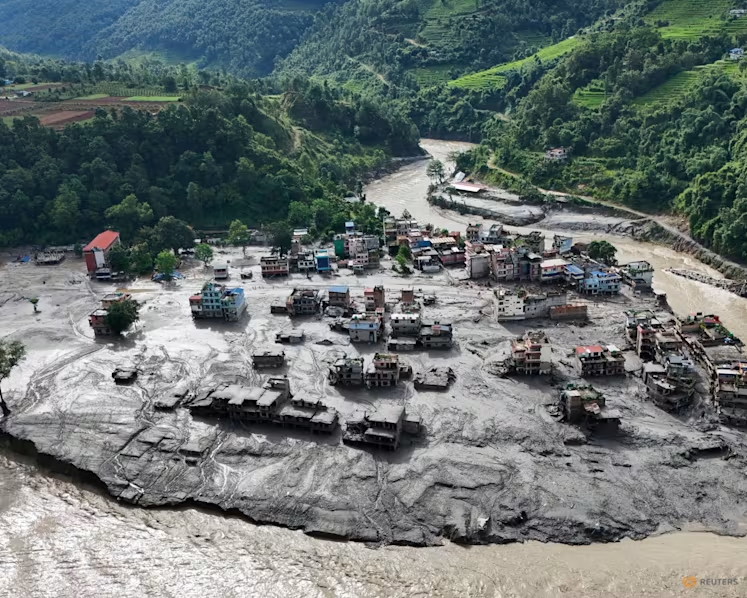

As of this writing, here are the latest updates following the catastrophic glacial collapse of August 26, 2026, that sent a wall of ice, mud, and rock tearing through the volatile Lhende Khola river system along the Nepal-Tibet border. As of Sunday, August 31, 2026, the combined death toll has risen to at least 750 across Nepal and Tibet, with more than 3,000 people still missing beneath the debris. Rescue teams are still clawing through obliterated infrastructure, and the tragedy has drawn in families across dozens of countries while sounding an alarm over the rapidly destabilizing ice systems of one of the world’s most densely populated mountain regions.

Glacier collapse near Langtang Lirung
The Himalayas have long been romanticized as the timeless, immovable spine of our world—a majestic sanctuary where the earth touches the heavens. But on the morning of August 26, 2026, that illusion shattered. Near the Langtang Lirung peak, along the high-altitude border dividing Nepal and the Tibet Autonomous Region of China, a large section of a mountain glacier suffered a catastrophic collapse from an elevation of roughly 5,200 to 5,400 meters. The collapsed mass sent pulverized ice, rock, and sediment down the valley. The U.S. Geological Survey has said the reported 5.2-magnitude tremor was not an earthquake that triggered the collapse, but rather seismic energy generated by the collapse itself—a correction worth noting, since early accounts had the causation reversed. Chinese officials said the avalanche of ice and rock took just six to seven minutes to reach Gyirong Port.
A cascading disaster
What followed was not a mere natural disaster; it was a glimpse into a future distorted by a warming climate. The ice-rock avalanche blocked the Lhende Khola, ponding the river behind a temporary dam of ice and debris. When that blockage failed, the stored water released in a single surge, unleashing a torrent of mud and debris down the Lhende, into the Bhote Koshi, and on into the Trishuli river system. Water levels in the Trishuli reportedly rose by as much as 9 meters (about 30 feet) in just 30 minutes, with destruction reaching at least 62 miles downriver from the border.
The velocity caught thousands unaware. The Gyirong Port complex, a vital economic gateway for trade and tourism between China and Nepal, was heavily damaged. Downstream settlements across Nepal’s Rasuwa and Nuwakot districts—including Timure and Syapru Besi—were swallowed by thick layers of mountain sludge that erased homes, snapped bridges, and buried essential infrastructure.
A staggering humanitarian crisis
Behind the aerial footage and ruined landscapes lies a humanitarian crisis that underscores the global nature of this tragedy. In Nepal alone, at least 675 people have been reported dead and roughly 2,500 remain missing, according to the Nepal National Disaster Management Authority; in Tibet’s Gyirong County, the toll has risen to 16 dead. More than 7,500 people have been rescued in Nepal, including well over 200 foreign nationals. Among the missing are nearly 900 Nepali hydropower workers, hundreds of whom have since been pulled to safety.

Because this transboundary region is a premier destination for trekkers and mountaineers, the disaster struck a diverse international community. Chinese state media reported that a large share of those missing in Tibet were foreigners, and the U.S. State Department has counted about 90 Americans among the missing while confirming the evacuation of several citizens. Reporting has described stranded groups with citizens unaccounted for from Australia, Canada, the United States, the United Kingdom, Singapore, and India, leaving families worldwide caught in a desperate, cross-continental vigil.
A wake-up call
This catastrophe must serve as a wake-up call for climate policy and cross-border cooperation. For decades, glaciologists and mountain communities have warned that the Hindu Kush Himalaya glaciers are melting at an accelerating rate. As warming continues, these frozen giants become structurally unstable: driven upward by tectonic uplift, the glaciers grow steeper and more fragile, while rising temperatures weaken them from within. This is the second time in 14 months that the same river system has flooded—in July 2025, a glacial outburst down the Lhende destroyed the recently rebuilt Nepal-China friendship bridge at Rasuwagadhi and killed more than a dozen people.
The friction of border politics
The aftermath also exposes the friction of border politics. A newly formed barrier lake north of the border—which authorities had warned held roughly two million cubic meters of water—has since overflowed and begun discharging; officials said Sunday the situation was stable and a complete breach appeared unlikely. Even so, rescue operations have been slowed by geopolitical communication gaps and the slow release of official information from Tibet. When nature strikes with transboundary fury, a fractured human response only compounds the tragedy. Emergency personnel wading through deep sediment are fighting an uphill battle if nations cannot share real-time satellite data and risk assessments.
The consequences of delayed action
We can no longer treat the collapse of our cryosphere as a distant vulnerability. The devastating event on the Nepal-Tibet border demonstrates that the consequences of delayed climate action can wash away entire communities, claim hundreds of lives, and reverberate across oceans. The United States has pledged $3.6 million in humanitarian assistance, but the mountains are speaking in a language of violent torrents and shattered ice. It is time for the world to stop romanticizing the peaks and start listening to their warnings.
