



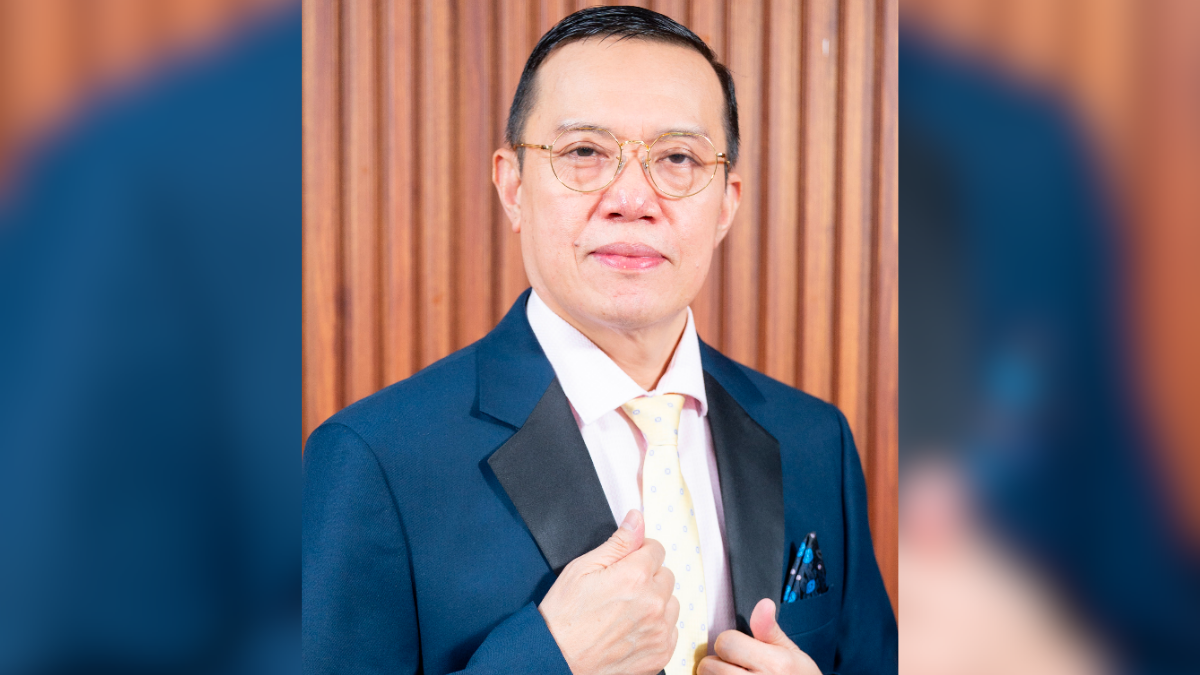

Most overseas Filipino workers will tell you the same quiet truth: the money comes, the money goes, and after years abroad, the bank account looks roughly the same as it did on day one. The remittance lands, the family back home is fed, the bills are paid — and the worker remains a worker. Salimar M. Salomabao has spent more than three decades trying to break that cycle, and he is convinced the problem was never a lack of earnings. It was a lack of mindset.

As Senior Assistant Vice President and Region Head of the Middle East for the Philippine National Bank, Salimar oversees the bank’s footprint from Riyadh to Dubai to the emerging corridors of Muscat and Manama. But he resists the language of transaction volumes and earnings reports. To him, the real ledger is human. “Community service is the highest form of banking,” Salimar shares with TGFM. “It is the investment that yields the most meaningful dividends: the success and dignity of my people.”
Where the calm comes from
To understand the banker, you have to start in Lanao del Sur. Salimar grew up in Tamparan, in the heart of Lanao, in a community he describes as defined by resilience under pressure. That upbringing, he says, gave him something no finance degree could.
“My upbringing taught me that resilience is rooted in our faith and our deep connection to our ancestral lands,” the Maranao executive explains. “This perspective allows me to remain calm and grounded when navigating complex challenges.” His roots, he adds, function as a moral compass — a reminder that even while he operates in a modern, digital world, his strength comes from the history and values of the people of Lanao del Sur.
That sense of place would later collide with ambition. When Salimar left for Saudi Arabia and eventually the UAE, it was not simply for a paycheck. He wanted to understand how global capital actually moved — how Islamic finance worked at a sovereign level, how sophisticated markets spoke to one another. There was also something to prove. He wanted to show, in his words, that “a Filipino-Maranao professional could excel in the most competitive international environments, breaking barriers and representing our culture on a global stage.”
His path ran through two of the region’s banking giants. Salimar began at Al Rajhi Bank as a senior marketing officer, then moved in 2001 to Arab National Bank, where he spent sixteen years as a remittance manager — overseeing the flow of capital for thousands of expatriate workers. In 2017, he joined PNB. The work, he is quick to note, was never glamorous. But every transfer carried weight: a child’s tuition, a small business, a family’s shot at a dignified future.
The trap of the hero

Ask the region head what holds OFWs back, and he does not hesitate. The enemy is lifestyle inflation, fueled by the crushing pressure to be the family hero. Salimar sees it splinter into two traps — the remittance trap, where nearly every dirham earned vanishes into consumption back home, and the status trap, where workers spend on visible markers of success while their actual net worth flatlines.
His prescription is blunt and memorable. “Pay yourself first, then build a business, not just a house,” Salimar advises. Set aside a fixed percentage — even ten percent — before sending a single peso home. “You cannot pour from an empty cup,” he says. “If you don’t secure your own future, you will eventually become a burden to the very people you are trying to help.” A house is a home, he points out, but it is not an investment unless it earns. The goal, as he frames it, is to make the journey home a choice rather than a necessity — to stop being a temporary worker and start becoming a permanent provider.
It is a philosophy Salimar has watched transform a life. He recalls a young, highly educated Filipino trapped in an underemployed service role in the UAE, drowning in high-interest debt and convinced his time abroad was a dead end. The banker did not just point him toward a job; he sat down and mapped out the man’s debts, then helped him pivot into work that matched his real skills. Two years later, the man returned — debt-free, running a poultry business for his parents in Mindanao, and mentoring other Filipinos to do the same. “I didn’t give you anything,” Salimar told him. “You simply reclaimed the value you already possessed.”
The honor he won’t outgrow
For a man operating at the top of international finance, the pull back toward community is non-negotiable. Salimar frames it through Maratabat — a Maranao concept often mistaken for mere pride, but which he insists is really about honor, dignity, and social responsibility. “My success is not mine alone; it belongs to my people,” he says. “If I rise, I have a duty to pull others up with me.”
The Maranao banker serves as an adviser to his community in the UAE, and says his office door stays open — for a contract dispute, a business question, or simply someone feeling lost. He worries about a generation of professionals who climb the corporate ladder only to become rootless. Staying connected, Salimar argues, is how Filipinos hold on to faith, family, and identity even as they compete for the highest seats at the table.
That, ultimately, is the legacy he is reaching for: a shift in the Filipino narrative from survival to sovereignty. Salimar wants the next generation to see working abroad not as permanent exile but as a strategic chapter — a period of building wealth, not just surviving it. His message to them is the same one his own life has tried to prove. “Do not just work for a salary; work for your freedom,” he says. “You are not just ‘workers’ — you are the architects of the Philippines’ future.”
