



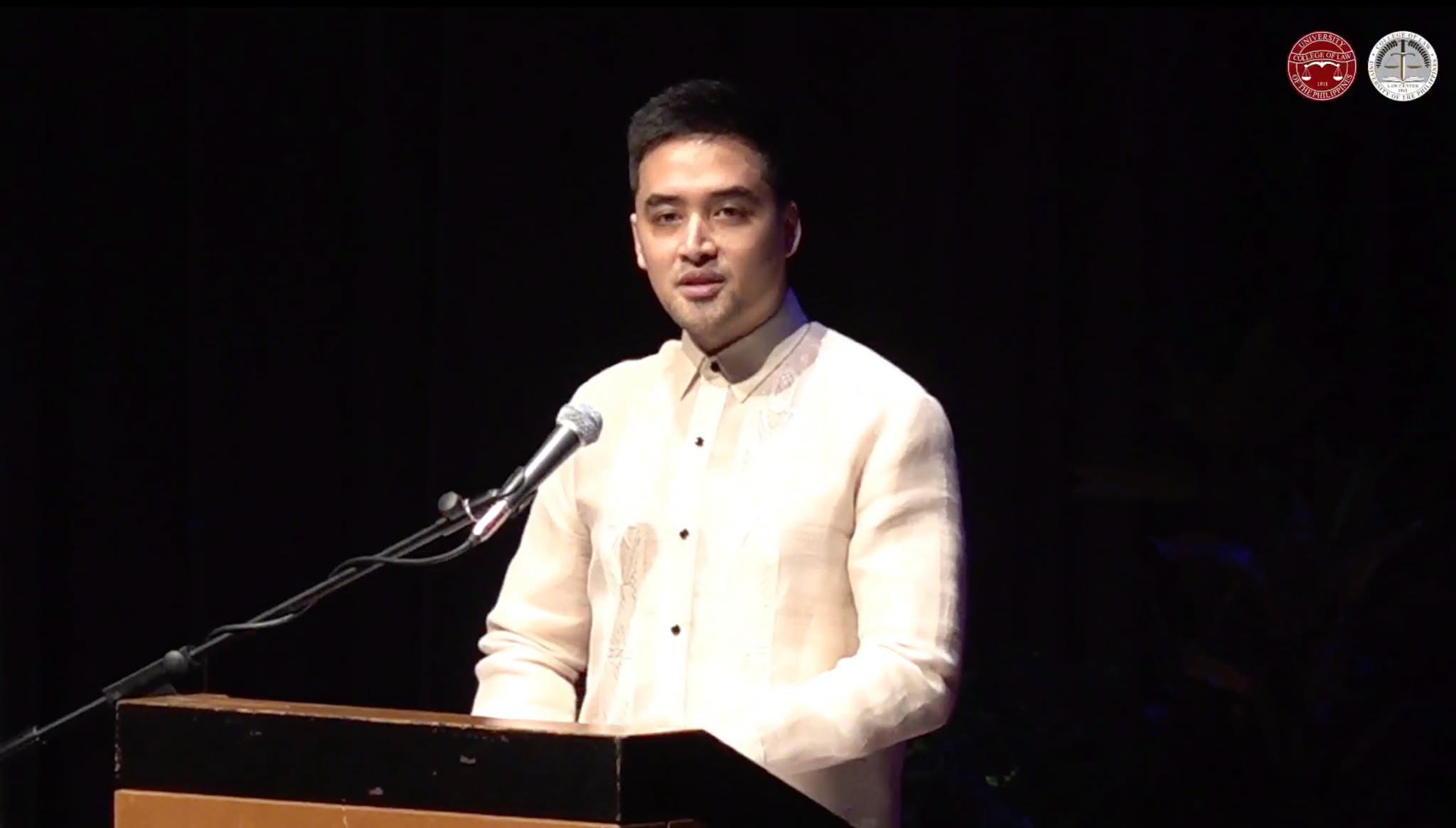

For the 298 lawyers who received their degrees from the University of the Philippines College of Law on Saturday, Pasig City Mayor Vico Sotto had a warning wrapped in encouragement: nobody is coming to fix the nation for them.

Serving as guest of honor at the commencement rites in Quezon City, Sotto told the Class of 2026 that the pace of national reform now depends on whether they, as the country’s next set of leaders, refuse to bend when tested.
“There will be no savior of our nation. How fast we go will depend on you — the incoming generation of leaders and changemakers,” he said.
Much of his message drew on a candor rarely offered at graduation ceremonies. Sotto admitted that the daily grind of pushing reforms inside government has worn him down, and that despair is a familiar companion.
“As someone who has been trying to fight for positive reforms and changes in our government, I have to admit to you that many times, I feel frustrated almost every day… I feel a lack of hope. Parang ang hirap namang sabihin hopeless, but standing here… looking at your glowing faces, looking at the Class of 2026… I feel hopeful again. I feel a resurgence of hope in my heart.”
What restored that hope, he said, was watching a generation that refuses to look away. He pointed to the graduates’ online outrage and their attempts at anti-corruption demonstrations as evidence they had not gone numb.
“I’ve seen some of your angry posts on social media. I’ve heard that many of you have attempted anti-corruption rallies, and part of the reason why I’m hopeful for our country… is that I know that you care and that you are not apathetic,” he said.
Before urging them to remake society, though, Sotto pressed the graduates to look inward. Indignation online, he cautioned, means little when paired with private dishonesty.
“Sa Facebook, galit tayo sa corrupt, pero kapag may exam tayo nandaraya tayo,” he said.
The temptations ahead, he added, would not always announce themselves. Lawyers and professionals could someday find themselves nudged toward bribery, doctored records, manipulated financial statements, or the spread of falsehoods.
“Wherever life takes you, you will eventually be pressured by others, or tempted by circumstances, into crossing ethical boundaries, compromising your principles and breaking your integrity.”
To illustrate how deeply graft has taken root, Sotto recounted a moment when a contractor approached Pasig with an unsolicited proposal — and got straight to the point about kickbacks.
“Ang tinanong nila sa aking city administrator ay, ‘Magkano ang SOP? Ilang percent ba sa Pasig City?'”
His administrator’s answer, he said, was blunt: “Huwag ninyo kaming tanungin ng ganyan. Zero percent ang SOP namin. Wala kaming ganyan sa Pasig.”

The contractor’s stunned disbelief, Sotto argued, revealed how thoroughly the public has come to expect the worst.
“Ha? Talaga? Zero percent? Totoo pala na walang SOP sa Pasig. Akala namin sa balita lang ‘yun, akala namin sabi-sabi lang ‘yun.”
“Parang nakarating na tayo sa punto kung saan mas nakakagulat pa kung may nakasalubong kang honest kaysa sa corrupt,” he added.
The pattern, he told the graduates, is not one they can afford to dismiss as inevitable, because it never begins as a grand scheme. Systemic rot, he explained, starts with a single yielding.
“Institutionalized ba ang kickbacks ng DPWH o rigged bidding sa DPWH? Hindi naman ‘yan nagsimula na ganyan na siya. Nagsimula ‘yan sa isang kontrata, nagsimula ‘yan sa maliit na padulas, nagsimula ‘yan sa maliit na bribe, and progressively it got bigger and bigger.”
Sotto tied that observation to scandals the graduates have watched unfold. Today’s flood control controversy, he suggested, is a rerun of the Napoles and PDAF cases from a decade ago — only with steeper sums.
“We see things like the flood control scandal… 10 to 15 years ago, hindi ba’t parang ‘yun din naman ang nangyari noong Napoles scam? PDAF scam. Ano bang nangyari noon? Opo may nakulong, pero lahat ba nakulong?”
Accountability, he noted, remains stubbornly partial. “Tingnan natin yung mga nangyayari ngayon, parang umuulit lang pero parang mas malaki pa ang mga halaga… Sa isanglibong sangkot… ilan pa ho kaya ang mapapanagot? Baka masaya na tayo kung may limampung mapakulong at mapanagot doon sa libong involved.”
The mayor said the single question he fields most often from students and young professionals is how to stay clean once inside the system.
“Mayor Vico, papaano ako hindi makakain ng sistema? How do I maintain my integrity if I want to enter government? How do I stand up to my boss who is pressuring me to do certain things that I know are immoral, illegal or unethical?”
His answer took the form of a personal list of 10 principles for staying whole. Among them: preparing rather than counting on nerve alone, deciding in advance which values cannot be traded, valuing integrity above money and power, steering clear of echo chambers, keeping ego in check, gathering people who hold the same convictions, letting those people call one to account, and being ready to push against the status quo.
Sotto offered his own city as proof — imperfect proof — that entrenched systems can still be dismantled. “Sinusubukan naming gawin sa Pasig, hindi po siya perpektong modelo… pero siguro yung kahalagahan ng ginagawa namin sa Pasig ay pinakita namin na kahit mahirap, posible ang pagbabago ng luma at bulok na sistema. Posibleng talikuran ang mga lumang kalakaran kahit matagal na itong nakaugat sa ating mga institution, sa ating kultura.”
He left the graduates with the choice he said each of them will eventually face alone.
“When you find yourself at the crossroads, will you choose the easier, more convenient path to success or will you stand with integrity? Will you stand for truth and justice. To the Class of 2026, may you become great lawyers, who will not only lead with excellence but also with integrity.”
