



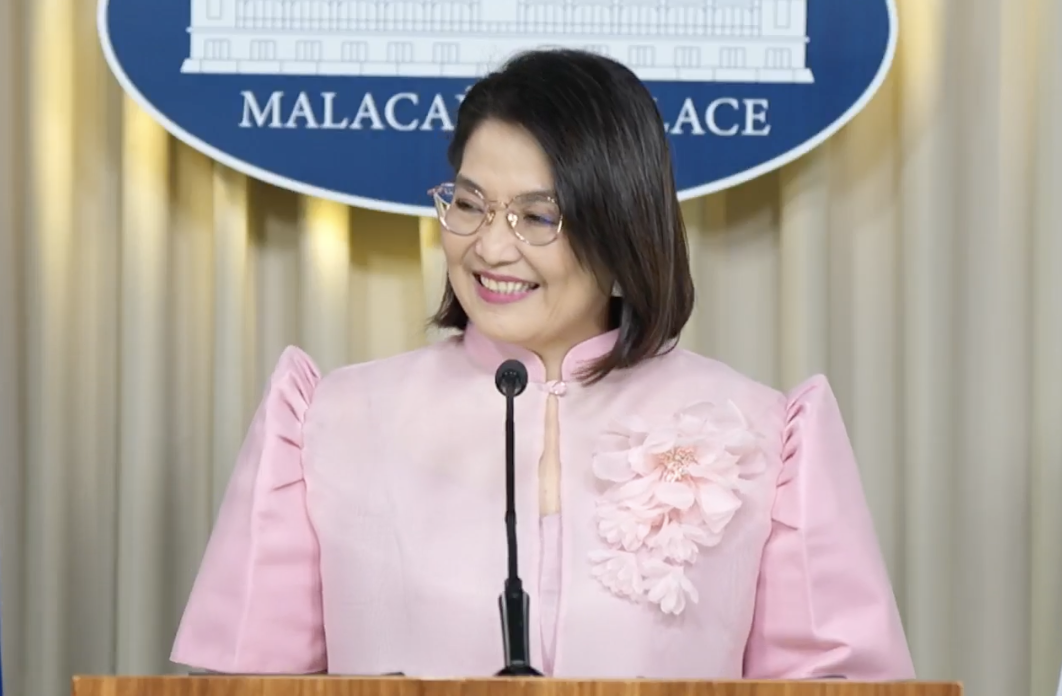

Whether a threat comes with strings attached does not determine whether a crime was committed, Malacañang argued Thursday, July 9, invoking jurisprudence to counter the defense mounted by Vice President Sara Duterte’s legal team at her impeachment trial.

Presidential Communications Undersecretary and press officer Claire Castro pointed to the Supreme Court’s decision in Caluag versus People, which she said establishes that a threatened wrong constituting a crime “may or may not be accompanied by a condition.” Article 282 of the penal code, she noted, recognizes two ways grave threats can be committed — one where the threat against a person, their property or their family carries a condition, and another where no condition attaches to the threatening statement or act.
That legal argument responded to the position taken by Duterte’s counsel, who told the tribunal that the Vice President spoke as a private individual with a family to protect rather than as a constitutional officer. Her lawyers also asserted before the Senate that a scheme designated “Romanov” was “in place,” and that danger to Duterte and her relatives was “real.”
Castro rejected the separation between Duterte’s public and private roles.
“We cannot separate her being Vice President from her being a mother. A threat is a threat, whoever you are, if you threaten the President, even if you are a mother, a Vice President, it doesn’t make any difference,” she said.
Speaking to One News, former chief presidential legal counsel Salvador Panelo characterized the remarks as a defensive reaction to a danger against Duterte’s own life, and said they fell short of an impeachable offense. Castro pushed back on that reading.
“This is not manufactured by imagination. This is not a fantasy. It was stated by the Vice President herself and she did not deny it,” she said.
The Palace official also faulted the defense for anchoring Duterte’s remarks on what her camp described as mistreatment of her chief of staff, Zuleika Lopez, at the hands of the House of Representatives. Castro said resorting to justification carries an implicit concession.

“You cannot and you will not justify something if you did not commit any act. They (defense panel) are justifying the action, saying it was committed because of the alleged incidents involving attorney Zuleika Lopez. There was an admission about the threat against the life of the President,” she said.
The prosecution echoed the Palace on the matter of the supposed Romanov operation, with House prosecution counsel and spokesman Benjamin Tolosa Jr. saying nothing had been submitted to substantiate it. “It’s very clear that no evidence can be presented to prove that in any way. It remains an allegation,” Tolosa said.
Duterte’s opening sessions before the Senate have centered on accusations that she arranged for Marcos, First Lady Liza Marcos and former speaker Martin Romualdez to be killed if a supposed assassination plot against her succeeded — a scenario she described herself during an online press conference. She also faces corruption allegations.
Prosecutors dismissed the notion that the absence of a formal arrangement weakens the case. Rep. Ysabel Maria Zamora said the premise misunderstands how such crimes work.
“I’m sure there has been no written contract relating to the hiring of an assassin. As lawyers, we have yet to handle a case with such,” Zamora said. “And this one – this is not from a prosecutor, but I guess from a lawyer. Any contract involving an assassin or involving a killing of a person would be illegal because it involved something that is void, that is illegal. So, the contract itself is void.”
Trial spokesman and adviser Robert Ace Barbers made a similar point about the impossibility of enforcing an agreement to commit murder.
“I haven’t seen a case where a criminal signed a contract to kill – if indeed the person is an assassin, I really don’t think that there is a contract, or that he would sign it. What if he refused to do it? Can you sue him for a breach of contract? I don’t think so,” Barbers said.
Castro reiterated that the executive branch is staying out of the Senate proceedings on grounds of separation of powers, though it reserves the right to address questions touching on Marcos directly. Shielding an official from consequences when evidence points to wrongdoing, she said, amounts to a betrayal of the public.
