



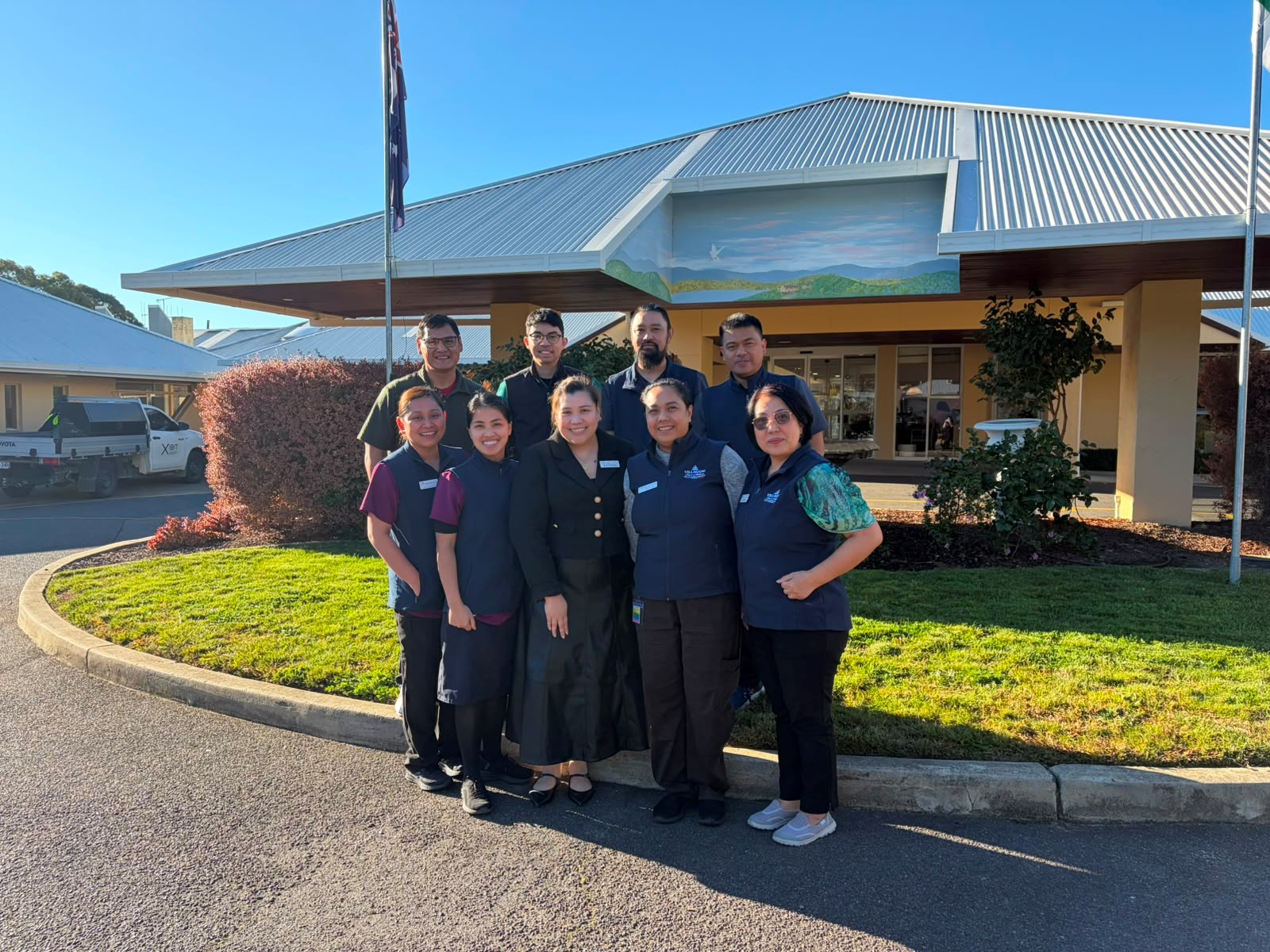

In aged care, leadership is often less about authority and more about presence. It is seen in how teams are supported during difficult shifts, how residents are spoken to with dignity, and how care is delivered even in moments of pressure and uncertainty. At Villaggio Sant’ Antonio in Australia, this kind of leadership is strongly embodied by a group of Filipino nurse leaders whose stories reflect resilience, migration, compassion, and service.

This feature highlights the journeys and insights of the Director of Nursing, Nena Delos Santos (Clinical Care Manager), Ella Helle (Director of Quality, Risk and Education), Katrina Tanalgo (Director of Nursing), and Jorge Tapar (Clinical Care Manager)—four professionals whose leadership continues to shape both people and practice in aged care.
Leadership Across Borders: The Director of Nursing
For the Director of Nursing, leadership did not begin with a title—it began with experience across different healthcare systems and countries. Starting as an ICU nurse in the Philippines, the journey eventually led through New Zealand and Australia, where roles expanded into Nurse Manager, Care Director, Clinical Nurse Leader, and ultimately, Director of Nursing at Villaggio Sant’ Antonio.
Looking back, the journey is defined by constant adaptation and growth.
“My nursing leadership journey has been shaped by both challenge and purpose,” the Director of Nursing shared. “Working across different countries and healthcare systems strengthened my adaptability, resilience, and ability to lead diverse teams.”
But beyond systems and roles, their leadership philosophy remains grounded in people.
“Leadership is ultimately about people. Clinical knowledge and operational skills are important, but genuine leadership comes from trust, empathy, accountability, and consistency.”
In aged care, this philosophy translates into creating environments where both residents and staff feel valued, supported, and safe. Leadership becomes less about directing and more about enabling others to thrive.
Leadership Born in Unexpected Places: Nena Delos Santos
For Nena Delos Santos, Clinical Care Manager, the path to leadership began in a setting far from what many would expect—correctional health. Yet it was here that some of her most important leadership lessons were formed.
“Working in this environment taught me resilience, empathy, and treating every individual with dignity and respect,” Nena reflected. “Healthcare is not only about clinical care but also about human connection.”
This experience shaped a leadership style rooted in humility and service. In aged care today, she continues to carry these values into every interaction with residents, families, and staff.
For Nena, leadership is not defined by position or title.
“Leadership is not defined by a title or position,” she explained. “It is about serving others, building trust, inspiring confidence, and helping people reach their full potential.”
Her approach emphasizes teamwork and shared responsibility, ensuring that every staff member feels heard, supported, and empowered to contribute to quality care.
Quality, Risk, and the Future of Nursing: Ella Helle
As Director of Quality, Risk and Education, Ella Helle brings a wide lens shaped by over 15 years of experience across Manila and Australia, spanning acute care, community health, mental health, and aged care.
For Ella, nursing leadership today requires more than experience—it demands agility and emotional intelligence.
“Future nursing leaders must maintain current knowledge and model evidence-based practice while confidently navigating change, uncertainty, and high-pressure environments,” she explained.
She emphasizes that leadership in modern healthcare is multidimensional. It involves balancing clinical standards, regulatory demands, and human relationships.
“They are expected to lead teams effectively, make sound decisions, and take accountability, while demonstrating empathy, self-awareness, and the ability to build trust with colleagues and stakeholders.”

For Ella, leadership is not static. It evolves with every challenge, policy change, and patient need—requiring continuous learning and reflection.
Faith, Purpose, and Service: Jorge Tapar
For Jorge Tapar, Clinical Care Manager, leadership is deeply tied to faith and service. After graduating from Lyceum of the Philippines University and completing his nursing licensure in 2009, he moved to Canberra, eventually spending a decade in hospital care before transitioning to aged care leadership.
His message to fellow Filipino nurses is grounded in encouragement and belief.
“If you feel called to lead and opportunity presents itself, don’t be afraid to take that step,” Jorge shared. “Trust that God will guide you and equip you for every challenge along the way.”
He defines leadership simply but meaningfully:
“Leadership is not about titles—it’s about serving others, supporting your team, and making a positive difference every day.”
For Jorge, leadership is less about authority and more about influence through kindness, humility, and consistency.
A Shared Filipino Identity in Leadership
Despite different paths, specialties, and experiences, all four leaders share a common thread—the influence of Filipino values in their leadership approach.
The Director of Nursing reflected this clearly:
“Being Filipino has deeply influenced both my values and leadership style. Filipino nurses are often recognised for compassion, resilience, adaptability, and strong work ethic.”
These values are not abstract—they are lived daily in how care is delivered, how teams are supported, and how challenges are approached in aged care environments.
Across Villaggio Sant’ Antonio, this cultural foundation contributes to a leadership style that is relational, compassionate, and deeply human.
Leading Through People, Not Position
What stands out across all four stories is a shared belief: leadership is not defined by hierarchy, but by impact.
Whether it is the Director of Nursing guiding organizational culture, Nena Delos Santos building trust in care environments, Ella Helle strengthening systems of quality and safety, or Jorge Tapar leading with faith and service—each journey reflects a commitment to people above process.
As the Director of Nursing summarized:
“I strongly believe leaders should create environments where people feel safe, valued, supported, and empowered to grow.”
Closing Reflection
At Villaggio Sant’ Antonio, leadership is not confined to offices or job titles. It lives in daily interactions, shared decisions, and moments of care that often go unseen but deeply felt.
The stories of the Director of Nursing, Nena Delos Santos, Ella Helle, and Jorge Tapar remind us that nursing leadership is ultimately human work—shaped by compassion, strengthened by experience, and sustained by purpose.
In their hands, leadership becomes more than a role. It becomes a way of caring, a way of guiding, and a way of quietly transforming lives—one resident, one staff member, one moment at a time.
