



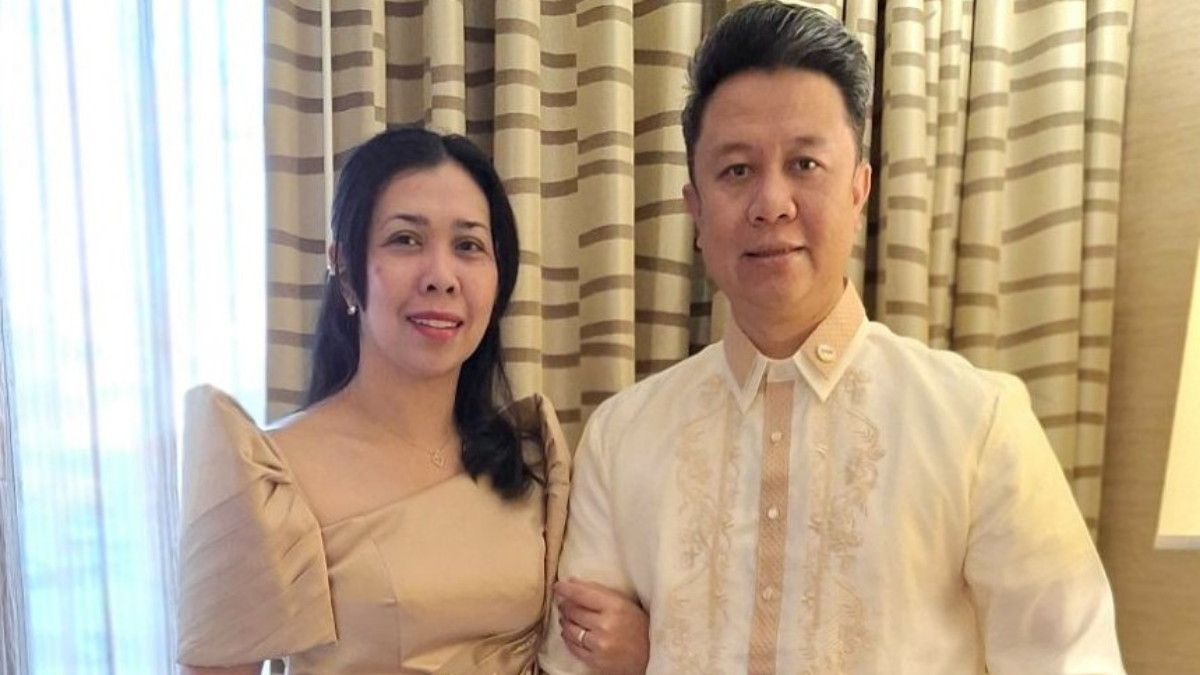

The brochure version of the immigrant story shows the arrival and skips the cost: the recognized professionals reduced to strangers’ ideas of beginners, the careers paused at a border. When this couple landed in the United States in 2016, both had built something worth losing — and both had to set it down. He had designed high-rises in Manila and an eight-story development on a Papua New Guinea mountainside. She had spent seven years in legal research and was retraining as a special-education teacher. Within months of arriving, Rei Minguez was working night shifts at a convenience store and Novie Minguez was the family’s sole provider, teaching in a Virginia elementary school.

That the two of them now run their own architecture and design firm in the Arizona highlands is not a story about luck. It is a story about two people who agreed, more or less at the same time, to build their foundations twice.
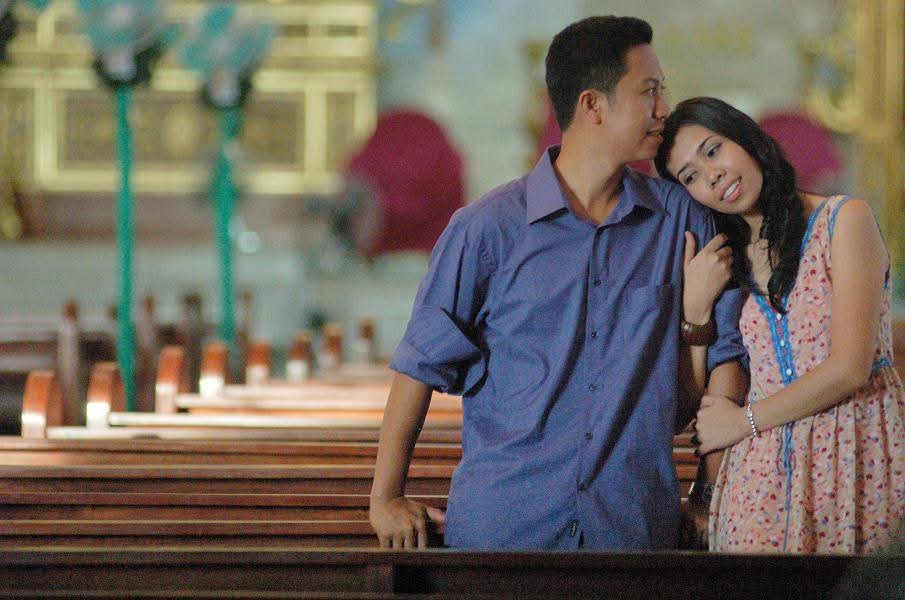
Two careers, set down at the border
Before America, there were two separate bodies of work.
Rei trained at Mapúa and made his name with some of the most respected firms in Philippine architecture — Leandro V. Locsin Partners and Lor Calma Partners in Makati — before a stint at Filinvest in Alabang and a senior role abroad. The project he still returns to was an eight-story serviced apartment building for Glory Estate Ltd. in Port Moresby, set on a mountainside above Ela Beach. “The site was located on a mountainside overlooking Ela Beach, which presented both unique opportunities and complex design challenges,” he recalls. The terrain demanded a design that answered the land rather than fought it, but the lesson he carried out was about people, not slopes. “What made this project especially meaningful was the opportunity to design within a cultural context different from my own,” he says — proof that a building’s character comes as much from local values as from any calculation.
Novie’s résumé reads like several careers stacked on top of one another. A University of Santo Tomas graduate in Education with a major in Library Science, she spent seven years as a legal researcher at the Romulo Law Office in Makati before pursuing graduate work in Special Education at De La Salle University. Library science, she explains, is “fundamentally about organizing information, locating reliable sources, analyzing needs, and creating systems that people can use effectively.” Two disciplines that look unrelated from the outside — his drawings, her research — would eventually meet in the same studio. But not before both were nearly set aside entirely.
Starting over, together
When the family arrived in 2016, Rei assumed his profession would travel with him. It did not. His Philippine architectural license carried no weight in the American system, and rebuilding it would take years.
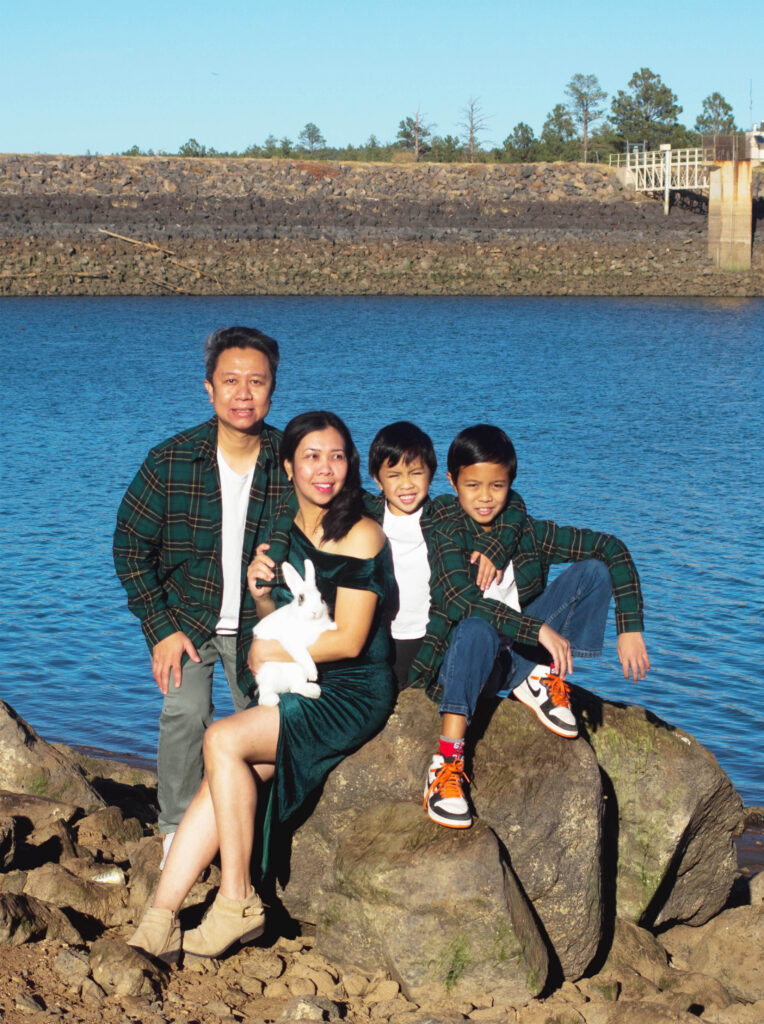
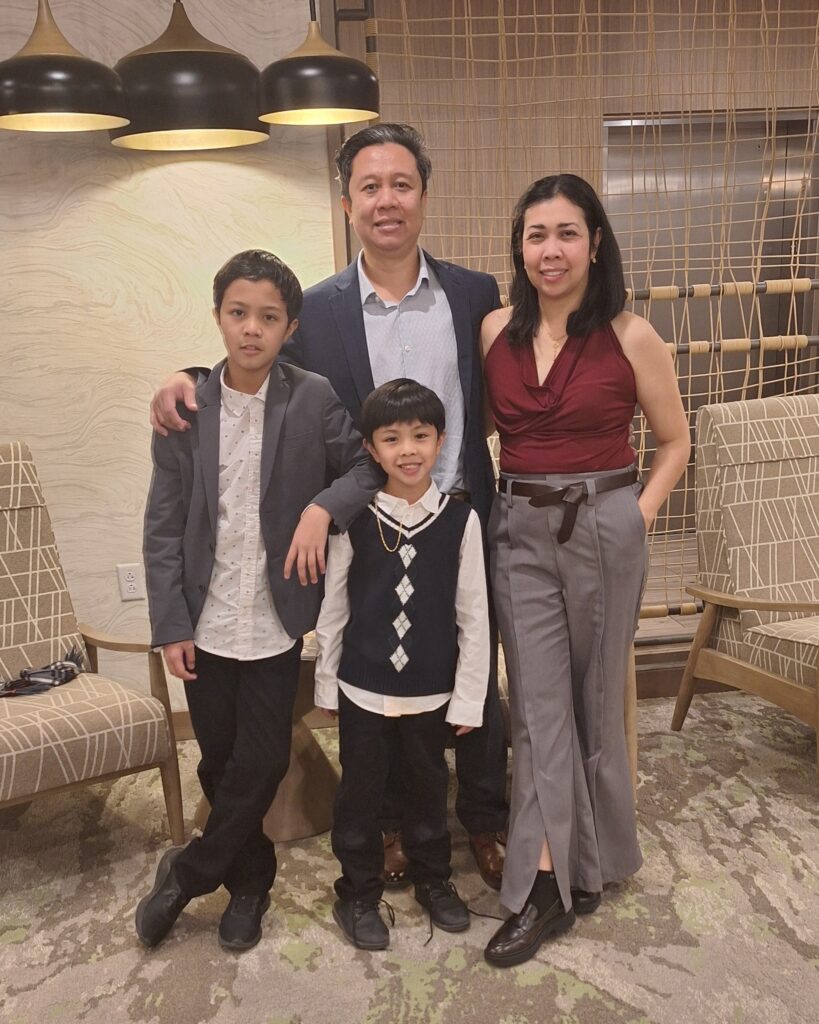
The math of the household made the decision for them. Their eldest, Benedict, was in preschool, there were no relatives nearby, and the couple split the load the only way it could be split. Novie, who had come over as an exchange teacher and media specialist at a Virginia elementary school, became the primary provider. Rei took the role of stay-at-home father by day and worked night shifts at a convenience store a few miles from home to keep contributing.
He does not dress up how that felt. “After spending many years in the architectural profession and working with respected firms, adjusting to a completely different role was both humbling and challenging,” he says. The frustration and self-doubt were shared — “Novie and I experienced moments of frustration, uncertainty, and self-doubt.” What pulled them through was a reframing that arrived with the birth of their second son, Juan Felix: the sacrifices were buying a wider set of opportunities for their children. “That perspective helped me move forward with renewed determination.”
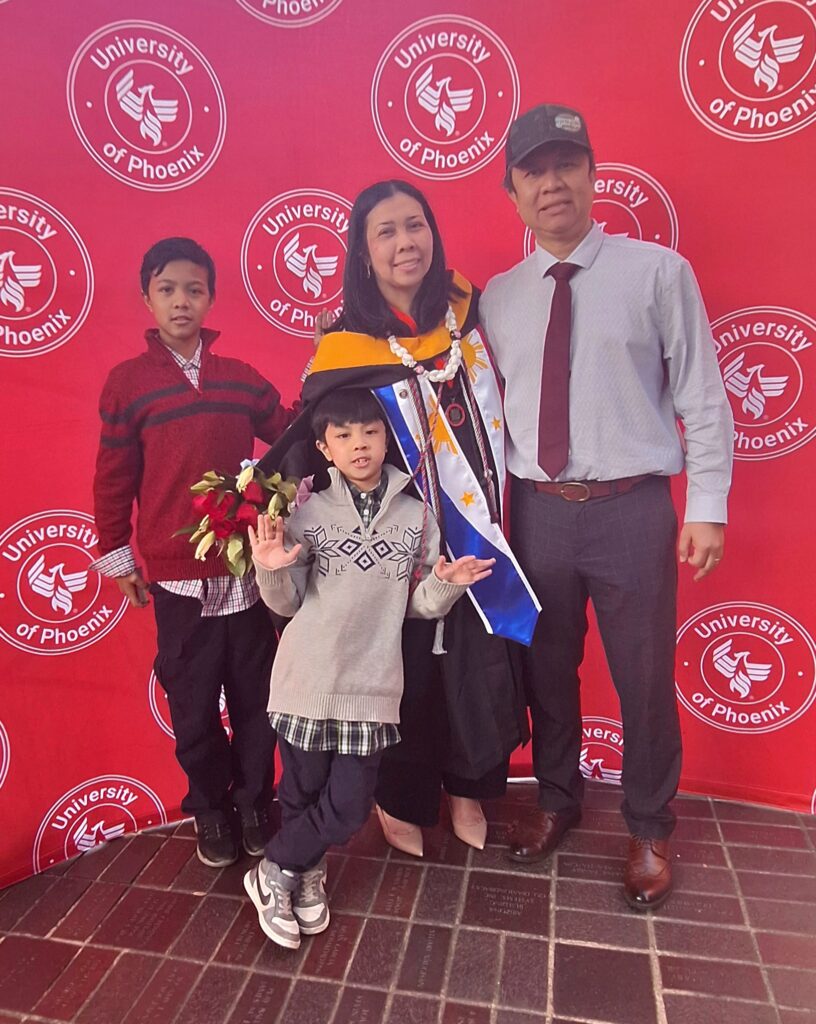
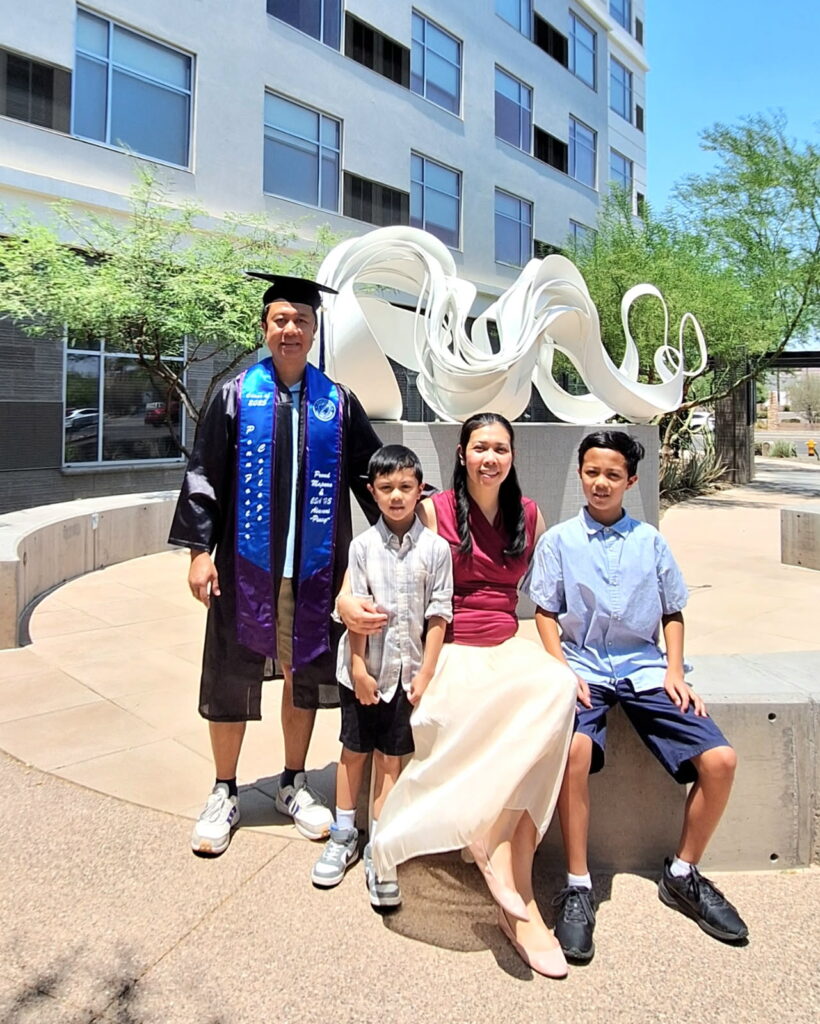
So they both studied — at the same time, in different directions. While stocking shelves at night, Rei worked toward an Arizona Career and Technical Education license, dug into green-building principles, and earned an Associate of Science in Interior Design from Penn Foster. Novie, in parallel, was rebuilding her own profession from the ground up: earning her U.S. teaching license and, on an employer scholarship, completing a Master’s in Psychology at the University of Phoenix. Neither was coasting while the other climbed. They were climbing two separate walls in the same house.

The 2017 move to Arizona was hers as much as his — the family relocated for Novie’s position as a Special Education teacher at Dishchii’bikoh Community School, where she ran a self-contained classroom. For Rei, the professional turn came through people: a local builder couple, Anthea and Manny Garcia, took a chance on him and brought him onto several design projects. “His trust reignited my passion for design and drafting and reminded me that professional setbacks do not define one’s future,” he says. It confirmed what the whole detour had been teaching both of them — that careers are rarely linear, and perseverance counts for as much as any title.
What each of them brought back
By the time they founded Brick and Modern Design, LLC, neither had simply recovered an old career. Each had returned with something extra, and the firm is the sum of the two.
Rei came back to design with a sharpened conviction about sustainability that traced to his Filinvest days, when he first saw building systems tuned to how people actually live. At the firm, he says, green design “is not simply about adding green features to a building” but about considering from the first sketch how a structure answers its climate and uses its resources.
Novie came back with a toolkit no architecture studio usually has on staff. Her seven years in legal research now feed the technical work directly — she helps with building-code research, ADA accessibility requirements, and permitting and compliance. Her years in special education give the firm a working fluency in universal design, sensory-sensitive spaces, and aging-in-place solutions. And the psychology degree supplies the rest: an understanding of “how environments affect behavior, how colors, lighting, acoustics, and layouts influence experience,” along with the client communication and conflict resolution that any building project demands.
The students at Dishchii’bikoh shaped how she thinks about all of it. The school’s mission — “For everyone, A way to learn, grow and succeed” — became a design principle as much as an educational one. “That mission reminds me that every person has unique needs, strengths, and goals,” she says. Her work as a seasonal research fellow with Northern Arizona University’s Institute for Native-serving Educators deepened the same belief: that good design, like good teaching, is about creating room for people to thrive.
One studio, two spines
Ask them what the firm’s name means and the answer describes how they work. “Brick” stands for strong foundations, craftsmanship, and timeless design; “Modern” for creativity and designing for the way people actually live now. His architectural vision meets her understanding of how people experience the spaces they are handed. “Together, we combine thoughtful design with a people-centered approach.”
In practice, his drawings get pressure-tested against her questions about who will use a room and how. His instinct for form meets her instinct for function and feeling, so a floor plan becomes a question about behavior. Based in Show Low, Arizona, the firm now takes on private residences, interior renovations, mixed-use developments, and early planning studies. The growth plan is deliberately unglamorous: stay grounded in listening to clients, keep the process clear, build lasting value for the communities they serve.
There is a particular confidence that comes only from having lost a profession and earned it back — and the Minguezes have a double dose, because both of them did it, side by side. He knows a license can be taken at a border; she knows a career can be paused for a classroom and a household. What they learned, between a Virginia classroom and an Arizona night shift and finally a studio of their own, is that the thing underneath the title does not vanish. You can be made to build the foundation twice. Theirs holds because two people poured it.
