



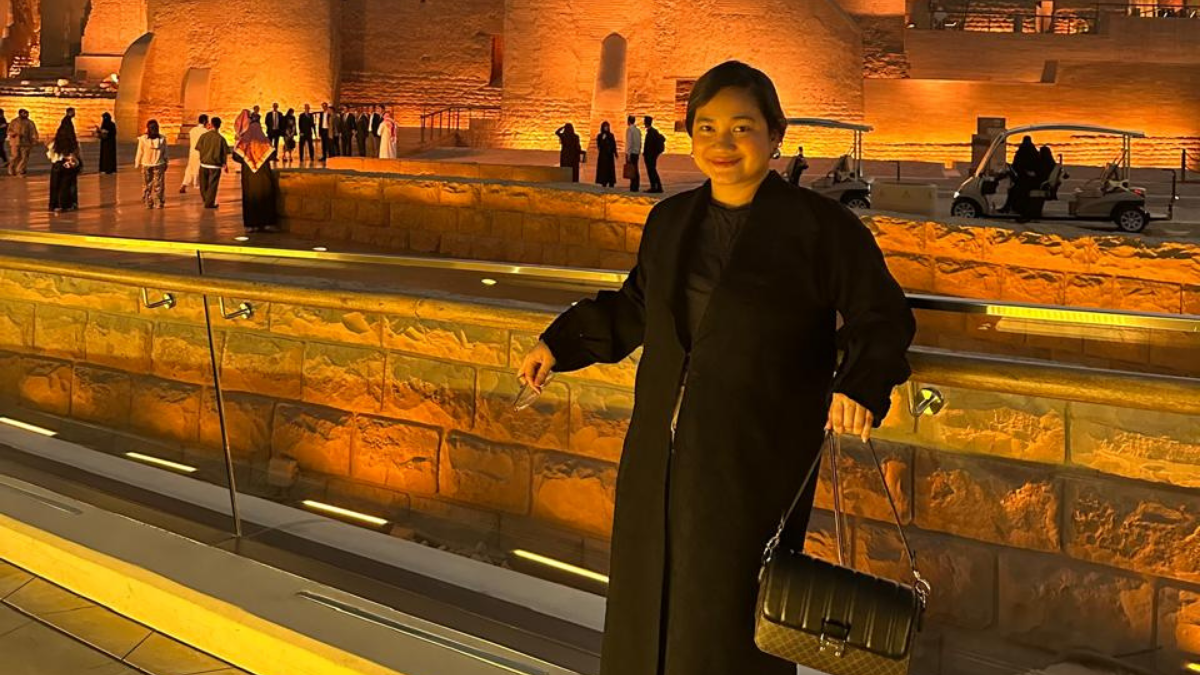

Walk into almost any classroom in the Kingdom of Saudi Arabia and you’ll find a familiar quiet calculation happening at the back: students sizing up whoever stands at the front, deciding in the first few minutes whether this person has earned the right to teach them. For Almera Carmena Passion, that calculation came with an added complication — she was often younger than the people she was teaching.

At 30, Passion has spent seven years building a career in education across Riyadh, moving from an international school classroom to one of the Kingdom’s most prestigious universities and, most recently, into a government ministry shaping how the country trains its logistics workforce. The throughline isn’t just ambition. It’s the steady, sometimes stubborn work of proving she belonged in rooms where her age invited doubt.
Earning the room
Passion currently serves as a Curriculum Reviewer and Occupational Health and Safety Coordinator and Lecturer at the Saudi Logistics Academy, under the Ministry of Transport and Logistics in Riyadh, a role she has held since June 2024. Her responsibilities sit at the intersection of two demands: building and reviewing curriculum that meets quality standards, and delivering the occupational health and safety training that keeps a fast-growing sector running. She facilitates professional sessions for both learners and working industry professionals, contributing to workforce development across the Kingdom’s transportation and logistics sectors.

It’s a long way from where she started. Before the Ministry, Passion taught English for Medicine at King Saud University from September 2021 to June 2024, working with students across the Humanities, Sciences, and Business departments at what she describes as the top university in the kingdom. Before that, from 2019 to 2021, she taught at Dome International Schools in Riyadh, delivering instruction across both American and British curricula while also working as an SAT examiner. She is an IELTS trainer certified through the British Council.
What’s striking about that progression isn’t only its speed but its timing. By her own account, Passion became an international school instructor at 23, a university instructor at 25, and a Ministry instructor at 28 — appointments she says made her the youngest person in each of those roles. Those superlatives are her own, and there’s no public registry to confirm them. But the underlying trajectory is real, and unusually compressed for someone now only entering her thirties.
The skepticism she had to outwork
Youth, in her telling, was rarely an asset at first. It was a hurdle.
“As a relatively young educator, I often encountered skepticism regarding my experience and capabilities, particularly when teaching students and collaborating with colleagues who were older than me,” she says. The doubt wasn’t hostile, necessarily, but it was persistent — the kind that requires a person to keep re-earning credibility they thought they’d already established.
Her response was unglamorous and effective. “Rather than allowing age-related assumptions to discourage me, I used them as motivation to demonstrate competence through results, professionalism, and dedication,” she says. She over-prepared. She delivered consistently. She built relationships with students, colleagues, and administrators until the question of whether she belonged simply stopped getting asked. Competence, repeated often enough, becomes its own argument.
The professional skepticism layered onto a more familiar diaspora challenge: building a life far from the people who anchor you. Adjusting to new social norms and work cultures took resilience, she says, and she leaned on her family, close friends, and professional mentors to stay steady through the uncertain stretches. The educators and academic leaders she looked up to — people who’d built international careers on hard work and lifelong learning — gave her a template for what persistence could produce.

That’s the surprising shape of her story: the disadvantage she kept having to answer for was also, in a sense, the engine. Each appointment that came earlier than expected meant another room full of people to win over, and each one she won reinforced the same lesson.
Why education, and what comes after
Passion is clear about why she chose this field, and the clarity doesn’t sound rehearsed. “I chose the field of education because I am passionate about empowering individuals through learning. I believe that education creates opportunities, transforms lives, and drives national development,” she says. The satisfaction, for her, is concrete and observable: “The most rewarding aspect of my work is seeing students and trainees gain confidence, develop new competencies, and achieve their academic and professional goals.”
Her own academic record mirrors that conviction. She holds a Bachelor of Secondary Education majoring in English, where she was an Academic Dean’s Lister, and a Master of Arts in Education in English, earning the Meritissimus distinction for her oral defense. She is currently pursuing a Doctor of Philosophy in Education with a focus on Educational Management — a credential aimed squarely at the leadership role she eventually wants to play.
That role isn’t in Riyadh. Passion is candid that the overseas chapter has a planned ending. She went abroad, she says, to advance professionally while supporting her family’s financial stability and future goals, and the experience has delivered on both — international expertise, a multicultural working environment, and the means to invest in the people she left home for. But the long-term vision points back to the Philippines.
She wants to build something there. “One of my long-term aspirations is to establish a learning institute that provides high-quality, innovative, and accessible education, particularly in areas that strengthen academic excellence, professional skills, and lifelong learning,” she says. The plan is to import the teaching methodologies she has absorbed across three very different Saudi institutions and put them to work at home — alongside advocacies in education, youth empowerment, and professional development, and mentorship for the next set of young educators wondering whether anyone will take them seriously.

What she’d tell the next arrival
Ask Passion what she’d say to a kababayan struggling somewhere far from home, and the advice arrives without sentimentality. Patience, mostly. “Living and working overseas comes with many sacrifices, being away from family, facing loneliness, adjusting to different cultures, and overcoming unexpected challenges. However, success takes time. It is worth the wait,” she says.
The practical counsel is just as grounded. Avoid unnecessary debt and lifestyle inflation. Prioritize savings and long-term security over short-term gratification. Keep developing your skills, treat every role as a chance to grow, and be discerning about whom you trust — because financial success can attract people whose sincerity doesn’t survive scrutiny. “Trust should be earned through actions, not just words,” she says.
And underneath all of it, a single instruction to hold onto when the progress feels slow: “Most importantly, remember why you started your journey abroad. Keep your family, dreams, and future goals as your motivation.”
It’s advice with a particular authority coming from her. Passion has spent seven years being underestimated and outworking it, one classroom at a time, and she’s still only at the beginning of what she’s planning to build. The young woman at the front of the room turned out to be exactly where she belonged. The next room — the one she wants to build back home — is the one she’s still working toward.
