



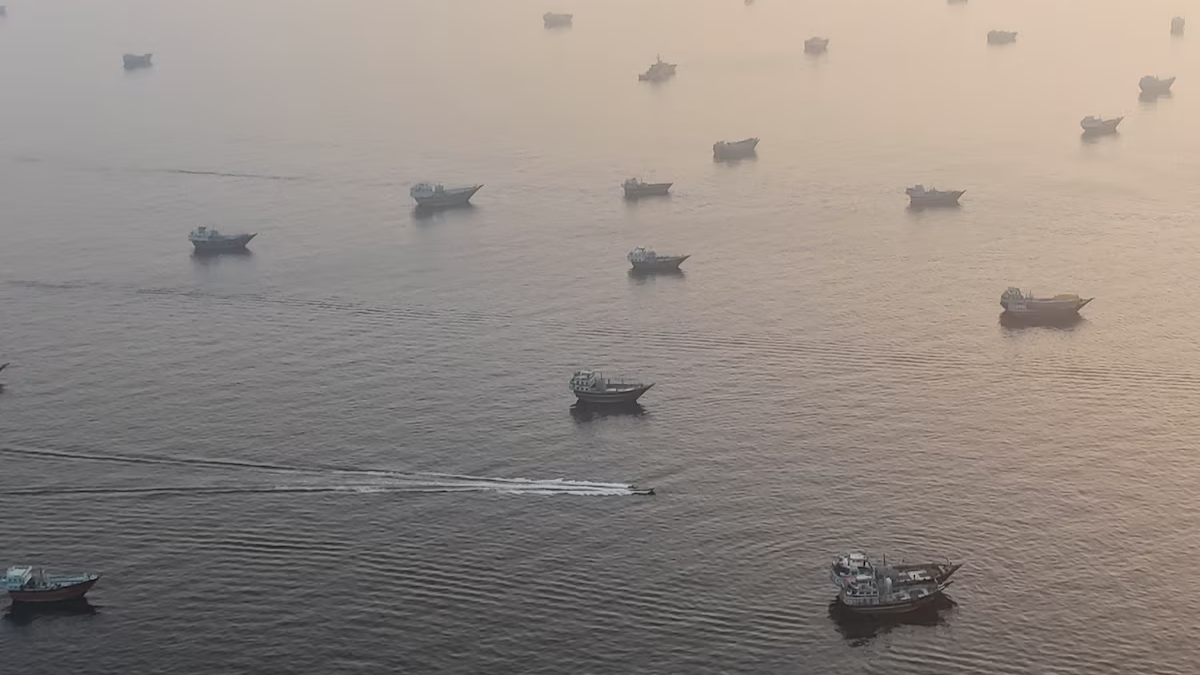

Tankers carrying crude have begun exiting the Strait of Hormuz along a corridor hugging Oman’s coastline, US President Donald Trump said Monday, framing the renewed movement as evidence that the world’s busiest oil chokepoint is returning to working order after months of paralysis.

“Ships are starting to move, many loaded up with Oil, out of the Strait of Hormuz. They are going along the Southern ‘Highway,’ which is totally safe, secure, and pristine. There are other areas of travel, also!!!” he wrote on Truth Social. The post went up Monday morning, shortly before he landed in France for the Group of Seven summit.
The route he praised is not the strait’s conventional shipping lane. Al Jazeera reported that the so-called Southern Highway runs through Omani territorial waters, a passage that has drawn concern because of sea mines. According to gCaptain, the corridor was developed during the US-led naval effort to escort commercial vessels while the strait itself stayed effectively shut, with ships moving at night under close coordination with American forces and following the coast off Oman and the United Arab Emirates rather than the usual lanes. That same outlet, citing industry reporting, put recent traffic at roughly 15 vessels a day.
Trump’s upbeat assessment runs ahead of where much of the maritime industry is willing to go. Shipping and security sources told Reuters, as reported by Al Jazeera, that clearing mines could take another 40 to 50 days before insurers and carriers feel secure enough to authorize regular passage, though some operators have signaled they may begin transiting sooner.

The movement of oil follows the announcement of an initial agreement between Washington and Tehran meant to halt a war that ground on for more than three months and choked off a passage that normally carries close to a fifth of the world’s seaborne oil. The waterway’s near-total closure after fighting erupted on February 28 sent crude prices climbing.
US Vice President JD Vance and a senior US official said Monday that the terms had been locked in and that both governments had electronically signed the document, Al Jazeera reported. Tehran, however, has not publicly confirmed that a digital signature took place, and no text of the agreement has been released.
How transit through the strait will work financially remains unsettled. Vance told CNBC he expected the waterway to be “opened in a toll-free way for the long term,” adding that the matter would be sorted out in technical negotiations. Iran’s foreign ministry spokesman, Esmaeil Baghaei, signaled a different expectation, indicating fees would apply. “Our goal is to pave the way for a secure passage in this waterway,” he said.
A formal signing ceremony is scheduled for Friday, June 19, in Switzerland, an arrangement confirmed by Pakistani Prime Minister Shehbaz Sharif, who helped broker the talks. Deeper disputes — among them Iran’s nuclear program, the fate of frozen Iranian assets, and the lifting of US sanctions — have been pushed into a 60-day window of further negotiation rather than resolved in this first stage.
