



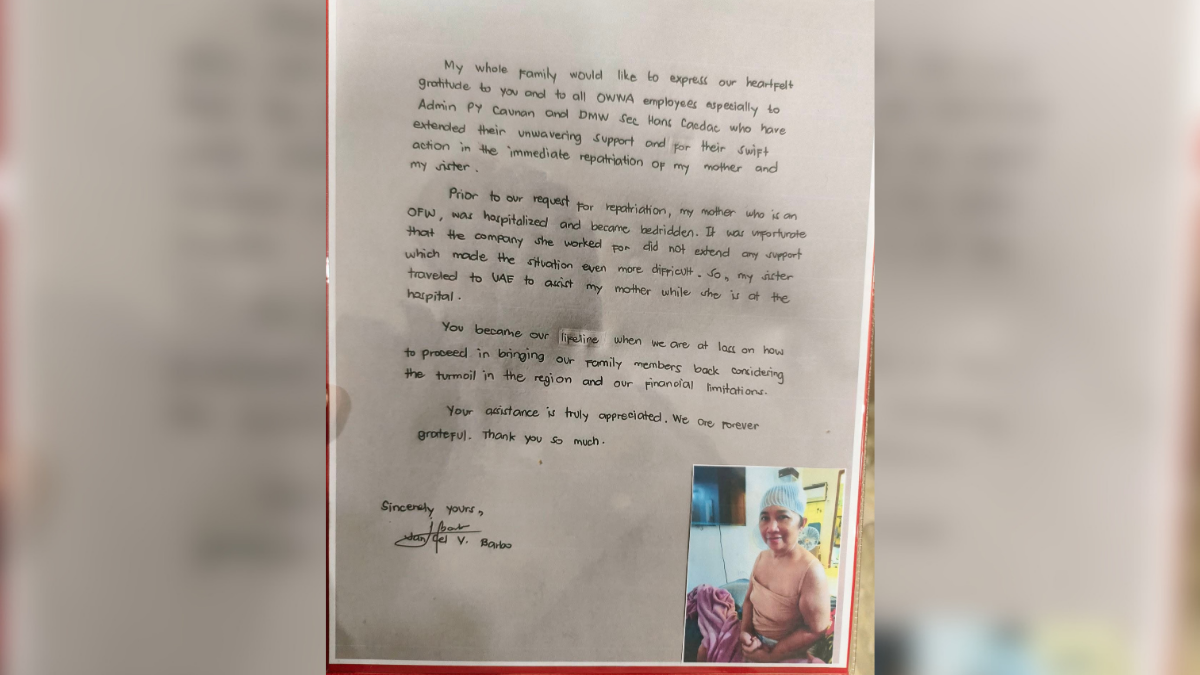

A Filipino family has publicly thanked the Overseas Workers Welfare Administration (OWWA) and the Department of Migrant Workers (DMW) for the swift repatriation of an overseas Filipino worker (OFW) and her sister from the United Arab Emirates, in a handwritten letter shared online by OWWA Administrator Patricia Yvonne “PY” Caunan.

In the letter, dated June 5, 2026, the family expressed its gratitude to OWWA personnel — singling out Caunan and DMW Secretary Hans Cacdac — for what it described as their unwavering support and swift action in bringing home the worker and her sister. The mother, an OFW, had been hospitalized and left bedridden, the family said, adding that the company she worked for did not extend support during her illness. Her sister had traveled to the UAE to care for her in the hospital.
“You became our lifeline when we are at loss on how to proceed in bringing our family members back, considering the turmoil in the region and our financial limitations,” the family wrote, signing off with their thanks. The note was accompanied by a photo of the recovering worker.

Caunan posted the letter on her Facebook account, sharing it alongside a reflection in Filipino on why she chose public service. While acknowledging that the government cannot solve every problem faced by OFWs, she wrote that her office does everything within its capacity to help when workers need it most.
The letter surfaces against the backdrop of an extended government repatriation drive prompted by conflict in the Middle East. Following joint United States and Israeli strikes on Iran that began in late February 2026, the DMW and OWWA mounted a series of government-chartered flights and assisted departures for Filipinos across the region, including from the UAE, which hosts the largest concentration of OFWs in the Middle East.
The Inquirer reported, citing OWWA data, that 6,532 OFWs and their dependents had been repatriated from the Middle East as of April 20, 2026, with the agency sponsoring close to half of them. OWWA has said it expects more workers to seek repatriation as the regional situation remains volatile, and has requested a P12-billion supplemental budget to sustain its emergency repatriation and reintegration programs.
