



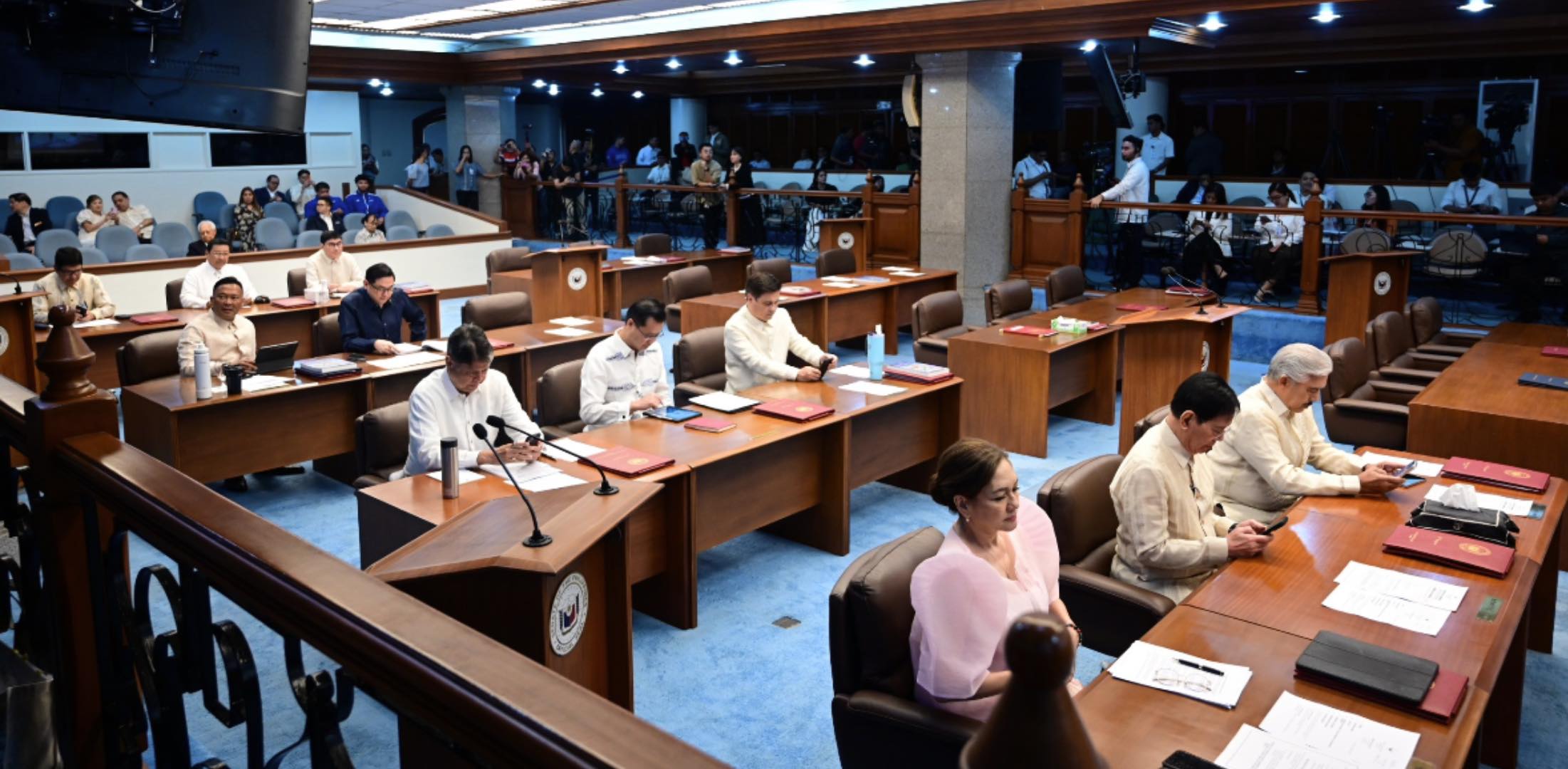

When a legislative chamber goes dark, the question is usually who pulled the plug. On Monday, June 1, the Senate’s 11-member minority bloc placed the blame squarely on Senate President Alan Peter Cayetano and the majority, accusing them of abandoning the session hall rather than defending the institution’s independence.

In a statement posted by Senator Risa Hontiveros on her Facebook page, the group calling itself Solid Bloc 11 said its members were present for the 5 p.m. resumption of session, prepared to work and vote on pending bills, but the majority led by Cayetano did not appear. The bloc said the majority “did not even have the courtesy to inform us when they ignored the rules, and could not extend the basic decency of telling the minority that they had no intention of convening.”
The absence left the chamber without a quorum. With at least 13 of the 24 senators required to be physically present to conduct business, the 11 minority senators were unable to proceed, and the session collapsed.
The minority bloc rejected Cayetano’s framing of the standoff as a matter of Senate independence. “Let us call this for what it is: the claim that this is about Senate independence is false, because what happened today was about the rule of law, public accountability and a lawful process before the Ombudsman and the Sandiganbayan that no senator, no bloc and no presiding officer controls,” the statement read.
The bloc tied the walkout to the arrest of Senator Jinggoy Estrada. “This is a boycott because of the arrest of Senator Jinggoy Estrada, and the public should not be asked to believe another convenient line from a leadership that has repeatedly twisted the truth,” the group said. It went further, asking pointedly: “Is Senate President Alan Cayetano now questioning the rule of law?”

Several measures were left pending because no business could be transacted. The bloc identified them as the Magna Carta of Barangay Health Workers, the Anti-Hospital Detention Bill, the confirmation of generals before the Commission on Appointments, and bills granting Philippine citizenship to Bennie Boatwright III and Matthew James Ramos.
Hontiveros’s group drew a contrast with past disruptions. “This may be the first time in decades that Senate work stopped because the presiding officer himself refused to work, because even during typhoons and the height of the pandemic, work was suspended only because of necessity or because systems still had to be set up, not because the leadership chose a boycott of duty,” the statement said. The bloc also raised whether Cayetano was “repeating what he did in the House of Representatives,” referencing earlier questions about a leader who refused to step aside or convene “when the numbers were no longer certain.”
The standoff unfolds against a sharply altered balance of power in the chamber. The Sandiganbayan’s Fifth Division issued a warrant for Estrada’s arrest on June 1 over a non-bailable plunder case linked to the flood control scandal, tied to alleged kickbacks of more than P573 million from infrastructure and flood control projects under the 2025 budget. Estrada surrendered to the Criminal Investigation and Detection Group at Camp Crame the same day, accompanied by Cayetano. With Estrada detained and Senator Ronald dela Rosa in hiding following an arrest warrant from the International Criminal Court, the majority bloc’s roster of senators able to attend in person was effectively reduced to match the minority’s count.
The minority closed its statement with a warning aimed at the days ahead and an appeal to the public. “Will they do this again for the next two session days, and will they keep the Senate idle simply to avoid facing the numbers on the floor?” the bloc asked. It called on the Senate to “open its doors, call the session to order and return to work,” and urged Filipinos to watch the chamber closely, “because when an institution refuses to work, public vigilance becomes the people’s first line of defense.”
