



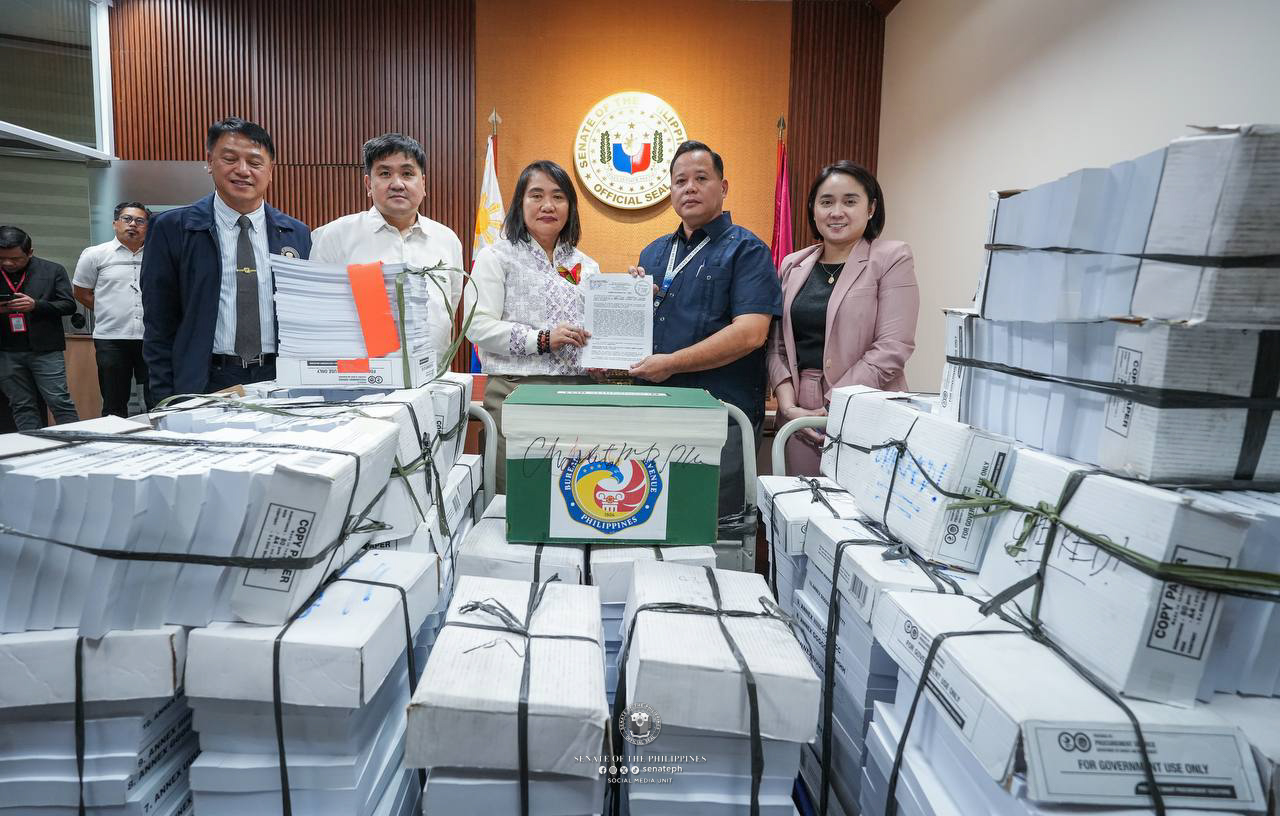

The Philippine Senate formally received the Articles of Impeachment against Vice President Sara Duterte on the night of Wednesday, May 13, 2026, formally opening the next — and far more consequential — phase of a political process that has gripped the country for months.

Senate Secretary Mark Llandro “Dong” L. Mendoza and Deputy Secretary for Legislation Atty. Marivic Laurel Garcia received the documents from their House counterpart, Secretary General Cheloy Velicaria-Garafil, at around 7:22 p.m. The transmittal included sealed boxes containing House Committee Report No. 261 on House Resolution No. 989, titled “Resolution Setting Forth the Articles of Impeachment Against Vice President Sara Z. Duterte,” along with annexes and USB devices containing file copies of the documents.
The transmittal came just two days after the House of Representatives voted 257–25, with nine abstentions, to impeach the Vice President for the second time — making her the first official in Philippine history to be impeached twice. The vote far exceeded the constitutional floor of one-third of the House, or 106 votes, and surpassed even the most ambitious projections made in the days before the May 11 plenary session.
What the articles charge
The consolidated complaint against Duterte covers four articles: betrayal of public trust, culpable violation of the Constitution, graft and corruption, and other high crimes. Specific allegations include the misuse of confidential funds at the Office of the Vice President and the Department of Education, unexplained wealth, possible falsification of official documents, and making death threats against President Ferdinand Marcos Jr., First Lady Liza Araneta Marcos, and former House Speaker Martin Romualdez. The articles also allege that Duterte contracted for the assassination of the President and incited sedition.
During House committee hearings in April, the National Bureau of Investigation confirmed that video footage showing Duterte making the alleged “kill remarks” against the Marcos family was authentic and showed no signs of editing, alteration, or AI manipulation. Duterte and her legal team boycotted all of the proceedings, issuing only general denials through press statements and press conferences.
The House prosecution seeks Duterte’s conviction on all four articles, her removal as Vice President, and her perpetual disqualification from holding any government office.
What happens next
Under the 1987 Constitution, the Senate is now constitutionally mandated to convene as an impeachment court. Once it does, all 24 senators will sit as senator-judges. The Senate is expected to issue a summons to Duterte, set the rules of the trial, and establish a calendar for proceedings. The trial will involve the presentation of documentary evidence, witness testimony, and legal arguments from House prosecutors on one side and Duterte’s defense team on the other. Proceedings are expected to be public.
Duterte’s legal team said after the House vote that they are “fully prepared” to defend her before the Senate impeachment court and that the burden of proof lies with the prosecution.
A conviction requires a two-thirds vote, or at least 16 of the 24 senators. If convicted, Duterte will be removed from office and barred from holding any public position — effectively ending her declared bid for the presidency in 2028. If acquitted, she remains in office.

The Senate leadership question
Whether the trial will proceed fairly — or at all — is the central political question. On the same day the House voted to impeach Duterte, pro-Duterte senators staged a leadership coup inside the Senate, ousting Senate President Vicente “Tito” Sotto III and electing Senator Alan Peter Cayetano in his place by a vote of 13–9. Cayetano served as Secretary of Foreign Affairs under Duterte’s father, former president Rodrigo Duterte, and has long been associated with the Duterte political family.
Cayetano has publicly pledged that the Senate will convene “forthwith” and without unnecessary delay once it formally processes the transmittal. “We will do what has to be done, and there won’t be delays. There’s no reason to delay. You judge us by our actions,” he told reporters on May 12.
Despite the assurances, political analysts and civic leaders have pointed to the timing of the Senate coup as a signal that the trial’s outcome may already be under pressure. National security expert Jose Antonio Goitia said the leadership change was “never really about leadership” and that its objective was to keep the impeachment process from proceeding. Ousted Senate President Sotto likewise said he believed the impeachment was the reason for his removal.
The Senate majority bloc is now composed largely of senators aligned with the Duterte camp. Several are already widely seen as likely votes to acquit: Imee Marcos, Robin Padilla, Bong Go, Rodante Marcoleta, Ronald dela Rosa — whose six-month absence from the Senate ended abruptly on May 11, just in time to cast the deciding vote in the leadership change — as well as the Cayetano and Villar siblings. Duterte needs only nine senators to block a conviction.
A troubled history
This is not the first time Duterte has faced a Senate trial. In 2025, she was first impeached by the House on similar charges, but the Senate under then-president Francis Escudero repeatedly delayed proceedings. When it finally convened, it voted to remand the articles back to the House. The Supreme Court subsequently nullified the entire proceeding, ruling that the complaint had been filed in violation of the constitutional one-year bar against initiating a second impeachment case against the same official within a year.
That one-year ban lapsed in early 2026, opening the door to fresh complaints. Four were filed starting in February, consolidated by the House Justice Committee, and endorsed to the full House in May.
Looking further back, only one official in Philippine history has ever been convicted through the Senate impeachment process: former Chief Justice Renato Corona, who was found guilty in May 2012 by a vote of 20–3, and subsequently removed from office and permanently barred from public service.
Whether Duterte will join that singular entry in the history books — or whether political dynamics in the Senate will again derail the process — is now the defining question of Philippine political life.
