



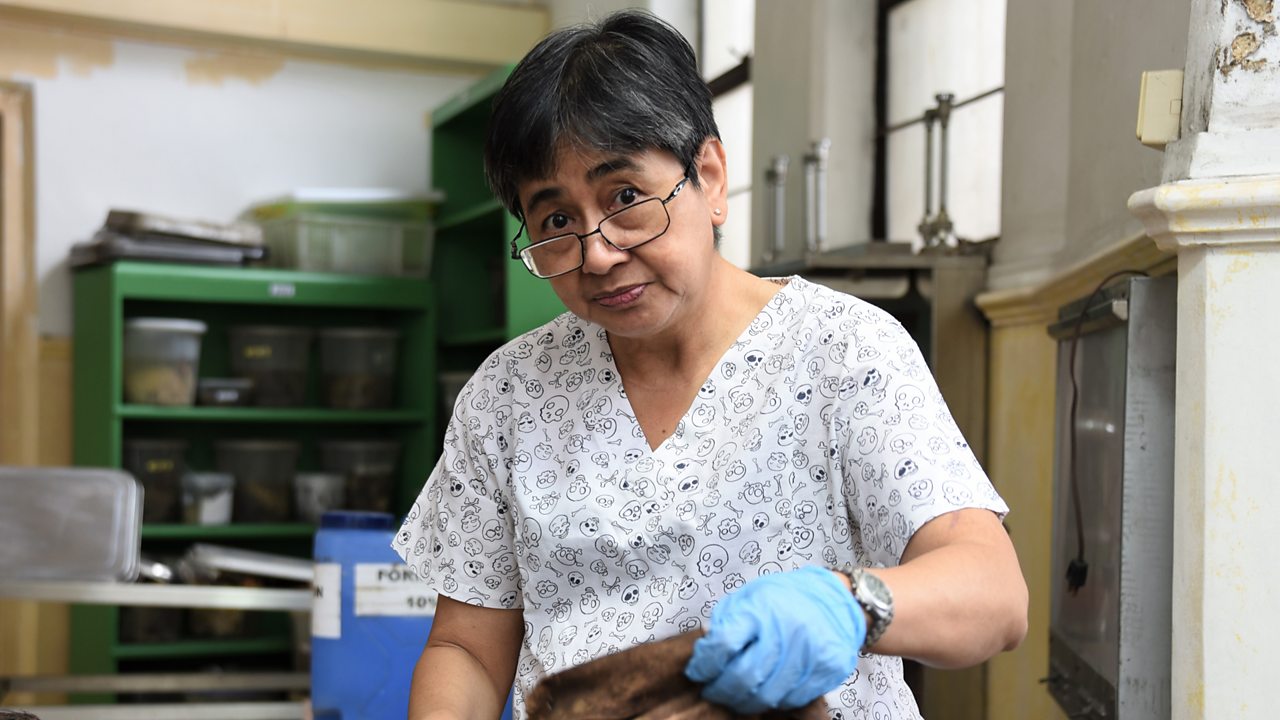

Forensic pathologist Raquel Fortun did not mince words Thursday when addressing online remarks that compared the remains of those killed in the April 19 Toboso, Negros Occidental encounter to canned meat — calling the comments an insult to the dead and a reflection of how little regard some members of the public have shown toward victims of violence.

“No, they don’t look anything like corned beef. I’ve seen a lot of dead bodies. You know what they look like? Tao. People. People with injuries. People who were killed. And that could be you,” she said at a press briefing held at the University of the Philippines in Diliman, Quezon City.
Fortun’s remarks came as she presented initial autopsy findings on five of the nineteen people killed in the clash between the Armed Forces of the Philippines and the New People’s Army. Among the dead were UP Diliman student leader Alyssa Alano, community journalist and Kabataan party-list nominee RJ Nichole Ledesma, and Filipino-American activists Lyle Prijoles and Kai Sorem. The military has classified all nineteen fatalities as NPA members, a position disputed by groups who say some of those killed were civilians doing community work.
She appealed directly to the public to treat the victims with basic dignity.
“Igalang ninyo ang mga patay. Lalo na ang mga biktima ng violence. Everybody please step up, nakakahiya naman tayo,” she said.
That call for accountability extended well beyond online commentary. Fortun laid out a series of forensic failures she said have compromised the investigation from the start — beginning with the crime scene itself.
“In the first place, all of these cases should’ve undergone basic homicide investigation. Which means, CSI pa lang meron — where they fell, and so on. Do we have that? Where’s that document?” she said.
Of the five bodies her team examined, three sustained multiple gunshot wounds with bullets still recovered from the remains. All five had injuries to the trunk, and at least three had gunshot wounds to the head. Some sustained wounds across the head, torso, and extremities. The bullets recovered, she said, are consistent with high-velocity rifles.
She also addressed whether the victims were shot at close range, saying the evidence points otherwise.
“If it’s close range or contact fire, meron yang itim which I did not see. Which I think… I don’t think they were fired close range,” she said. “It might be distant. And when you say distant, mahabang-mahabang range yan.”
The handling of physical evidence drew some of her sharpest criticism. Fortun said she received only two bags of clothing — one mislabelled, the other unlabelled — when the victims’ clothing should have been among the first things properly secured and tagged.
“Kapag binaril ka, mabubutas yung damit… that helps me decide. But I only received two bags. Yung isa mislabelled. Yung isa may damit pero unlabelled. So what happened?” she said.

She was equally blunt about the continued use of paraffin tests to determine whether individuals had fired weapons, calling the method scientifically indefensible.
“Thirty years ko nang tinitira yang paraffin test na yan. It’s junk,” she said, noting that one tested body had been submerged in water, rendering any residue findings worthless. “In the 21st century, the fact that you’re still doing it, that fact na ginagamit niyo pa rin yan, mahiya naman kayo.”
Identity discrepancies have further complicated matters. Fortun said physical features on some bodies — including height, dental records, and scars — did not match those of the individuals they were supposed to be, and she has appealed to families to help verify the remains.
“Yung body length hindi tugma sa height niya, yung ngipin hindi tugma, yung mga peklat hindi tugma,” she said.
Lawyer Julianne Agpalo of the National Union of Peoples’ Lawyers confirmed that at least one family may have been given the wrong body.
“There is some kind of negligence na nangyari kung bakit iba yung bangkay or iba yung katawan na iuwi ng pamilya ni Errol,” she said. “For now, we are focusing not only on a possible fact-finding mission but also on recovering the correct body and giving it to the family.”
Marienne Cuison, wife of slain Filipino-American human rights advocate Lyle Prijoles, said families have been left without answers.
“I have a lot of questions. Nothing is transparent,” she said. “I’m angry. I think it’s 19 lives that were taken. And I think everyone should be angry as well.”
For Fortun, the procedural failures are not just technical shortcomings — they speak to a deeper question of accountability.
“The bodies are evidence. You must hear the version of the dead. Hindi puwedeng yung buhay lang yung pakikinggan mo,” she said. “This is a homicide. May pumatay eh. Wala ba tayong accountability?”
The Commission on Human Rights has opened an investigation into the incident. Fortun’s final autopsy report is still being prepared.
