



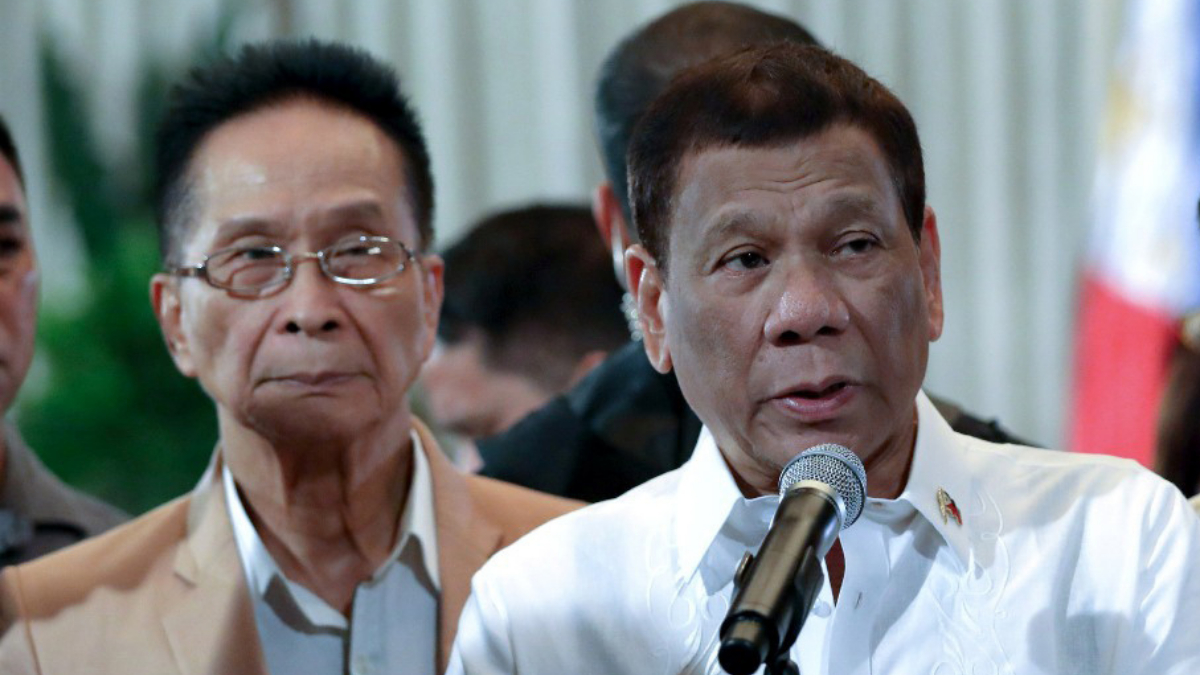

The International Criminal Court’s decision to send former president Rodrigo Duterte to trial drew sharp criticism from his former chief legal counsel, who said the outcome had been predetermined from the start.

Salvador Panelo issued a statement a day after ICC Pre-Trial Chamber I unanimously confirmed three counts of crimes against humanity against Duterte on April 23, clearing the path toward a full trial at The Hague. The charges — murder and attempted murder — cover 49 incidents involving 78 victims tied to Duterte’s drug war campaign, spanning his time as Davao City mayor through the final months of his presidency.
Panelo dismissed the evidentiary basis of the ruling outright. “As I have said on the last day of the hearing on the confirmation charges at The Hague, if the decision is based on the evidence presented by the prosecution, no court would not dismiss it for utter lack of evidence,” he said. “All prosecution presented before the pre-trial chamber were speculations, hearsay, double hearsay, hyperbolic speeches of PRRD, and news items.”
The former presidential spokesperson also raised longstanding objections over the court’s jurisdiction, citing what he described as unresolved legal questions that should have barred the proceedings from continuing. Among those, Panelo pointed to the Philippines’ withdrawal from the Rome Statute, the argument that the treaty was never validly enforceable domestically due to non-publication in the Official Gazette, and what he called a violation of the prescribed investigation timeline. Separately, Panelo argued the ICC had breached the principle of complementarity — the rule requiring the court to defer to states with functioning legal systems. “The Philippines has a functioning and robust legal system,” he said in an earlier statement. “Moreover, the Philippines has already withdrawn as member of the ICC and therefore the latter has already lost its jurisdiction over our country.”

Because the chambers pressed ahead with the confirmation hearing before those jurisdictional questions were resolved, Panelo said the conclusion was never in doubt. “The inevitable logical conclusion is the ICC has prejudged the case hence I said then that the ICC would confirm the charges and proceed with the trial of PRRD. Such ICC ruling therefore is not surprising but in fact expected. It was a foregone conclusion,” he said.
The Pre-Trial Chamber’s 50-page decision found substantial grounds to believe Duterte acted as an indirect co-perpetrator in the killings, establishing and overseeing what prosecutors described as a coordinated campaign of violence from the late 1980s through his presidential term. The court noted that once elected president, Duterte and his alleged co-perpetrators extended the scope of the killings nationwide, providing personnel and logistical resources to carry them out.
Duterte’s lead defense counsel Nicholas Kaufman said the team was not caught off guard by either ruling and was already focused on the trial phase, which he described as the only avenue through which his client could ultimately return to the Philippines. The case now moves to a newly constituted Trial Chamber, where three different judges will oversee proceedings. Under the Rome Statute, Duterte will be required to be present during trial.
