



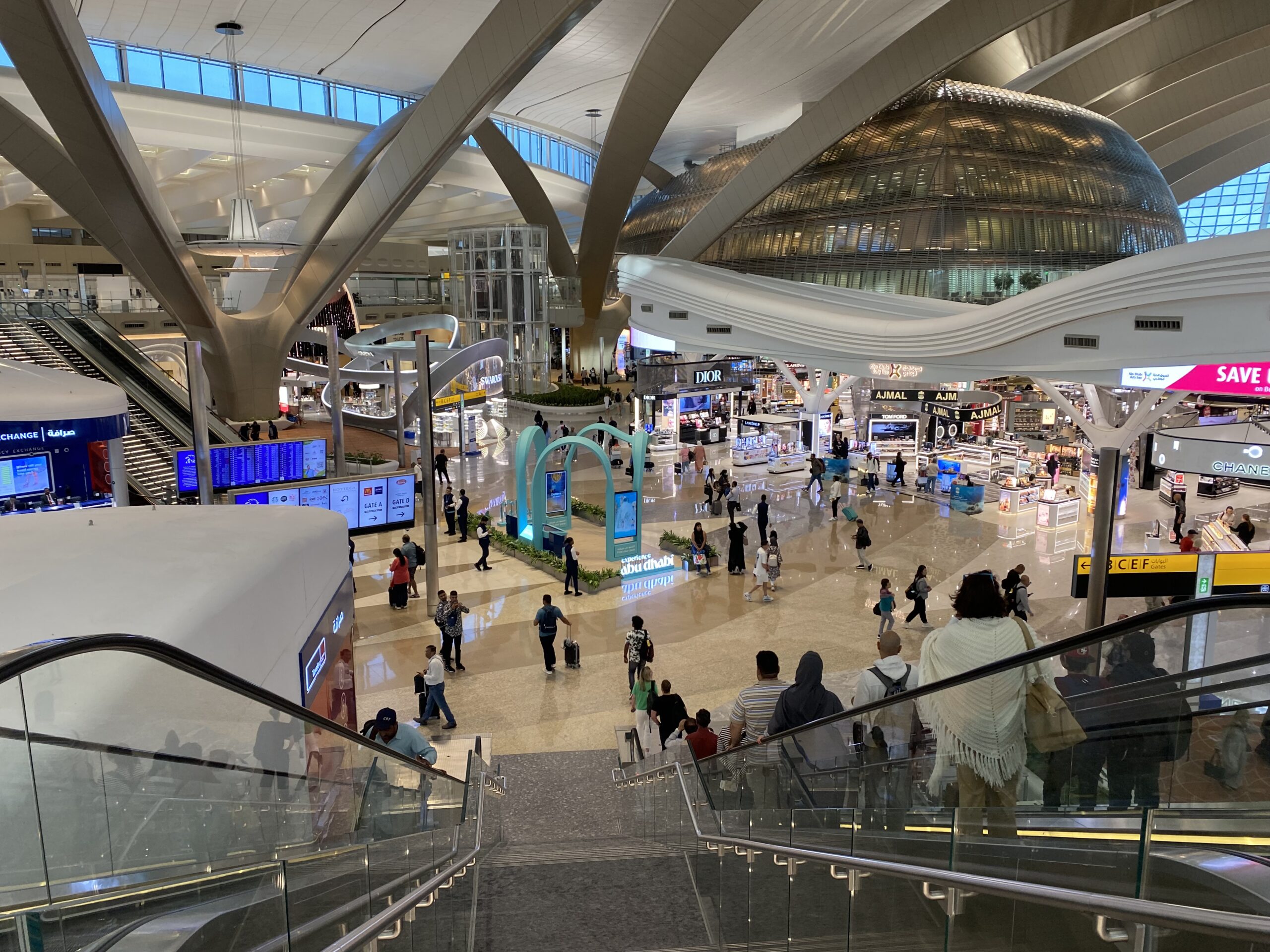

Zayed International Airport in Abu Dhabi is giving UAE residents a reason to visit even without a flight to catch. A new initiative called the Shopping Pass now allows non-travellers to enter sections of the terminal previously restricted to departing passengers, marking the first time the capital’s main airport has opened its airside spaces to the general public.

The programme, reported by The National, runs for eight weeks. Participants must register ahead of their visit through the airport’s website, after which they receive a digital pass containing a QR code used at entry checkpoints, inside shops, and at exit points. Visitors are expected to return their security badge before they leave, and access is restricted to a set window of time.
Inside, pass holders can browse duty-free and luxury retail outlets including Cartier, Chanel, and Hermès, alongside specialty boutiques at Abu Dhabi Duty Free. The dining offer spans sit-down restaurants and curated concepts — among them celebrity chef Todd English’s outlets, Jones the Grocer, and Taste of India. Visitors can also take in the airport’s much-lauded architecture and design without the urgency of a departure.
There are limits to what the pass covers. Personal electronic devices such as laptops and tablets are not permitted during visits, and the purchase of tobacco or alcohol requires a valid boarding pass. Those who spend at least AED 200 inside the terminal may claim up to four hours of complimentary parking, subject to validating their stay before departure.

Opened on February 9, 2024, Zayed International was named in honour of UAE Founding Father the late Sheikh Zayed bin Sultan Al Nahyan. That same year, it received the title of world’s most beautiful airport at the Prix Versailles international architecture awards.
The terminal was designed by Kohn Pedersen Fox architects. Its sculptural roof draws from the form of desert sand dunes, and an X-shaped layout divides the building into four piers — each themed around a natural element of Abu Dhabi: desert, sea, city, and oasis. The configuration also reduces average walking distances for passengers moving through the facility.
Among the terminal’s most prominent interior features is Sana Al Nour, a 22-metre-tall installation in the arrivals hall. Inspired by the Islamic architectural tradition of barjeel wind towers, the vase-shaped structure spans 30 metres in diameter, weighs more than 100 tons, and is assembled from 1,632 glass panels. Beyond its aesthetic function, it plays a role in the building’s energy system — filtering daylight and directing air in a way that reduces the terminal’s overall energy demand by 10 percent. At night, LED lighting transforms the piece entirely.
Airside visitor programmes remain uncommon globally, though airports in Seattle and Detroit have piloted limited-access schemes for non-travellers in the United States. Singapore’s Changi, a longstanding benchmark for airport experience, offers substantial retail and leisure options on the public side of its terminal. Abu Dhabi’s Shopping Pass joins a narrow but expanding group of airports reconsidering who their spaces are designed to serve.
