



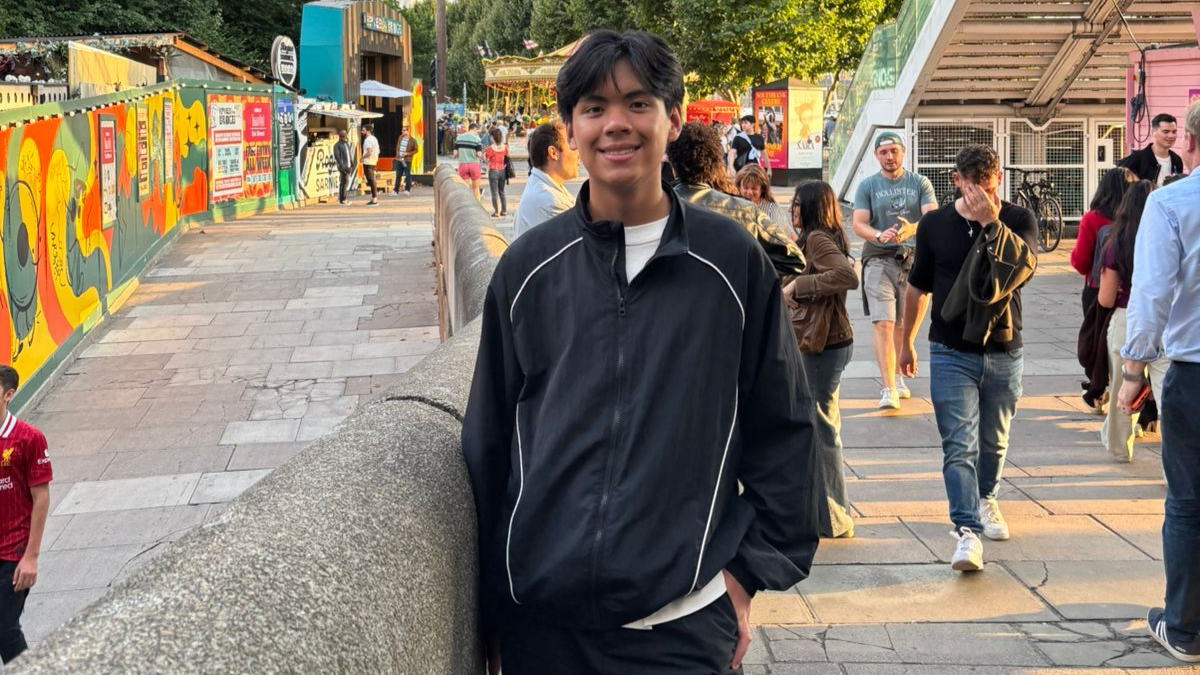

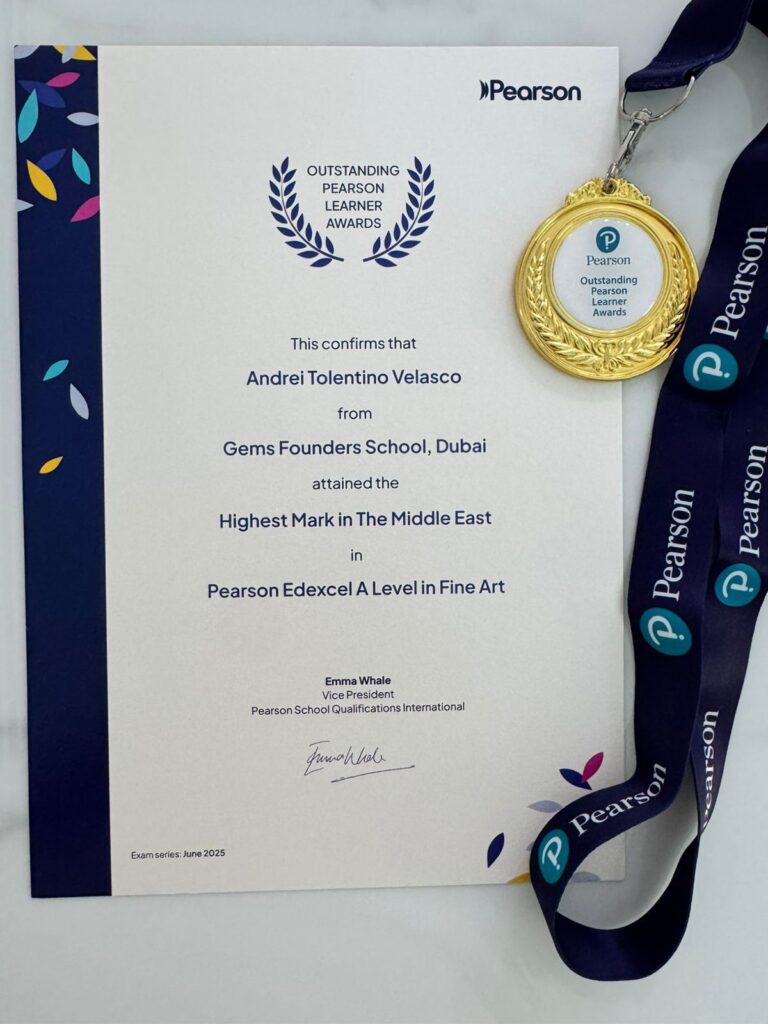
Andrei Tolentino Velasco did not expect a phone call that would reframe everything he thought he knew about his own limits. At 19, the Dubai-raised student had just completed his A-Level Fine Art coursework at Gulf English School — already proud of what he had produced, already grateful for the grade he had earned. Then came the news: he had achieved the highest mark in the Middle East for Pearson Edexcel A Level Fine Art.

“To say that I was ecstatic would be an understatement,” he recalls. “I was already grateful for the grade I had received, but to find out that I had achieved the highest mark in the region was a momentous cherry-on-top experience.”
The boy who grew up between two worlds
Andrei has spent 16 of his 19 years living abroad. His parents — both OFWs who have carved out senior careers in multinational companies — raised him in the UAE while building careers of their own. His mother is a MEA regional sales operations specialist at a French multinational company; his father, an EMEA regional manager at an American multinational company. It is a household shaped by precision, performance, and the particular ambition that tends to follow families who build their lives far from home.
That environment, it turns out, did not push him away from the arts. It gave him something to say through them.

His A-Level portfolio leaned into mythological storytelling and personal memory — two threads that, on the surface, seem worlds apart but reveal a coherent inner logic when you understand who Andrei is. For his exam component titled Union, he channelled Greek tragedy to explore what he calls “inherently human flaw and how that is something that defines the human condition.” For his personal project, he turned inward, exploring childhood nostalgia during his final stretch of secondary school.
The piece that surprised even him
Ask Andrei which work from his A-Level collection he is most proud of, and he does not hesitate. It is the painting of his father and sister rendered gold — a modern reimagining of the myth of King Midas — and the reason he loves it has little to do with how it looks on canvas.
“Ironically created under timed exam conditions, it was the first time in a long while where I felt truly uninhibited,” he says. “Instead of obsessing over every minute detail, I allowed myself to work more instinctively and fluidly; there was a looseness to my brushstrokes and a freedom in my decisions that felt refreshing and genuine.”
There is also a quietly self-aware humour to it. “As frivolous as it sounds,” he adds, “I think it’s funny seeing my dad and sister depicted in such a terrifyingly distinguished manner.”
It is the kind of observation that reveals something important about Andrei: he takes his craft seriously, but not so seriously that he has lost the ability to laugh at it.

Learning to work with yourself, not against yourself
Year 13 was not simply about art. Andrei was also heading the school’s media and events student council, running internal and external school events while simultaneously managing two other technical subjects alongside Fine Art. The daily cognitive gear-shifting — from scientific problem sets to oil paint and canvas — was, by his own admission, a real obstacle.
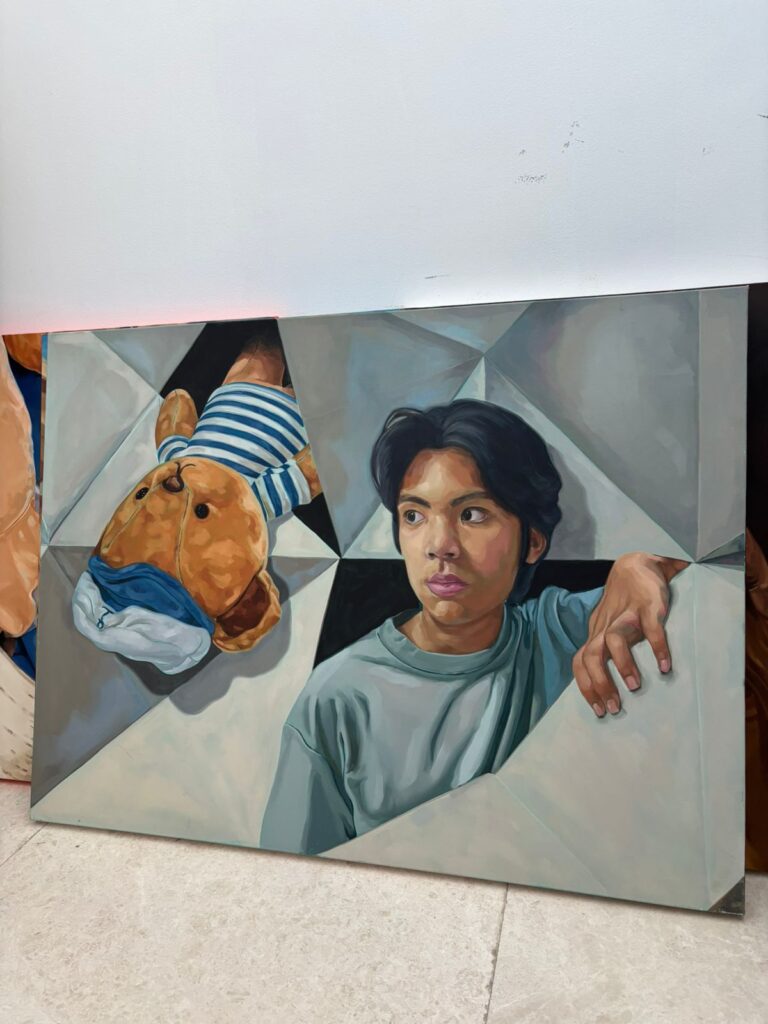
“I found difficulty in constantly transitioning between vastly different activities in the same day,” he says. “It took time to set up materials and get in the proper headspace to create, so constantly switching was a bit of a demotivating factor.”
His solution was not a productivity hack or a rigid timetable borrowed from a self-help article. It was something slower and more honest: paying attention to himself. “There were periods when I tried to follow schedules that worked perfectly for others but left me feeling overwhelmed or unmotivated,” he reflects. “It wasn’t until I began paying attention to my own energy levels, habits, and responsibilities that I started to see what truly fit my lifestyle.”
Eventually, art became the release valve rather than the added burden — “a break from academics,” as he puts it, rather than another item on the to-do list.
Art does not have to end
Andrei is now studying Biomedical Engineering in the UK — a pivot that raised eyebrows among people who assumed his Fine Art achievement pointed in a different direction. He is untroubled by the apparent contradiction.
“As much as I loved art, I’ve always appreciated the technicalities of maths and physics,” he explains. “I settled on the biomedical route as it would provide me with an avenue to use engineering to directly make positive and impactful change in people’s lives. That isn’t to say that I’ve quit art — it remains an essential part of who I am.”
He still creates. He does not plan to stop.
For students in Dubai navigating the same competing pulls of academics, identity, and ambition, Andrei’s parting thought is less about strategy and more about community. “Surround yourself with a community who love what they do as much as you do,” he says. “Success isn’t a solo endeavour — saying that I achieved everything on my own would be a huge disservice to my support system of friends and family who were with me through every step of the way.”
The highest mark in the Middle East did not come from working alone. It came from knowing, eventually, that he did not have to.
